Citizen Poet (eBook)
440 Seiten
Lives and Letters (Verlag)
978-1-80017-171-8 (ISBN)
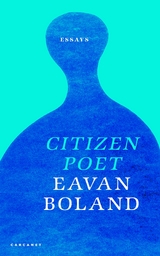
Eavan Boland (1944-2020) was born in Dublin and studied in Ireland, London and New York. Her first book appeared in 1967. She taught widely in Ireland and the United States. She was Mabury Knapp Professor in the Humanities at Stanford University. A pioneering figure in Irish poetry, a key figure for a generation of female and male writers, her Carcanet books include The Journey and other poems (1987), a Collected and a New Collected Poems. The Historians, her posthumous collection, was awarded the Costa Prize in 2020.
Irish poetry, Eavan Boland famously said, was one in which you could “have a political murder, but not a baby.” The first time I read this statement, in 1997, it hit me like a revelation. I was a graduate student at Trinity College Dublin, and Boland’s first book of prose, Object Lessons, had recently come out. As I read Boland’s essays about a young woman writing poems in her Dublin garret, I felt less alone in my own damp, cold flat in the Liberties. I was thrilled by the attention Boland paid to women, and I appreciated her clean prose. Unlike the poststructuralist theory then sweeping American campuses, Object Lessons was obviously the work of a poet—its language clear and crystalline, a slow-running stream glinting in sunlight. And poetry was all I wanted that year in Dublin. I spent my days discussing poems in class and my nights at boozy poetry readings. But the voices I read and heard belonged mostly to men. Object Lessons called my attention to this gap. I knew about Sylvia Plath, Anne Sexton, and Adrienne Rich—all poets who influenced Boland—but I had managed to get an undergraduate degree in English literature without reading any of them. The only woman poet I had studied with any seriousness was Emily Dickinson, whose work I cherished but found gnomic. I had practically memorized James Joyce’s Portrait of the Artist as a Young Man, but there was no künstlerroman for women who wanted to light out for the territory, like Stephen Dedalus, and make art. Now I see that Boland’s essays are that guide.
Living in Dublin in the late 1990s, I began to understand what Boland was up against as a woman poet trying to make herself the subject, rather than the object, of the Irish poem. I could see that the Irish poetic tradition made little room for what Boland called “ordinary” women. Irish women did not have recourse to the freedoms that I, as an American, took for granted then. Divorce was illegal in Ireland until 1996, and abortion illegal until 2018. I found these sexist laws infuriating, but not surprising. I had grown up in an Irish American family in which the answer to life’s burdens was to “offer it up.” I thought I knew about the secrets and silence that abraded women’s suffering, but I was not prepared for the revelations that began to surface in the 1990s about the Magdalene Laundries. These Catholic institutions were places of violence and cruelty where unmarried pregnant women were abandoned, shamed, and imprisoned until a male relative came to free them, or until their babies were adopted—often by wealthy American Catholics. I was later shocked to learn that one of the laundries was still operating when I lived in Dublin, a half-hour walk from my flat. I’d had no idea. These were the stories I did not know, because they were women’s stories, and no one had told them.
I had heard other stories. One summer during college, I lived on an island off the Connemara coast. I worked long nights in a pub where the crowd quieted as old men stood up and sang ballads of loss, their voices a living register of pain. Islanders still talked about Oliver Cromwell’s murderous seventeenth-century campaign through Connaught, and how he had imprisoned priests on the island. His men had tied a bishop to a rock in the island’s harbor and watched him drown as the tide rose. All the islanders knew this rock, whose location had been passed down for more than 300 years. On the island, I began to understand that the Irish had a pressing and intimate relationship to history—the “nightmare,” Stephen Dedalus famously said, “from which I am trying to awake.” That summer, there was a steady drumbeat of stories on the radio about sectarian murders in Northern Ireland. I heard stories, too, about domestic violence and alcoholism on the island. A young woman drowned in mysterious circumstances. But those stories were whispered, not sung. And not passed down.
Boland knew the powerful songs, poetry, and plays that had inspired generations of Irish men and women to fight for independence from Britain. She knew, too, about the dangers of mixing art and politics in Ireland. “Did that play of mine send out / Certain men the English shot?” William Butler Yeats wondered in his poem “Man and the Echo,” about his and Lady Gregory’s incendiary 1902 drama Cathleen ni Houlihan. Boland understood better than Yeats the mythic and seductive role that women had played in Irish nationalist iconography. “Until we resolve our relation to both past and tradition,” she wrote in “Letter to a Young Woman Poet,” “we are still hostages to that danger.” For Boland, resolving that relationship to the past meant telling women’s stories, both real and imagined. In her poems and essays, she reinscribes the voices of women who were silenced, and left no trace. We meet Boland’s grandmother, dying alone in a Dublin maternity hospital; an elderly woman on Achill Island with a living memory of the famine; a desperate mother and her children fighting for survival in the Clonmel workhouse; poor young women bound for Boston to work as domestics, or forced by hunger into prostitution. Like the water diviners in the Irish countryside, Boland searched for the undercurrents of suffering that coursed below the official histories. Reading Object Lessons, I began to see how Irish women had been written out of their own poetic tradition, made into “dehumanized ornaments,” as Boland put it, by men. They were queens and muses, reduced to political propaganda, emblems of a colonized nation—Cathleen Ni Houlihan, Dark Rosaleen, the Poor Old Woman. If this truth was hiding in plain sight, it was also, for Boland, a fraught discovery. As she told Jody Allen Randolph in 1999, “There was only one poetry world in Ireland and I seemed to be putting myself at odds with it…. [T]he idea of the poet it offered was not mine. I couldn’t use this inherited authority and pretend it was mine. I had to make it for myself.”
Boland was eighteen when she first wrote what she called a “real poem.” It happened during the Big Freeze of 1963, the coldest winter in a century. In Object Lessons, she writes about how that experience overlapped with news of Sylvia Plath’s death:
She had died alone in that season. The more I heard, the more pity I felt for it, that single act of desolation. From now on I would write, at least partly, in the shadow of that act: unsettled and loyal. Other poets—men—moved easily among the models of the poet’s life, picking and choosing. I chose this one—not to emulate but to honor. Not simply for the beautiful, striving language of the poems when I came to read them. But because I could see increasingly the stresses and fractures between a poet’s life and a woman’s. And how—alone, at a heartbroken moment—they might become fatal.
The essays in Citizen Poet record Boland’s struggle to harmonize the parts of herself that she once thought were unreconcilable, and to renew and reshape the Irish poetic tradition through the inclusion of women’s voices and stories. Sylvia Plath, Adrienne Rich, and Denise Levertov were inspirations, but, as Boland later wrote in her introduction to Rich’s Selected Poems (1996), her own feminism was different. Rich’s poems “describe a struggle and record a moment that was not my struggle and would never be my moment. Nor my country, nor my companionship. Nor even my aesthetic.” Boland had a harder battle to fight in a conservative, Catholic nation where sexism and sexual repression were pervasive, and where the violence in Northern Ireland consumed political and emotional capital that might otherwise have supported a women’s movement. Boland would look to Rich’s poetry and prose for inspiration, but she would become a different kind of citizen poet. “We need to go to that past: not to learn from it, but to change it,” she wrote in “Letter to a Young Woman Poet.” “If we do not change that past, it will change us. And I, for one, do not want to become a grateful daughter in a darkened house.”
When Boland was an undergraduate at Trinity College Dublin in the early sixties, she spent time with her fellow student Derek Mahon, who would become, like Boland, one of the finest Irish poets of his generation. Though she had been writing poems for years, she saw herself as Mahon’s apprentice—a grateful daughter. She remembered, “When I was starting out, over coffee in Roberts’, he told me approvingly that one of the real strengths of my poetry was that you could hardly tell it had been written by a woman.” She took Mahon’s words as a compliment and continued to write what she called “genderless” poems. Dublin then, she recalled, was “not only male. It was bardic.” In pubs and coffeehouses, she heard slights from her male friends “that women were bringing into poetry currents of experience which would somehow make it small. One word above any other: autobiography…. Women—so it goes—have not lived the lives which fit them to be the central, defining poets...
| Erscheint lt. Verlag | 24.9.2024 |
|---|---|
| Vorwort | Heather Clark |
| Verlagsort | London |
| Sprache | englisch |
| Themenwelt | Literatur ► Essays / Feuilleton |
| Literatur ► Romane / Erzählungen | |
| Schlagworte | Critical • Culture • Essays • exile • female • Irish • Literature • Poet • Poetry • Women |
| ISBN-10 | 1-80017-171-4 / 1800171714 |
| ISBN-13 | 978-1-80017-171-8 / 9781800171718 |
| Informationen gemäß Produktsicherheitsverordnung (GPSR) | |
| Haben Sie eine Frage zum Produkt? |
 EPUB (Wasserzeichen)
DRM: Digitales Wasserzeichen
Dieses eBook enthält ein digitales Wasserzeichen und ist damit für Sie personalisiert. Bei einer missbräuchlichen Weitergabe des eBooks an Dritte ist eine Rückverfolgung an die Quelle möglich.
Dateiformat: EPUB (Electronic Publication)
EPUB ist ein offener Standard für eBooks und eignet sich besonders zur Darstellung von Belletristik und Sachbüchern. Der Fließtext wird dynamisch an die Display- und Schriftgröße angepasst. Auch für mobile Lesegeräte ist EPUB daher gut geeignet.
Systemvoraussetzungen:
PC/Mac: Mit einem PC oder Mac können Sie dieses eBook lesen. Sie benötigen dafür die kostenlose Software Adobe Digital Editions.
eReader: Dieses eBook kann mit (fast) allen eBook-Readern gelesen werden. Mit dem amazon-Kindle ist es aber nicht kompatibel.
Smartphone/Tablet: Egal ob Apple oder Android, dieses eBook können Sie lesen. Sie benötigen dafür eine kostenlose App.
Geräteliste und zusätzliche Hinweise
Buying eBooks from abroad
For tax law reasons we can sell eBooks just within Germany and Switzerland. Regrettably we cannot fulfill eBook-orders from other countries.
aus dem Bereich