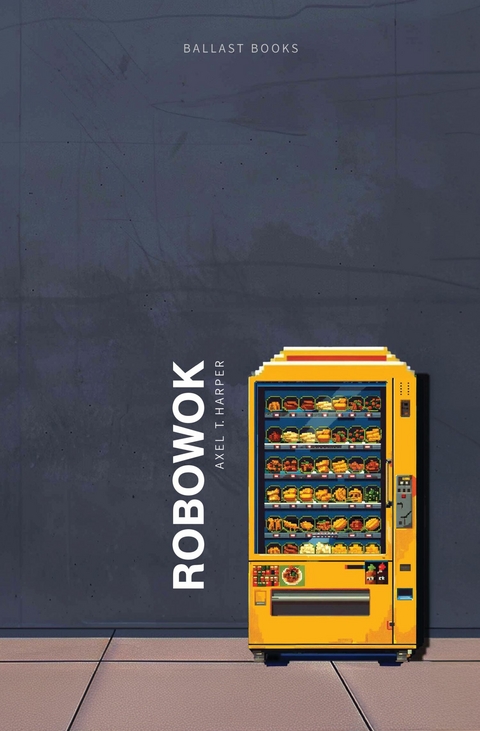
Robowok (eBook)
440 Seiten
Ballast Books (Verlag)
978-1-964934-25-9 (ISBN)
Axel T. Harper is the proud father of three amazing children and is married to the greatest woman who has ever lived on the face of this planet. He has worked in and around the interface of business and technology for most of his life.
At RoboWok's inception, no one knew the effect the automated wok would have on the world of food. Now, four characters, each on a journey of self-discovery, must find a way to create their own legacies. David is a wildly successful entrepreneur. One catch, though he's peaked early. Having founded RoboWok with the help of a small, dedicated team he then quickly forgot, he has sold the company for an outlandish sum. He now spends his days puttering about in his mansion, musing on what further challenge might be out there for him and fielding constant calls from his father, Bernard. Bernard is calculatingly keen for the world and above all the other members of his gentlemen's club to know that David was produced with his own excellent genetics. And he's constantly working to railroad his son into contrived appearances at the club to advertise their family's superiority. Natasha, a team member whom David promptly forgot, is existentially adrift after the sale of RoboWok to a corporate buyer. No puttering about in large mansions for her though. Instead, it's mindless overwork for a new, mindless boss. She's riddled with doubts that she'll never have the courage to break free. Maria, a member of David's cleaning staff, is also racked by doubts. Desperate to escape her life of poverty and thankless work, she comes up with a plan, though it may not exactly be legal. Four characters, one tautly written drama replete with biting cultural commentary. Their paths cross in a deft interweaving that produces one surprising plot twist after another.
So there he is, sitting in his private hammam. Through the thick man-made fog, David sees his insignia on the glass door. The architect had convinced him that having his own insignia throughout his entire home would give it that extra touch of class—that it would, as he put it, transform it into a résidence. He’d roll the R and draw out the nasal -ence before pronouncing the final E: “résiden-n-n-nsuh.” And when you said “résidence” that way, you just had to add a lot more gestural flourishes and nasally inflected grimacing than one could ever hope to see accompanying the little pedestrian word “house.” The main reason David had agreed to the insignia, in fact, was to get past all this high theatricality. Good architects were hard to come by these days.
The hammam was made for eight adults. David sat there on his own. It was Tuesday afternoon. He hadn’t been awake that long.
Around eleven o’clock that morning, he’d started with a hand-pressed newspaper. He’d always skip quickly past the domestic news stories, past the politics and society pages, to sports and economics—the only things that mattered in the world as far as he was concerned. He was looking above all for stories about start-ups or young sports talents who were nurturing big dreams.
This morning’s stories were mostly about clumsy big businesses run by what he saw as even clumsier bosses, who had what they called “plans for innovation.” “We’re going to be doing things radically differently,” they’d say, and then reel off a slew of buzzwords such as “the cloud,” “mobile,” and “holacracy.” Not even a quarter of the way through that story, David had given up.
The kitchen had clearly done its best with his breakfast. He’d already fallen out with them over the thickness of the yogurt and how much milk they’d put in his cappuccino.
David hadn’t been born a nasty or an especially spoiled person; he’d been forced to become one—or rather, he acted that way for the sake of his staff. At least that was how he saw it.
After finishing with the newspaper, he’d turned to the day ahead. A businessman from up north might be coming to pitch his invention, and in the evening, he’d been invited to a fair for those willing to pay an entrance fee of “just” 2,000 euros. David had decided then and there not to go.
To give a bit of purpose to his life, he’d decided to go do some sports. He’d called his personal trainer over, only to end up doing exercises for way too much per hour while someone barked in his ear. The barking had gone on and on and on, so it no longer had any effect; at a certain point, he was going through the motions not because he was being barked at but just so he could say he’d done what he’d set out to do.
He was not unhappy after he’d finished. After his allegedly super healthy shake, which he’d had mainly to keep the kitchen busy, he’d earned the trip to his hammam.
And that was where he was now, looking at a fogged-over door with a specially designed insignia sporting his initials—and a bear. The architect considered lions, elephants, tigers, and birds to be too clichéd, but he’d never seen a bear at any of his clients’ houses, even though it had much more of an aura about it. Well that’s what he said. It was clear he didn’t know any financial market lingo.
David had been staring blankly in front of him in the hammam for so long that the skin on his fingertips looked like a forty-year-old version of himself. He stood up, stretched, and walked to his ice-cold shower.
When it came time for the ice-cold shower, David wasn’t allowed to be a wuss; the plaster had to be snatched off in one go. His body was shocked by the freezing water that pummeled him thick and fast—but his expression didn’t change. He just stared out in front of him, counting down in his head from twenty to zero.
His bathrobe—also emblazoned with his insignia—was hanging there, waiting for him.
He skipped lunch, just as he had done in the past. “In the past” made it sound like it had been ages, but how long ago could it really have been? After all, he’d been just twenty-seven when he sold his company
In any case, it felt like a completely different life. He’d get up early, while the world still slept, and then have a coffee for breakfast. He’d have his phone in one hand showing the latest figures and would put on his clothes with the other, like a seasoned contortionist, as he headed toward the door.
Lunch was a purely professional affair—a check to make sure the machines were working properly that day and that the ingredients were as fresh as all the messages promised. The joy of lunch had long since disappeared. All these years, he had been eating the same limited variations several times a day. Rice or noodles. With chicken, beef, shrimp, and/or veggies. And finally, orange, hoisin, black bean, or green sauce. To consumers, it seemed like so many degrees of freedom. For David, the range of options was more like a weather forecast in the north of Scotland: cats and dogs or rain just bucketing down.
Now David could have any lunch he wanted. In the beginning, he’d taken full advantage of that. But then that freedom too had turned out to be worth less than it’d been cracked up to be. Often, it was an Italian roll with cheese, ham, or both. Or like today, having lunch would’ve felt like overdoing it.
David had so much time on his hands. He had looked forward to that time as much as he had to the options for lunch. He had daydreamed about the possibilities: traveling, watching films, playing sports, just hanging out with friends. He wandered around in the western part of the front of the house. In his head there was a long list of possibilities, but the rest of his body did not feel any sensation at all in response to any of them.
The men in the garden were busy, and if the green mountain that stood among them was anything to go by, they must have started early. David did everything he could to avoid being seen. There was an enormous risk that he’d be forced into some chit-chat.
Like a spy in a movie, he moved as stealthily and invisibly as he could from one side of the room to the other. He managed it. But once he’d arrived safely, there wasn’t much to do on this side of the room either. This was not because of the options before him, all of which were within easy reach: a pool table, stacks of books, old-fashioned stacks of DVDs (all box sets he could not have afforded before the streaming era), and an unpacked consumer electronics item that had seemed to promise, when he’d bought it, to make his life better. David was like the ten-year-old son of a billionaire—though he had all the playthings in the world, he still had nothing to play with.
The truth was that he just had to start over, to start building again—to do what he had been born to do. This had already been the conclusion several times based on several expensive sessions with people who had studied the issue he was having. Each time, the diplomas on the wall had given David confidence that this person with such-and-such a title was going to help him find himself again—a new purpose in his life.
And each time, these learned individuals had helped him to reach the same understanding, the same insights, which were nothing if not crashingly obvious.
There had already been ideas. He’d even bought a domain name for a six-figure sum from an American in the midwestern United States. However, despite the investments made in them, all the ideas had died a death for want of any relevance to the world. If they couldn’t exercise any fascination over him after three weeks, how could he possibly spend years on them?
So there he was, waiting for inspiration. He’d even tried to force things by going on a number of inspirational trips and speaking to several “innovators.” And it had all been rather underwhelming. The “innovations” were often variations on the same themes, based on the same trends, applications of the same old new technologies.
A few weeks earlier, it had gotten to the point where he’d ordered an old-fashioned multi-volume encyclopedia. After delivery, he had put them all in a catapult he had jerry-rigged. After firing it, he’d grabbed the farthest book, closed his eyes, opened the book blindly at a random page, and put his finger on it.
His hope was that the word his finger landed on would give him the inspiration he was so desperate for. The project, which lasted days, had given him words and names such as stratigraphy, sholes, Elbrus, nettle, and hit parade. He’d then spent a lot of time trying to explain to himself what might have given him the idea that this brainwave could ever have worked.
And then there was the acceptance phase. Perhaps he was allowed just the one truly disruptive idea. And like everyone else, he had to go and call something ordinary “disruptive” when those in the know would realize it was just a logical variation on an already existing consumer proposition. Perhaps he’d even have to stoop to doing a business-to-business proposition or, worse yet, make himself useful as a consultant, sharing his knowledge and skills with large companies that were desperate to produce any kind of innovation or change.
There were times when David was about to...
| Erscheint lt. Verlag | 18.3.2025 |
|---|---|
| Sprache | englisch |
| Themenwelt | Literatur ► Krimi / Thriller / Horror |
| ISBN-10 | 1-964934-25-7 / 1964934257 |
| ISBN-13 | 978-1-964934-25-9 / 9781964934259 |
| Informationen gemäß Produktsicherheitsverordnung (GPSR) | |
| Haben Sie eine Frage zum Produkt? |
 EPUB (Ohne DRM)
Größe: 2,4 MB
Digital Rights Management: ohne DRM
Dieses eBook enthält kein DRM oder Kopierschutz. Eine Weitergabe an Dritte ist jedoch rechtlich nicht zulässig, weil Sie beim Kauf nur die Rechte an der persönlichen Nutzung erwerben.
Dateiformat: EPUB (Electronic Publication)
EPUB ist ein offener Standard für eBooks und eignet sich besonders zur Darstellung von Belletristik und Sachbüchern. Der Fließtext wird dynamisch an die Display- und Schriftgröße angepasst. Auch für mobile Lesegeräte ist EPUB daher gut geeignet.
Systemvoraussetzungen:
PC/Mac: Mit einem PC oder Mac können Sie dieses eBook lesen. Sie benötigen dafür die kostenlose Software Adobe Digital Editions.
eReader: Dieses eBook kann mit (fast) allen eBook-Readern gelesen werden. Mit dem amazon-Kindle ist es aber nicht kompatibel.
Smartphone/Tablet: Egal ob Apple oder Android, dieses eBook können Sie lesen. Sie benötigen dafür eine kostenlose App.
Geräteliste und zusätzliche Hinweise
Buying eBooks from abroad
For tax law reasons we can sell eBooks just within Germany and Switzerland. Regrettably we cannot fulfill eBook-orders from other countries.
aus dem Bereich