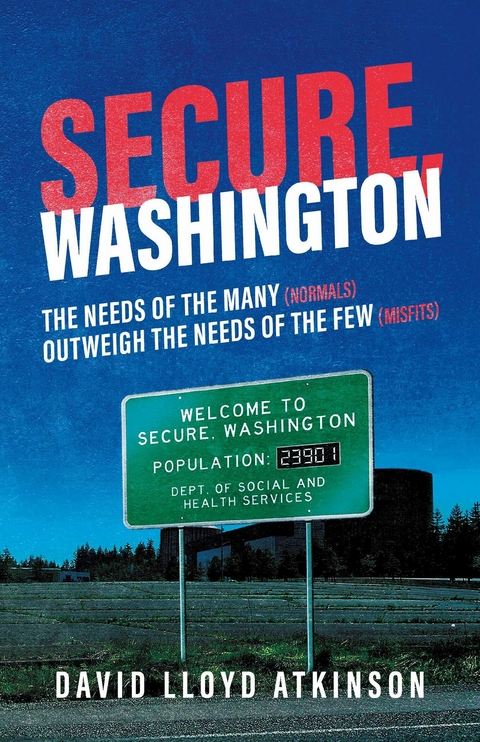
Secure, Washington (eBook)
280 Seiten
Bookbaby (Verlag)
979-8-3509-6791-3 (ISBN)
David Lloyd Atkinson was born on Seattle's Capitol Hill in late 1953, and lived his entire life in the greater Puget Sound region until 2016, when he and his wife Amy moved to Clallam County on the Olympic Peninsula. While the book is fictional, his personal story is told by several of the characters. He lost his left leg and part of his lung to sarcoma cancer in 2018-2019. His earlier unpublished book The Yonder Years-Two People, Two Motorhomes, and Two Years of Travel, Discovery, and Adventure (Volumes 1 through 3) tells the story through text and photos about David, Amy, and their cat Buzzie's adventure throughout the United States between 2014 and 2016 (PDF files of each volume are available at no charge upon request). Today, David, Amy, and their two cats Lucy and Rita live between the coastal cities of Sequim and Port Angeles.
The year is 2039, and as the Independence Day holiday approaches, George Stoltz (best-selling author of the Those Who Made it Happen books) is given a suggestion by his agent for a new entry into that series. As it so happens, July 4th will also mark the tenth anniversary of the opening of Secure, Washington-a hybrid (part prison/part conventional) city owned and operated by the state to permanently house the worst of its misfit citizens: repeat criminal convicts, people who suffer from severe mental illness who lack any means of support, and the homeless (only those who volunteer to live there). The story begins in late 2018, with the MM Group which began as a coffee klatch developing and finally putting forth a citizen's initiative to deal with misfits. I-1719 went on to earn overwhelming approval (76%) by the voters, culminating in the construction of Secure. The state's 282nd city ended up being built on the 1,800-acre site of an abandoned nuclear power plant, which ironically was terminated due to another successful citizen's initiative that passed in 1981. Mr. Stoltz creates a fascinating portrait of this unique city through numerous interviews, along with personal observations from his unprecedented week-long stay inside Secure. He also provides an eye-opening before/after analysis of what Seattle and the rest of the Puget Sound region look like now that 23,901 misfits (Secure's population during George's stay) have been removed from normal society, with untold numbers of additional misfits choosing to relocate out of state.
Chapter 2 –
The State Of The State Of Washington
Washington state politics makes for interesting conversations. With few exceptions, everything west of the Cascade mountain range is left-wing, or blue, while the area east of the mountains is right-wing, or red.
Because the western half of the state has more people in it than the east—the split is roughly 60/40—the folks in the west call the political shots for the most part.
As of 2016, the people of Washington had elected precisely one Republican as their governor over the past eleven elections. Since 1986, one of the United States Senate seats had always gone to a Democrat, while the other had a Republican for just two terms (out of six). Out of its ten US Representative seats, four were Republican.
When things go awry, it is in a politician’s DNA to instinctively blame the other party. People east of the mountains can blame the Democrats for what they see as a breakdown of society, but to be honest, Republican-led Spokane, which is the largest city in Eastern Washington, is no stranger to homelessness, drug addicts, “career criminals” or the mentally ill who have no support.
Way back in 2018, I visited Seattle to attend a writer’s convention. I was there for four days, staying at a very nice hotel that was close to the Interstate 5–straddling Washington State Convention Center. I met some really great people during my stay, some who remain friends to this day, and a few who were natives of Seattle and had knowledge of the downtown area.
Naturally, I had planned on visiting some of Seattle’s tourist attractions such as the Space Needle, the Pike Place Market, Underground Seattle, the waterfront, and perhaps even ride on one of the many ferries that crisscross Puget Sound. The natives managed to temper my enthusiasm. “You can walk directly from the Convention Center to Freeway Park if you dare, but I wouldn’t do it, especially at night. The place is just one big hypodermic needle—nothing but druggies.” Freeway Park also straddles I-5, and I had wanted to visit it. Guess not.
I did venture out one evening to catch a movie only a few blocks away from my hotel. As I was leaving the theater, a group of young toughs spotted me all alone and looked to be laying an intercept course. I was closer to my hotel than they were, so I broke into a run, and quickly turned around to see them running towards me. I made it back to the hotel lobby, as the group broke off pursuit at the last minute.
For the rest of my stay in Seattle, I took a cab from my hotel to the Convention Center and back, and dined courtesy of room service.
So, as you might imagine, my return to Seattle more than twenty years later brought back those unpleasant memories. When on the road, I pack sparsely—just what I can stow in the carry-on bins on my flight, which is a backpack and a duffle bag. When I visited in 2018, the regional public transportation authority known as Sound Transit had direct airport-to-downtown service via their light rail, but after reading some negative reviews and experiences while researching it online, I opted to go with an Uber car. I didn’t want any rail-riding thugs to relieve me of my pack and duffle bag.
This time around, it was different—there were no warnings to would-be passengers not to wear their headphones or read their cell-sats for fear of having them stolen or violently ripped away. What was once known as Sound Transit’s “Ghetto Line” was now serving modern-looking communities that had sprouted around each stop on the line. To me, that meant that passengers were comfortable living and walking a short distance away to board their public transportation.
I departed from the light rail train in the heart of Downtown Seattle, which was near Westlake Center (still the southern terminus of the 1964 World’s Fair Monorail ride), and walked a couple of blocks to the Hyatt Regency Hotel, where I checked into my west-facing room on the 42nd floor.
Looking out of the huge window towards Elliott Bay and Puget Sound, I was almost dumbfounded by the number of construction cranes in nearly every direction. I caught a quick lunch in the Hyatt’s lobby restaurant (which I highly recommend!), and then decided to take advantage of the unusually warm spring day to venture out into the city.
As they say, you could’ve knocked me over with a feather!
Block after block I walked with no one hassling me, no hint of danger anywhere. I hiked over to the Pike Place Market, and down the back side towards the waterfront, which had been completely rejuvenated now that the hideous (and noisy) Alaskan Way Viaduct had been replaced with a tunnel and then demolished. When I was here in June of 2018, the tunnel was not due to open until December, and the viaduct still was standing. Today it was a sprawling waterfront park.
I made a point to walk through the numerous parks in the downtown area as I made my way back to the Hyatt, and guess what? They were functioning parks, not seas of homeless tents, cardboard boxes, and crazy people like I see back home in L.A. People were sitting on the benches. Young people were out running on the grass with their dogs and Frisbees.
I prefer the weather of Southern California over Seattle, but if that wasn’t an issue, I could certainly see myself uprooting and moving north. If I had to choose a word, the place was vibrant. If I had to choose two words, they would be vibrant and safe.
My next day in Seattle would fulfill what I had wanted to do back in 2018 but chickened out. I would walk to the Coleman Ferry Terminal, which was just over a mile away, and ride one of the Washington State Department of Transportation’s newer electric-powered “superferries” west across Puget Sound to Bainbridge Island, where I would be meeting five key people that make up the Secure story.
My walk to the ferry terminal was completely uneventful, other than passing one construction site after another, many with graffiti-free “Dacus/Beith International–General Contractor” signs hanging off the pedestrian protective fences.
The ride over to Bainbridge Island was amazing. The electric drives propelled the huge vessel through the water, with the only noise coming from the waves as they lapped against the hull. Well, that plus the screeches from the ship’s entourage of seagulls as they were begging for the passengers riding up on the top deck to toss them some fries or a piece of their pastry. I saw a few harbor porpoises arcing out and back into their saltwater surroundings, and several seals or sea lions–I get confused–poked their heads out of the water every so often and then disappeared.
My hostess for the day was Bethany Askoy, and her husband Farid had volunteered to pick me up at the Bainbridge ferry terminal, but since the day was much like the one before, I opted to walk. The distance was similar to my hike from the Hyatt to Coleman Dock, but this was a completely different setting. Wing Point Way cut through the golf course and country club bearing the same name, and soon I was heading north, then east, and down a private driveway that led me to my destination.
Bethany and Farid live in a beautiful waterfront home. From the sunroom, they view Downtown Seattle straight on, and today I could see the imposing Cascade Mountains rising up behind the city.
Bethany had invited three other people who were crucial to the Secure story—Reginald Wahls, James Carver, and Leslie McDonald.
(George) “First of all, thank you, Bethany, for coordinating with my staff, and for all of you agreeing to meet with me. Will Leslie be here?”
(Beth) “Yes, but she was running a bit late and said to begin without her.”
(George) “I think that you are part of a story that needs to be told. Should I call you Bethany, Farid, Reginald and James, or would you prefer that I use a nickname?”
(Beth) “I just go by Beth, and Farid is, well, Farid.”
(Beth looks at Farid and they both laugh)
(Reg) “Either Reggie or just Reg works for me.”
(Jim) “And I’m Jim. Thanks.”
(George) “I’m just going to drill down into this story from the beginning to the end, and I’m hoping to meet with you again if it works into your schedule. From what I’ve been able to ascertain, the story begins back in late 2018–is that right?”
(Jim) “Yeah, that’s when our part of it began at least. The Satsop nuclear plant part of the story began quite a few years earlier.”
(George) “Yes, I’ve accounted for that. So, thinking back over twenty years ago, how did you end up in Seattle?”
(Beth) “I’ll start if that’s OK. I was born and raised in the small southern Illinois town of Effingham, and after I graduated from college, I was offered a job by a Seattle-based firm called Dacus/Beith Construction. My first projects were in the Bellevue area, which is east of Lake Washington, and I rented an apartment in...
| Erscheint lt. Verlag | 28.8.2024 |
|---|---|
| Sprache | englisch |
| Themenwelt | Literatur ► Romane / Erzählungen |
| ISBN-13 | 979-8-3509-6791-3 / 9798350967913 |
| Informationen gemäß Produktsicherheitsverordnung (GPSR) | |
| Haben Sie eine Frage zum Produkt? |
 EPUB (Ohne DRM)
Größe: 5,2 MB
Digital Rights Management: ohne DRM
Dieses eBook enthält kein DRM oder Kopierschutz. Eine Weitergabe an Dritte ist jedoch rechtlich nicht zulässig, weil Sie beim Kauf nur die Rechte an der persönlichen Nutzung erwerben.
Dateiformat: EPUB (Electronic Publication)
EPUB ist ein offener Standard für eBooks und eignet sich besonders zur Darstellung von Belletristik und Sachbüchern. Der Fließtext wird dynamisch an die Display- und Schriftgröße angepasst. Auch für mobile Lesegeräte ist EPUB daher gut geeignet.
Systemvoraussetzungen:
PC/Mac: Mit einem PC oder Mac können Sie dieses eBook lesen. Sie benötigen dafür die kostenlose Software Adobe Digital Editions.
eReader: Dieses eBook kann mit (fast) allen eBook-Readern gelesen werden. Mit dem amazon-Kindle ist es aber nicht kompatibel.
Smartphone/Tablet: Egal ob Apple oder Android, dieses eBook können Sie lesen. Sie benötigen dafür eine kostenlose App.
Geräteliste und zusätzliche Hinweise
Buying eBooks from abroad
For tax law reasons we can sell eBooks just within Germany and Switzerland. Regrettably we cannot fulfill eBook-orders from other countries.
aus dem Bereich