


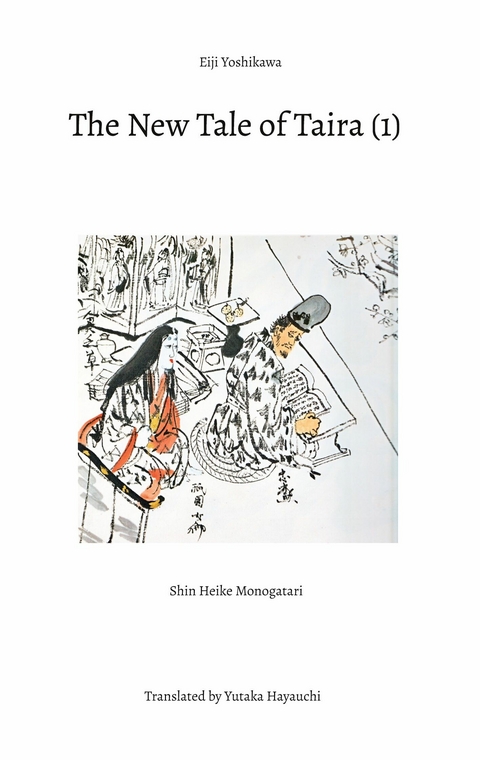
The New Tale of Taira (1) (eBook)
490 Seiten
Books on Demand (Verlag)
978-3-7597-9811-4 (ISBN)
Eiji Yoshikawa (1892 - 1962) is one of Japan's best-known writers of popular literature. He wrote novels about historical characters and themes from an early age. From 1935 to 1939, he published the serial novel Miyamoto Musashi in a weekly newspaper. Japanese read no other serial novel as widely as Miyamoto Musashi. His literary portrayal of the famous swordsman resonated strongly with the Japanese suffering under the miserable circumstances of the Second World War. As renowned literature novel, Miyamoto Musashi was a great success. Eiji Yoshikawa was very disappointed by the defeat of the Second World War and the unimaginable destruction of Japan and was unable to write for several years. He only began writing the great novel Shin Heike Monogatari ,The New Tale of Taira, in 1950 and completed it after 7 years. In this novel, which Shukan Asahi published as a newspaper series, Eiji Yoshikawa interpreted the classic novel The Tale of The Heike from a new perspective. The Taira tribe perishes in the power struggle against arch-rival Minamoto. This long novel appealed to many Japanese, whom the postwar situation badly shook. A literature scholar says this novel is his life's work and Japan's eternal literature. Kodansha published 1989 the paperback version with 16 volumes. Shinchosha followed in 2014 with 20 books.
Market
The cold February wind was called “the first East wind.” And because people imagined it would soon be spring when the first East wind blew, they felt it all the more as piercingly cold.
“Oh, I’m ravenous. This cold is also from my empty stomach.”
Neither his uncle nor his aunt had offered him anything to eat. Now, it came in handy for him. He wanted to leave his uncle’s house as quickly as he tried to fly. He never wanted to run such an errand again, even if he had to be a beggar. As he walked back down the path, he became angry about the visit to his uncle and aunt:
“It is a pity that even I, Kiyomori, burst into tears in front of them. They probably misunderstood me to mean that I would have cried with joy because we got the money we desperately needed. If so, it is very annoying.”
His eyes were still swollen. He was ashamed that people noticed he had been crying when they turned to look at him closely on the street. However, people noticed not his dirty face, blurred by tears, but the rags the young Kiyomori wore. He had on a rumpled hitatare (the simple clothing of a samurai) and an undergarment on which the thick layer of dirt was already shining. Even tramps at the gate Rashomon did not put on such dirty clothes. What kind of people would he be mistaken for if he took the sword from his waist? His rice straw sandals and leather socks looked like he had stepped in a puddle or a rice field. His official hat, eboshi, which all samurai wore and whose black lacquer coating was already peeling off, sat crookedly on his head.
Kiyomori, by the way, was small and corpulently built. His head was disproportionately large compared to his height. His ears, nose, mouth - everything was carved large on him. These external features were what made his face special. Along his thick eyebrows, the corners of his eyes tapered rather narrowly and fell downward, making his facial expression slightly smirking. Thus, his face fortunately saved him from a cruelty-inducing impression of a strange-looking little man.
In contrast, his skin was pale. His large earlobes looked crimson and glowed like blood were dripping from them. These were among his beautiful physical features despite his different appearance.
Therefore, people wondered and asked, “To what family does this young gentleman belong?” “What office does he hold in the capital?” Kiyomori had a bad habit and often walked around in the street with his hands in his breast pocket. His behavior was not at all proper for a son from a good family. He never acted like that in front of his father, but outside his bad habit came out again. This wrong manner was undoubtedly due to the influence of the people who frequented Little Salt Lane.
“I won’t be stopping by Little Salt Lane today. I own a lot of money we regretfully borrowed for our household.” He was afraid that he would lose his self-control. Kiyomori already suspected that the attraction that Little Salt Lane exerted on him began to appeal powerfully to his drive. His reason was thus displaced from deep within him by his desire. He knew that he naturally had a weak will and that his will would not conquer his vices.
But when he came to the corner of Little Salt Lane, he could not hold back. From the opening of a narrow little alley, the lukewarm fragrance that his sensory organs loved so much flowed over him, and he immediately laughed at his previously sworn restraint.
“Something is going on here, as usual!”
In Little Salt Lane, for example, an old woman was grilling and selling pheasant legs and skewers of small birds. Next to her, another man had a giant barrel of sake standing at the edge of the alley but was drinking along with himself, singing under the influence of alcohol, and still selling his sake well, which was his main business. Or a little girl sat motionless in the shade in the market, hugging a basket of citrus fruits on her knee. One continued to see a wooden sandal seller or father and son of a cobbler. People said that in this corner, there were over a hundred stalls with various goods on the shelves, where people offered dried fish, old clothes, and all sorts of trifles to sell them and earn little money for their poor households.
They were, without exception, people engaged in many kinds of gainful activities. These people were similar to weeds that grew under the soil of the upper class's ostentatious society by being kicked and discouraged by the ruling aristocracy and were, therefore, pitiful, miserable creatures. On the other hand, when one saw these individual human souls trying to take root, survive, and get along in this squalor, the terrible struggle for survival seemed to outsmart reason and decency. Smoke from a kitchen fire where people were grilling and cooking befogged the mysterious black crowd that lived in Little Salt Lane. From next door, the shouting of card players pierced Kiyomori’s ears on the street. The giggles of indecent women, the cries of infants, the drumming of street dancers, and other inexplicable smells and sounds were everywhere. There was the only paradise that ordinary people proudly possessed according to their social rank, in contrast to the culture of the aristocratic class under the eternal domination of the tenno. The market was the flowery capital of the people and the underground people. It was only because of this that Kiyomori’s father told him not to approach such places under any circumstances.
But Kiyomori wanted this place. He liked the people who came and went there. On the West side of the market, from time to time, under a big Japanese hackberry tree, there was a thieves’ market called “the weeds market” or “the grass market.” Even this market Kiyomori found amusing. He talked to himself:
“People shout that robbers or burglars are raging in the capital. But when the robbers have something to eat, they live peacefully with the citizens. Evil people are not here. Surely, the bad ones are in the world above the clouds. On Mount Hiei, in the temple Onjoji, or Nara, many evil Buddhists wear their clothes with gold threads woven into them.” Kiyomori soon found himself swept along by the crowd. He peered in here, stood there, drifted about, forgetting the time until evening came.
At “the grass market,” no one could be seen hawking their stuff that day. It was instead a going out day of the thieves. People see red lanterns and bouquets under the Japanese hackberry tree. The smoke of incense sticks rose in the dusk. Women who looked like dancers and lowly prostitutes gradually flocked to the Japanese hackberry tree to pray.
A mistress of a great robber named Yasunosuke Hakamadare had previously lived there. At this place now stood this big Japanese hackberry tree, so they said. From this, the superstition arose at some point that a prostitute could transfer the dream of a secret love to her beloved man or that she could pray love rivals ill if she highly revered this hackberry tree. The women declared the seventh day of each month a day of going out because the great robber had died in prison on June 7, the second year of the Eien era (988). Many people, such as the young thieves of “the weeds market” and various women, made pilgrimages there. Therefore, “the grass market” was always crowded.
The great robber had been born in a family of a fourthrank civil servant and had committed the worst deeds, such as arsons, robberies, and murders. This man, feared by the world with the evil name of Hakamadare, had died a hundred years ago. Nevertheless, he had exemplified to the descendant world a kind of will of resistance of the people against the Fujiwara rule.
The disturbance caused by the great robber was a social event in those days when the most potent regent, Michinaga Fujiwara, also called Lord Hojoji, was still alive and when the despotism of the Fujiwara clan was at its peak. “This world, I think, is mine” was how this regent expressed his self-aggrandizement in a poem. The great robber embodied the people’s feelings towards the allpowerful regent in his person and won many resistance battles against the ruler. That is why the petty bourgeois of that time could praise him despite his crimes. And that is why somebody still lighted incense there as long as the power of the Fujiwara family lasted. One can also interpret the superstition of the weak as a modified form of their longing for justice. Kiyomori thought:
“I, too, have the same need for justice in me. It’s in my blood, similar to the great robber.”
The red lanterns under the hackberry tree seemed to Kiyomori like a hint of his future, and this thought gave him the creeps. Therefore, he was about to leave the hackberry tree, but suddenly, a voice came from somewhere: “Hey, Heita from Ise province! What have you been looking at all this time? Have you been looking at the faces of the women who make pilgrimages to the hackberry tree?”
In the dusk, he could not see so well who it was. While he was still standing there startled, the other one stretched out his arms to Kiyomori. He grabbed Kiyomori’s shoulders and shook them so hard that his neck wobbled back and forth.
“Oh, you’re Morito!”
“Of course. You can’t forget a Morito Endo. What’s the matter with you? You look like a maniac.”
“Really? Are my eyelids still swollen?”
“Did you flee your house again because your beautiful mother and one-eyed father...
| Erscheint lt. Verlag | 21.8.2024 |
|---|---|
| Sprache | englisch |
| Themenwelt | Literatur ► Historische Romane |
| ISBN-10 | 3-7597-9811-X / 375979811X |
| ISBN-13 | 978-3-7597-9811-4 / 9783759798114 |
| Informationen gemäß Produktsicherheitsverordnung (GPSR) | |
| Haben Sie eine Frage zum Produkt? |
 EPUB (Wasserzeichen)
Größe: 1,4 MB
DRM: Digitales Wasserzeichen
Dieses eBook enthält ein digitales Wasserzeichen und ist damit für Sie personalisiert. Bei einer missbräuchlichen Weitergabe des eBooks an Dritte ist eine Rückverfolgung an die Quelle möglich.
Dateiformat: EPUB (Electronic Publication)
EPUB ist ein offener Standard für eBooks und eignet sich besonders zur Darstellung von Belletristik und Sachbüchern. Der Fließtext wird dynamisch an die Display- und Schriftgröße angepasst. Auch für mobile Lesegeräte ist EPUB daher gut geeignet.
Systemvoraussetzungen:
PC/Mac: Mit einem PC oder Mac können Sie dieses eBook lesen. Sie benötigen dafür die kostenlose Software Adobe Digital Editions.
eReader: Dieses eBook kann mit (fast) allen eBook-Readern gelesen werden. Mit dem amazon-Kindle ist es aber nicht kompatibel.
Smartphone/Tablet: Egal ob Apple oder Android, dieses eBook können Sie lesen. Sie benötigen dafür eine kostenlose App.
Geräteliste und zusätzliche Hinweise
Buying eBooks from abroad
For tax law reasons we can sell eBooks just within Germany and Switzerland. Regrettably we cannot fulfill eBook-orders from other countries.
aus dem Bereich


