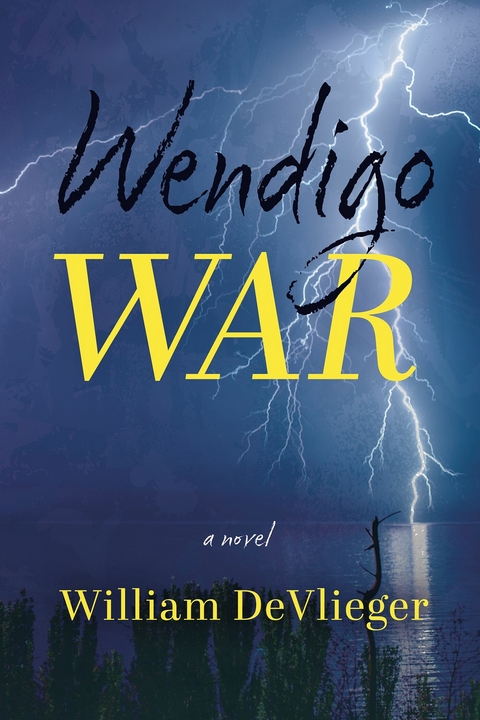
Wendigo War (eBook)
300 Seiten
Bookbaby (Verlag)
979-8-3509-5264-3 (ISBN)
William (Bill) DeVlieger came to the Anishinabe Ojibway people as a student at Northland College in Ashland, Wisconsin, where he received instruction in Native American Studies from tribal elders. Bill developed close friendships with Anishinabe Ojibway elders, teachers, activists, holy people, and people just living life, who taught him to think about the world in new ways. Learning about the Seventh Fire Prophecy, Bill identified and was accepted as one of the New People prophesized to lead humanity down the natural path to peace and sustainability. He attended native ceremonies, participating in talking circles, sweat lodges, shaking tents, and ceremonies at the Three Fires Midewiwin Grand Medicine Lodge, and participated in several environmental battles, fighting alongside the Anishinabe Ogitchida Warrior Society to protect the sacred lands and resources of the Northwoods. The author describes himself as one of the New People, a Seventh Fire Storyteller, a Celtic Druid, and a son of Mother Earth. He lives in Warren, Pennsylvania, with his wife and son, a dog, and four cats.
8.
John awoke in his hotel room to an unfamiliar alarm. Exhausted, he turned on the television and walked to the bathroom. A ragged man reflected in the mirror. In the next room, a weatherman forecasted severe thunderstorms passing over Nawadjiwon in the evening. He dressed, took two pills to knock out the throbbing in his head, and proceeded to check out.
The team met in the lobby at nine and drove to the airport. After clearing security, they boarded a Migizi Airways single-engine prop plane. The Northern Ontario First Nations created the airline to serve northern communities, bringing necessities such as groceries, supplies, and gas. Minutes after takeoff, they reached their flight ceiling. The captain spoke with an Ojibway accent: “Boozhoo, my name is Captain Thomas White. My co-pilot’s Charlie Makaday.”
“Boozhoo,” the co-pilot said.
Captain White continued, “Welcome to Migizi Airways, with service everywhere the other airlines won’t go. Today, we’re cruising to the Arctic Circle…heh heh…just kidding; we’re going to Baswenaazhi First Nation. We’ll be in the air for about seventy-five minutes. The weather in Baswenaazhi is sunny with a few clouds, and it is about seventy-one degrees. The forecast says there’s a southwest wind bringing the Thunderers that way later today, but there’s nothing to worry about. We’ll climb to around three thousand meters today and cruise at about two hundred seventy knots. We don’t have drink service, but if you brought your own…feel free.” The pilots didn’t say much during the flight until their descent into Baswenaazhi, which sat on a larger island on the east side of the lake.
A man in jeans and a flannel shirt and a young woman in a blue summer dress met them on the tarmac. “Boozhoo,” the man said. I’m Buster Wiigwas, and this is my niece, Angela. We’re council members. We wanted to meet you before the hearing and walk you down to the Big Beaver.”
“Excuse me?” Clark asked.
“The Big Beaver…our seaplane.”
“Oh,” Clark said.
“You are meeting with us tomorrow evening, is that right?” Angela asked.
“Yes,” John replied.
Paul asked, “May I ask you a question?”
“You just did,” Buster said, grinning. Paul smiled back, and Buster said, “What’s your question?”
“What does the word ‘Baswenaazhi’ mean in your language?”
“Echo Maker,” Angela said. “Crane.”
They walked down the dirt road leading from the airstrip to the dock. A brown and white seaplane sat in the water with its engine hatch open and a mechanic hard at work. Buster said, “Yeah, she’ll always get you where you’re going. There’s the pilot, Jimmy Waaban.”
The young mechanic turned and offered his grease-covered hand. He stood tall, six-two, and wore his long hair in a braided ponytail. John shook his hand, and Jimmy handed him a rag from his pocket. “Heading to Nawadj’ for the day, right?” he asked.
“Yes,” John replied.
“Okay, the Beaver’s ready.”
The cabin boasted just enough room for them to cram inside. “How long to the village?” Paul asked. The engine made considerable noise, so Paul repeated himself.
“Takeoff to landing…about twenty minutes.”
Buster and Angela waved from the dock as the Big Beaver skied into open water. The engine roar became deafening as the plane glided over the lake. The plane bobbed up and down momentarily before climbing high over the endless wetlands, strikingly beautiful below the soft azure sky. Fifteen minutes later, they circled Nawadjiwon and sat down in the water.
The small village had four roads running across it, with the houses mostly built on the higher northern end. A large building with a painted turtle swimming between two large islands was near the center. Further on sat a smaller building with a giant Red Cross painted on the side. The houses were wood framed with faded siding, shingled roofs, and plywood porches. People waited in the harbor. Jimmy landed off the south shore and taxied among fishing boats and motorized canoes. When the engine cut out, he turned and said, “Radio’s saying there might be storms later…if it starts looking bad, I’ll take the Beaver back to Baswenaazhi and come get you in the morning, okay?”
“No, it’s not okay,” Bill said. “Where would we stay?”
“They’ll take care of you. As long as the storm breaks by morning, I’ll be back.”
Bill was incensed, Paul timid. Clark stared at the gathered crowd.
John stepped onto the dock. The sunlight cast a million sparkling diamonds over the lake. A solidly built middle-aged man stepped forward. He wore his long black hair in a single braided ponytail, and his glasses rested low on his nose, giving him a scholarly appearance that complemented his working-tough exterior. “Boozhoo,” the man said. “I’m Martin Kineu, Chief of Nawadjiwon. Welcome to our village. These are our council members. The man at the front is Alvin St. Claire, and the man in the cowboy hat is Leonard Bineshii. Behind him is Joseph Waaban, Jimmy’s father. This is my sister, Mary Kineu.” He indicated a woman with delicate features and long braided hair and continued, “The ladies behind Mary are Dory St. Claire and Rose Ningaabii. Rose’s husband Albert is an herbal doctor.”
After John introduced the team, Martin said, “Let’s walk, and I’ll tell you a little about us.” He motioned up the path, not with his hand, but by pursing his lips together and pointing with them as if kissing the air. The strange gesture piqued John’s curiosity, and he resolved to ask about it later if time allowed. They started up the path from the dock, the others following behind. John lit a cigarette as Martin began, “Nawadjiwon’s a small community with two-hundred fifteen Oji-Cree people and a few non-natives: teachers, nurses, a couple of students, and a marine mechanic who married one of our young women. Mark Taylor, the white doctor, comes over from Baswenaazhi on Wednesdays and Saturdays, but we prefer our medicine people do our doctoring. We’re traditional people. Our ancestors have lived on this land for generations. We came here to escape the missionaries and government men trying to change us. The attempts to assimilate First Nations people have been devastating. Many communities lost their culture and identity. We didn’t escape entirely but fared better than other communities.”
“I’ve heard your people referred to as Anishinabe, Ojibway, and Oji-Cree,” John said. “Which is correct?”
“They’re all correct. Anishinabe describes the culture. Many nations come from the Anishinabe, like branches from one tree. The word describes our creation story. It means, ‘Original Man was lowered down to the earth.’ The Ojibway are one nation that came from the Anishinabe language culture. The word Ojibi means ‘to write.’ We record our history and teachings on birch bark scrolls using pictographs. Oji-Cree refers to our people here. Long ago, Ojibway people migrated north and married Cree. Now we’re one people, Oji-Cree. Our language is a little different than our southern Ojibway cousins.”
“Okay, what does Mameigwess mean?”
“It means ‘Little People.’ There are taboos against speaking about some spirits, but I’ll explain since you’re our guest. A rock shelf not far from here sits a little below the water. When the wakes lap against the shelf, it makes a strange warbling sound associated with the Little People. The other communities avoid this place because the Little People are powerful, but the Creator directed us to live here.”
“I see. Thank you.”
“This place is sacred to us. We live by the old ways. We fish, we hunt, we gather. The village consumes thirty thousand fish a year. We also hunt geese. It’s true we get supplies from the South, but for the most part, we sustain ourselves. The muskeg is sacred. We need clean water. One community I know of lived under a water ban for twenty years after their water plant failed. Nobody would help them. When people get desperate, bad things happen. We don’t have suicides here like many First Nations communities do because we have clean water, safe food, and we have our culture.”
John staggered for a moment. Stress.
“I’m going to tell you where we stand. The other communities may support your mines, but our council stands against them. We won’t allow it if there’s even a small chance of toxins entering our water. So we’re voting against them. We’re protecting the water.”
John felt sweaty, anxious, and exhausted. He said, “Give us the chance to answer your concerns.”
“We’ll listen to you, but many of our people feel strongly about the mines. Emotions may run high tonight, but before all that, what do you say to lunch at the school?”
They walked past the Community Building and the Health Center with the giant Red Cross and approached the school. Detailed murals decorated the walls, animals and birds in natural...
| Erscheint lt. Verlag | 15.8.2024 |
|---|---|
| Sprache | englisch |
| Themenwelt | Literatur ► Romane / Erzählungen |
| ISBN-13 | 979-8-3509-5264-3 / 9798350952643 |
| Informationen gemäß Produktsicherheitsverordnung (GPSR) | |
| Haben Sie eine Frage zum Produkt? |
 EPUB (Ohne DRM)
Größe: 2,4 MB
Digital Rights Management: ohne DRM
Dieses eBook enthält kein DRM oder Kopierschutz. Eine Weitergabe an Dritte ist jedoch rechtlich nicht zulässig, weil Sie beim Kauf nur die Rechte an der persönlichen Nutzung erwerben.
Dateiformat: EPUB (Electronic Publication)
EPUB ist ein offener Standard für eBooks und eignet sich besonders zur Darstellung von Belletristik und Sachbüchern. Der Fließtext wird dynamisch an die Display- und Schriftgröße angepasst. Auch für mobile Lesegeräte ist EPUB daher gut geeignet.
Systemvoraussetzungen:
PC/Mac: Mit einem PC oder Mac können Sie dieses eBook lesen. Sie benötigen dafür die kostenlose Software Adobe Digital Editions.
eReader: Dieses eBook kann mit (fast) allen eBook-Readern gelesen werden. Mit dem amazon-Kindle ist es aber nicht kompatibel.
Smartphone/Tablet: Egal ob Apple oder Android, dieses eBook können Sie lesen. Sie benötigen dafür eine kostenlose App.
Geräteliste und zusätzliche Hinweise
Buying eBooks from abroad
For tax law reasons we can sell eBooks just within Germany and Switzerland. Regrettably we cannot fulfill eBook-orders from other countries.
aus dem Bereich