


No Heart is Free (eBook)
245 Seiten
Barbara Cartland eBooks Ltd (Verlag)
978-1-78867-773-8 (ISBN)
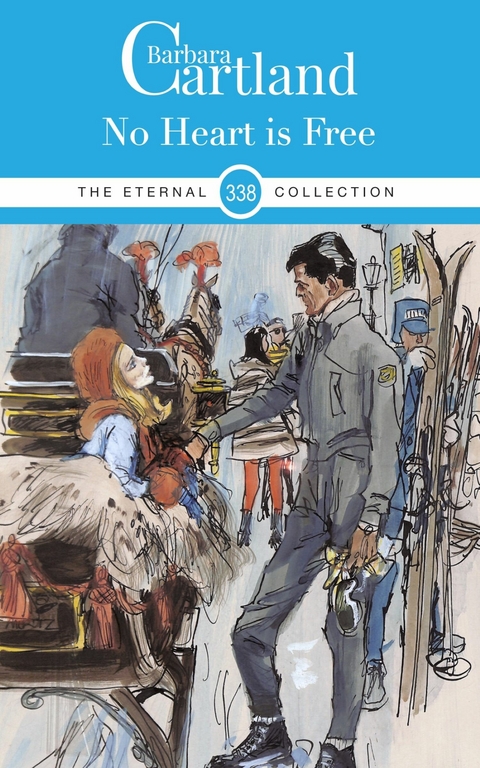
Tally, Lord Brora, is heartbroken to discover that Amelia Melchester, whom he hoped to marry, has jilted him for Ernest Danks, a man likely to be the next Prime Minister. In a chance encounter, he meets young Jean Macloed, who is in the same unhappy situation as himself. Tally devises a scheme to bring Amelia and Jean's boyfriend, Angus, to their senses.
With the help of his friend Gerald, Tally transforms Jean from a penniless waif to society beauty and takes her to St. Moritz, with his mother acting as chaperone, in a bid to make the love of his life, Amelia, jealous and take him back. All is going to plan until a skiing accident makes Jean realise she no longer loves Angus. In despair she understands that her pretend love for Tally, is the real thing but his heart still belongs to the lovely, but selfish Amelia. She travels back to England to help some friends whose child is seriously ill and discovers a secret that could change the life of Tally's mother, Margert Melton, forever.
How Tally's plan unravels and how the revelations of the past come to the surface are told in this magnificently moving story of jealously, sadness and the power of love to heal all.
Tally, Lord Brora, is heartbroken to discover that Amelia Melchester, whom he hoped to marry, has jilted him for Ernest Danks, a man likely to be the next Prime Minister. In a chance encounter, he meets young Jean Macloed, who is in the same unhappy situation as himself. Tally devises a scheme to bring Amelia and Jean's boyfriend, Angus, to their senses.With the help of his friend Gerald, Tally transforms Jean from a penniless waif to society beauty and takes her to St. Moritz, with his mother acting as chaperone, in a bid to make the love of his life, Amelia, jealous and take him back. All is going to plan until a skiing accident makes Jean realise she no longer loves Angus. In despair she understands that her pretend love for Tally, is the real thing but his heart still belongs to the lovely, but selfish Amelia. She travels back to England to help some friends whose child is seriously ill and discovers a secret that could change the life of Tally s mother, Margert Melton, forever.How Tally s plan unravels and how the revelations of the past come to the surface are told in this magnificently moving story of jealously, sadness and the power of love to heal all.
2
Without waiting for Jean’s reply, Tally jumped to his feet.
“This is tremendous,” he exclaimed, “but it has got to be properly handled, and I know the very chap to do it, too.”
He took up the telephone receiver and dialled a number while Jean struggled to find her voice. At last she stammered,
“B-but Lord Brora...”
“One minute,” he replied. “Hallo, is that White’s? Ask Captain Fairfax to come to the telephone.”
He smiled at her with the receiver to his ear, and it struck her, not for the first time, how good-looking he was. When he came into the office the first day she had been at work there, she had thought he was the most attractive man she had ever seen. Now she felt that this must all be a dream. This absurd situation could not be real. With an effort ,her good Scottish common sense reasserted itself. She moved across the room and stood beside Tally at the desk.
“Listen, Lord Brora,” she said quietly. “I know this is a joke, but I don’t quite understand. Please let me go now.”
“Joke? It’s no joke,” Tally replied sharply, and then spoke into the receiver, “Oh, hallo, Gerald. No, I wasn’t talking to you. Look here, I want you! Something important has happened and I want your help. Yes, at once! Action stations, old boy!”
He laughed at something that was said and put down the receiver.
“He will be round in a few minutes,” he remarked, then seeing Jean’s troubled, anxious expression, he added more kindly,
“Listen, leave this to me. We are both in a mess. We have both for a moment suffered a temporary, mind you, a very temporary defeat. Well, we are going to win. We are going to come out on top, whatever the betting is against us. Won’t you trust me?”
He smiled at her again and suddenly Jean felt as if it were impossible for her to oppose him. She must just do what he wanted.
“But I don’t understand...” she said uncertainly.
“Yes, you do,” Tally said soothingly. “You are going to make that young man of yours look a fool. Now, when did you get the letter?”
Jean drew it from the pocket of her dress.
“It arrived by the six o’clock post,” she answered. “I was just leaving – in fact, in another minute I should have gone. I stayed late because I promised Miss Ames that I would finish those letters for you to sign tomorrow morning.”
“It’s lucky you did,” Tally said. “When was the letter written?”
Jean drew the sheets of paper from the envelope. Despite an almost superhuman effort she could not keep her hands from trembling or a sudden mistiness from dimming her eyes. Angus’ handwriting stared up at her.
Dear Jean…
She had known something was wrong as soon as she had read those first words, so cold, so formal. She remembered the first time he had written to her. She had been so thrilled to see his writing. Ever since she had come south, she had waited for the posts, waiting and longing to hear from him. The few words of affection he had written had meant so much. And now this – a cold dismissal of all the things she had planned, all that the future was to have meant for both of them. “Dear Jean…” she read again, and with an effort she remembered that Tally was waiting.
“He wrote this on Saturday morning,” she said. “He must have posted it in Glendale about noon. He usually goes into the village on a Saturday for the things wanted for the farm at the weekend.”
“So, he is a farmer?”
Jean nodded.
“And you love him?”
“I suppose so!” She caught back a sob. “I thought it was so wonderful that he should want to marry me. You see, after my father died, I had nothing. He was the minister in Glendale and I’m afraid he was never very practical. Anyway, when he died there were a lot of debts to be met and to pay them off everything had to be sold.”
“What happened to you then?” Tally asked.
“I was only fifteen at the time,” Jean replied, “and I went to live with an aunt, actually she was a great-aunt. She was very strict and not very kind. She made me work very hard in the house and garden and I had no friends of my own age. Then one day I met Angus.”
Her face softened with remembrance. How could she explain to this strange young man what it had meant to her then? To speak with a man, to talk to someone kindly and human who seemed interested in her. It was impossible to describe the harshness of her life with her great-aunt. She was fed, she was clothed, she was given a roof over her head and there was nothing that could be described as real hardship or neglect. And yet it was a house of misery. Never for one moment was she allowed to forget her poverty or her orphan state. Never had she a possession that she was allowed to call her own nor, it seemed at times, even a thought or a feeling that was private or sacred from the prying eyes of her aunt or the sharpness of her tongue. Vaguely Jean sensed then what she was to know later – that there was a reason for the unceasing fault-finding and for her aunt’s desire to crush her spirit until it was too broken or humble ever to rise again.
She had been crying when she first met Angus, and because she was so desperate in her unhappiness she had done a thing she had never done before. She had slipped out of the house when she should have been preparing the evening meal, had gone up on the moor behind the house to find some solace, some comfort in solitude. The sun was sinking and throwing strange lights on the moors and distant mountains, and as he came striding towards her, his hair burnished gold, his neck bare, he had seemed almost supernatural, an immortal from another sphere rather than a harassed farmer in search of some straying sheep.
They talked together only for a few minutes, but in those moments Jean had wakened to womanhood. She was no longer a child, cowed and browbeaten, but a young woman with something alive and virile stirring within her veins.
She had gone back to the house with a smile on her lips, knowing that she would meet him again. It had taken a year for them to get to know each other well, a year in which Jean ran innumerable risks of her aunt finding out that she had made his acquaintance. And in that year she had come to a new knowledge of herself and, she believed, a new knowledge of the world.
It was only when her aunt died that she discovered the reason for many things that had perplexed and surprised her during her childhood. She had learned, too, that with her aunt’s death she was again penniless. The old lady had been living on an annuity. What she was free to bequeath she had left to the chapel. There was nothing for Jean except the knowledge that she was free – free to marry Angus should he ask her.
He did ask her, and then some pride belonging to her Scottish forbears had made her prevaricate. She wanted some time , time to breathe, time to purchase just a few things that she could call her own. Something within her revolted against the idea of going to Angus completely empty-handed – of asking him to pay for the very dress in which she would be married.
While working for her aunt she had taught herself typewriting and also shorthand by a correspondence course. Her aunt had made her work hard at both, even as she had made her slave in the house, cooking, and scrubbing, cleaning, and mending.
‘I shall make a good wife,’ Jean told herself. But she wanted more than that – a little of the beauty and glamour that she knew instinctively should be part of her youth. She wanted to be young, frivolous, and carefree – all the things she had never been allowed to be – and she wanted to go to Angus not as a poverty-stricken orphan but as a woman able to stand on her own feet and capable of earning money of her own.
Perhaps it had been an absurd idea, and yet it was deep-rooted in a pride that would not be denied, and so, despite Angus’ pleadings and protestations, she had come south to London to get herself a job.
There had been plenty of folk in the strath to tell her she was a fool. Once her aunt was dead she learnt a good many things about Angus – that he was a catch of the neighbourhood, that all the girls had set their cap at him, one after the other. His had a fine farm, for his father had farmed it before him and his father before that. His family were well-off and Angus had had a good schooling. “Too good,” some people had said, for he had “got a bit big for his boots” and was “after thinking himself the gentleman”. There would have been nothing wrong in that, if he had not cold-shouldered many of the lads with whom he had grown up and tried to be friends only with those who owned the lodges and rented the moors for the season.
“I remember his mother,” one old woman told Jean, “when she was proud to make the best butter of any farmer’s wife up the strath, but Angus is not letting his wife work. Ye’ll be a fine lady while others do the work for ye.”
“I’ll be nothing of the sort,” Jean laughed, but when she had tackled Angus on the subject, she found that his ideas were very definite.
“There will be plenty to occupy your time,” he said sharply, “without you’re doing a servant’s work. Besides, I’m not going to be tied to the farm. We will go down south and take a week or two in Edinburgh from time to time – in fact, we might even plan a trip abroad, who knows?”
Jean knew she ought to be thrilled and excited by such ambitious planning, but there was something self-conscious about the way he spoke, something that told her that his reason for all this was not that they should be amused, but something deeper and more...
| Erscheint lt. Verlag | 1.4.2024 |
|---|---|
| Reihe/Serie | The Eternal Collection |
| Sprache | englisch |
| Themenwelt | Literatur ► Historische Romane |
| Literatur ► Romane / Erzählungen | |
| Schlagworte | strong females • Strong Women • strong women characters |
| ISBN-10 | 1-78867-773-0 / 1788677730 |
| ISBN-13 | 978-1-78867-773-8 / 9781788677738 |
| Informationen gemäß Produktsicherheitsverordnung (GPSR) | |
| Haben Sie eine Frage zum Produkt? |
 EPUB (Ohne DRM)
Digital Rights Management: ohne DRM
Dieses eBook enthält kein DRM oder Kopierschutz. Eine Weitergabe an Dritte ist jedoch rechtlich nicht zulässig, weil Sie beim Kauf nur die Rechte an der persönlichen Nutzung erwerben.
Dateiformat: EPUB (Electronic Publication)
EPUB ist ein offener Standard für eBooks und eignet sich besonders zur Darstellung von Belletristik und Sachbüchern. Der Fließtext wird dynamisch an die Display- und Schriftgröße angepasst. Auch für mobile Lesegeräte ist EPUB daher gut geeignet.
Systemvoraussetzungen:
PC/Mac: Mit einem PC oder Mac können Sie dieses eBook lesen. Sie benötigen dafür die kostenlose Software Adobe Digital Editions.
eReader: Dieses eBook kann mit (fast) allen eBook-Readern gelesen werden. Mit dem amazon-Kindle ist es aber nicht kompatibel.
Smartphone/Tablet: Egal ob Apple oder Android, dieses eBook können Sie lesen. Sie benötigen dafür eine kostenlose App.
Geräteliste und zusätzliche Hinweise
Buying eBooks from abroad
For tax law reasons we can sell eBooks just within Germany and Switzerland. Regrettably we cannot fulfill eBook-orders from other countries.
aus dem Bereich


