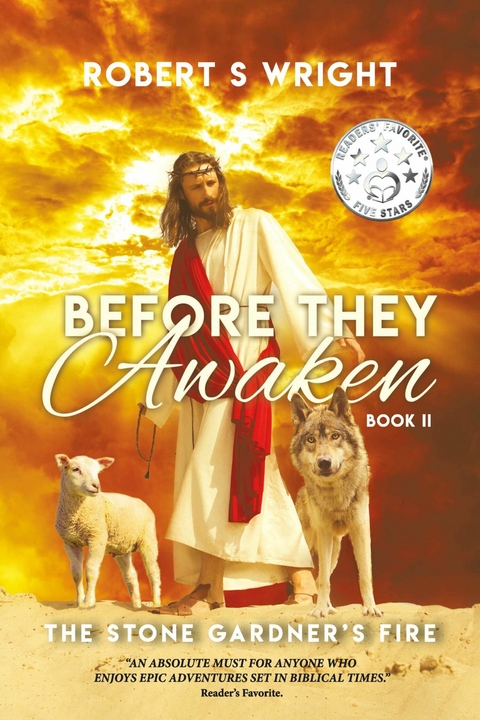
Before They Awaken (eBook)
424 Seiten
Bookbaby (Verlag)
979-8-3509-4435-8 (ISBN)
Robert S. Wright has been a student of history and comparative religion all his life, beginning with his years at the University of Idaho in Electrical Engineering with a minor in Philosophy and Comparative Religion. It was there that he discovered that theology and science do not necessarily conflict with one another, if viewed through the proper lens. His research over the years has been exhaustive, and has included religious texts from modern to ancient, from Biblical to Far Eastern. Over the years he has been a church youth group leader, a ski racer, and a journalist and newscaster, in a career that has spanned over five decades. He is currently a real estate broker and investor in Seattle and a private pilot.
In the sequel to King David's Lost Crown, Mahlir is given a note by a stranger disclosing that his two-year-old son is the blood offspring of King Philip of the northern regions. It is a revelation that marks the child for assassination, because he is the unwelcome heir to a crown that would otherwise belong to King Philip's younger brother, King Antipas of Galilee. There is hope, however, even though the child lies dead. There is a man who is rumored to have the ability to raise up the dead, and he is in Jerusalem for Passover. But there is only one way that can happen now. It is the way of the impossible. Because this man, this mysterious sorcerer, worker of the miraculous whom some are beginning to call the Messiah, would have to first raise himself from the dead, for unbeknownst to Mahlir, he has been executed, nailed to a cross, a method of death reserved for the most heinous of criminals.
Chapter 1
New Beginnings
Caesarea Philippi
Year 74(28AD) into Year 77(31AD) of the
Calendar of Pater Patriae Gaius Julius Caesar
While the southern part has the Judean Wilderness, waterless and unforgiving, the northern part has Pan, the god of the wild, and of shepherds and flocks, and of mountains free, and valleys soft with purples and yellows, and of deep green forests, and music, and – who knows? – maybe nymphs and other unseen creatures frolicking about in carefree play. The little family arrived simultaneous to the cresting of the sun over the Syrian heights, so that the entire city and its three conjoining rivers were bathed in gold.
Caesarea Philippi, they call it, a garden to rival the beauty of Eden, the peristylium of civilization, the new home of Mahlir-of-Matthias and his tall Nubian wife and their maid servant Esther, and their two children, one as yet unborn. The blending of two very different seeds, Mahlir with his olive-colored Hebrew skin and Amanirenas with skin as black and as flawless as polished obsidian, gave two-year-old Tabitha a type of beauty that would make the gods themselves envious. The child’s hair was so black it was blue, and her skin was the color of a golden sunset. Her lips were triangular like her mothers, ever pointed upward in happiness, as though each moment was one of wonder and fulfillment.
And soon they would have another. Amanirenas’ stomach had already begun to grow.
In six months’ time she would give birth. A boy. They nearly named him Yeshua, for without the hand of this man, if indeed he could be called a man, the child would not exist, because Amanirenas had died on that hillside, and had taken the unborn child with her. She quite simply collapsed with catastrophic pre-birth hemorrhaging and died…until this man called Yeshua raised her up with no more than a single command. “Daughter,” he had said. “Open your eyes and rise, and sin no more.” That was it. And she obeyed, as if she had been called back from beyond the gates of Heaven itself. There had been the smell of alabaster, strong and powder pure – Mahlir remembered that specifically – like the way an empty anointing jar smells, a slight whiff of perfume mixed with the powdery scent of newly crafted stone. A haze of yellow was shrouding his head and shoulders, translucent, almost like it wasn’t there, some kind of trick of nature, like heat shimmers on a hot day. It had given him a certain warmth, softened him, or empowered him, words fail. It was unlike anything Mahlir had ever seen.
To name a boy after one so high seemed blasphemous. So they chose the name of another who spoke and wrote down profound words, words similar to those of Yeshua, about love and forgiveness, and about fire and purity.
…it is I who have created the destroyer to work havoc; no weapon forged against you will prevail...
Isaiah, they called their child.
…I will give you the treasures of darkness, riches stored in secret places...
Isaiah, the prophet who spoke of a future time.
No longer will violence be heard in your land, nor ruin or destruction within your borders, but you will call your walls Salvation and your gates Praise. The sun will no more be your light by day, nor will the brightness of the moon shine on you, for the Lord will be your everlasting light, and your God will be your glory.
What specifically happened on that mountainside – whether the child had never actually been dislodged from the womb, or whether Yeshua, by his power, had made the child whole and placed him back within his mother, or whether the child was a surviving twin – would never be known. Only Yeshua knew, and the Lord God from whom he came, from whom springs creation, the Father, as termed by Yeshua. What Amanirenas and Mahlir did know, was that the child had been given back to them by God, that his existence was meant to be, and that he would be protected. It became a powerful comfort, knowing there existed that wall of protection. The child had a purpose, perhaps a grand one, perhaps as a great teacher like Yeshua. God himself had ordained it.
Isaiah.
And the child was precious. He slept between his mother and father at night, waking from time to time to nurse, then falling quickly back into his slumber. Sometimes Mahlir would sleep with his hand on the top of his son’s head, and feel the heat, the flow, the energy. Tabitha slept there too, between her mother and father, and felt the same flow. Each felt it for the other, and for the whole. It was a family bonded with a fusion unbreakable. Tabitha was beginning to walk. Her first step was taken while reaching out toward her baby brother. Her first word was his name, Isaiah, spoken “Eye-Hey.” Her favorite game was when they played, “Who loves baby Isaiah?” She would jump and clap her hands and point. She nursed alongside her brother, and held no jealousy. Which was something else that had happened – perhaps due also to the hand of Yeshua that day – Amanirenas could now hold milk in her breasts, whereas before, her nipples were cracked and split. She nursed free flowing and without pain, both children.
Philip also was attentive to the boy, almost as if the child were his as well. King Philip was a good man. When Herod-the-Great was on his death bed – in the 33rd year of the reign of Caesar Augustus – he divided the kingdom and gave each of four parts to his three sons and his sister Salome. Salome was bequeathed the southernmost portion of Idumea. Judea, later to be annexed by Rome, was given to his son Archelaus. Galilee and Perea were given to his son Antipas. And the eldest son, Philip, a viper lying deadly beneath a lovely flower, so said the talk, was bequeathed the portion to the north that lies peaceful and serene in the shadows of Hermon, the land of Pan, of Caesarea Philippi. Strange how rumors and third-party information can lead one astray. Philip, it turned out, was a noble king, far different than his brother Antipas. Philip was a small man, soft spoken, and very proper and businesslike. In all his mannerisms he was dignified. He had a full head of hair, white with streaks of gray, Roman style, and was beardless. Being a private person, never seeking public attention, Philip rarely wore a diadem, and he was polite, even to slaves. And while his brother Antipas’ stomach poked out from a thin frame like he had swallowed a meal of too many rocks, Philip was as trim and muscled as a soldier.
Philip had been good to his word. He accepted Mahlir immediately into his court. Within days they had set up the outline for the business, which was the reason for the move to Caesarea Philippi, to form a shipping company with Philip. Prior to the move Mahlir had been principal advisor to Pontius Pilate, procurator of Judea, where, in addition to his administrative duties, he was assisting Pilate with his shipping and import/export business, being good with figures and with negotiation.
King Philip was wise in the ways of business, and realized that Mahlir had been the staple of Pilate’s company, even though by title and salary he was only a clerical subordinate, and had made the statement to Amanirenas in private, when she had been lamenting the fact that her husband’s talents were going unrecognized by Pilate, “Send him to me. I shall fund a company and pay him twice as much. Never mind that, I shall make him an equal partner.” So when Mahlir came to a parting of the ways with Pilate, when Pilate went against his advice and built an aqueduct using Temple treasury funds, causing the people to riot, Mahlir accepted Philip’s offer. Capital was to come equally from three sources, from Philip, from loans secured in Rome, and from Mahlir. A quirk of fate had befallen Mahlir. His father had died and had bequeathed to him a set of golden menorahs and a sum of two hundred thousand sesterces. Mahlir didn’t know his father had money at all, let alone two hundred thousand sesterces. Philip put in two hundred thousand, Mahlir and Amanirenas put in two hundred thousand, and two hundred thousand was borrowed from the Probi House in Rome. The Probi House, established many years ago in the days of Augustus when the settlement of Egypt and the liquidation of the royal estates of Cleopatra provided enormous commissions to bankers, was one of the oldest and most respected money lenders in the Empire. It was headed by Sextus Probus, a loyal friend of Philip’s. Sextus loaned the money at twelve percent, using one of Philip’s well rented insulae as security, with the understanding that during the time the ships were at sea the rate would go to twenty-four percent. Philip provided the goodwill of his creditworthiness and the security of his insulae; Mahlir brought to the partnership his knowledge of accounting and of the shipping business. Each was valued equally. It was a legitimate fifty-fifty partnership.
There was but one concern – Antipas, and his threat to seize Mahlir’s assets. A real possibility, said Philip, now that Mahlir was no longer under the employ and protection of Rome. Mahlir had been one of the fifty Jews that had traveled to Rome and petitioned for annexation, marking him as a traitor in the eyes of many. Following Herod’s death, the other kingdoms ran well, but not so Judea. In Judea the people suffered under the rule of Archelaus. Confiscation of assets, torture, even murder were the norm, until Mahlir and a gathering of his fellow Jews traveled to Rome and pleaded for annexation and to have a Roman procurator...
| Erscheint lt. Verlag | 19.3.2024 |
|---|---|
| Sprache | englisch |
| Themenwelt | Literatur ► Romane / Erzählungen |
| ISBN-13 | 979-8-3509-4435-8 / 9798350944358 |
| Informationen gemäß Produktsicherheitsverordnung (GPSR) | |
| Haben Sie eine Frage zum Produkt? |
 EPUB (Ohne DRM)
Größe: 1,0 MB
Digital Rights Management: ohne DRM
Dieses eBook enthält kein DRM oder Kopierschutz. Eine Weitergabe an Dritte ist jedoch rechtlich nicht zulässig, weil Sie beim Kauf nur die Rechte an der persönlichen Nutzung erwerben.
Dateiformat: EPUB (Electronic Publication)
EPUB ist ein offener Standard für eBooks und eignet sich besonders zur Darstellung von Belletristik und Sachbüchern. Der Fließtext wird dynamisch an die Display- und Schriftgröße angepasst. Auch für mobile Lesegeräte ist EPUB daher gut geeignet.
Systemvoraussetzungen:
PC/Mac: Mit einem PC oder Mac können Sie dieses eBook lesen. Sie benötigen dafür die kostenlose Software Adobe Digital Editions.
eReader: Dieses eBook kann mit (fast) allen eBook-Readern gelesen werden. Mit dem amazon-Kindle ist es aber nicht kompatibel.
Smartphone/Tablet: Egal ob Apple oder Android, dieses eBook können Sie lesen. Sie benötigen dafür eine kostenlose App.
Geräteliste und zusätzliche Hinweise
Buying eBooks from abroad
For tax law reasons we can sell eBooks just within Germany and Switzerland. Regrettably we cannot fulfill eBook-orders from other countries.
aus dem Bereich