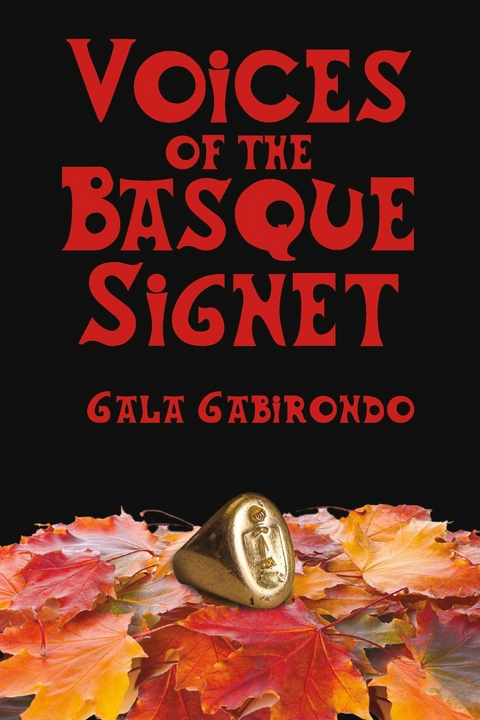
Voices of the Basque Signet (eBook)
410 Seiten
Bookbaby (Verlag)
979-8-3509-2334-6 (ISBN)
After the death of his godfather, Mikel, a would-be revolutionary, inherits the Basque signet ring, a priceless family heirloom that has fascinated and eluded him since he was a child. How did his grandfather-an indentured Basque peasant-acquire such a valuable ring? Different answers lurk in this rich tapestry of family memoirs. The truth-or versions of it-will test Mikel's beliefs in his cause, his family, and himself. Based on people and events in the author's own family, the overlapping tales move back and forth across time and generations, starting with the reflections of Mikel's great-grandmother Amaia Itsasmendia Galarza. In the winter of 1939, the irreverent Basque matriarch talks to the photograph of her deceased husband Arturo Quijano as she burns furniture to keep warm during the fascist siege of Madrid. A strange, silent visitor sits with her, knitting and listening as Amaia recounts her days as a farm girl, a daring smuggler, and a maid in the sprawling Quijano de Goni mansion. It was here she met and fell in love with Arturo when he was the young man of the house. Born in secret, their son Emmanuel is raised by Amaia's father Patxi, in the emblematic mountain village of Galduamendi. After a difficult, indentured childhood, Emmanuel, deemed by Patxi as "e;too clever for his own good,"e; travels with his mother to Madrid. Though he thrives at his father's house, he finds himself caught between his rural Basque roots, his upper-class Spanish life, and his newfound anarchist politics. A violent general strike and an affective indiscretion with Nina, the beguiling daughter of a Spanish army captain, forces him back to Galduamendi. There, his grandfather helps him sneak across the border into Basque France. Ending up in New York City's "e;Little Spain,"e; he meets and marries Monserrat Romero, a young woman from Puerto Rico who is beautiful, troubled and pregnant. Seeking the life of tradition and leisure she once had in Puerto Rico, Monserrat convinces Emmanuel to relocate the family back to Madrid. She leaves first, with their three children in tow. Waiting nervously for her husband to re-join her in the old mansion, she yearns to be a part of the aristocratic world that is rapidly disappearing under the new Republican Spain. Monserrat's surreptitious return to Puerto Rico in an old tramp steamer is told through the eyes of her rebellious daughter Esmeralda, whose untamed imagination holds the key to her resilience. Young Esmeralda falls under the spell of her mother's Caribbean culture and her family's deep spiritual beliefs. These will form the foundation for the shamanic practices she will develop over the course of her life in New York, Los Angeles, and the small towns of the Northern California coast where she struggles to raise Mikel and her youngest son, Kiko. Mikel remembers a free-ranging childhood cut short when he is unjustly thrown in juvenile hall. Later, he travels through Latin America. His militancy and disillusionment with the Sandinista Revolution and his brush with death are chronicled alongside the lives of his ancestors, revealing the threads of pride, ingenuity, and trauma that weave through his family history. Ring in hand, his pilgrimage back to his grandfather's village brings an unexpected encounter with the ghosts of his family's past.
Chapter One
American Dream
Mikel “Mike” Prince-Quijano
(Roslyn, NY, July 3, 1953)
January 3, 2020—Graton, CA
I unearthed the old family album this evening. It was hiding at the bottom of the battered steamer trunk we use to prop up our coffee table. Crusts of gilded trim clung precariously to the worn sides of its red leather binding. Inside, black and white photographs with serrated edges, glued into place with little corner tabs, were carefully arranged on faded leaves of black construction paper.
The first photograph—our “American dream” photo—is a nine-by-twelve-inch portrait taken in the backyard of my parents’ tract house in Pomona, the one my father bought with a loan guarantee under the G.I. Bill. Two generations of migration have come to an end. The adults, all smiling, young, and attractive, offer up their children to the camera.
Manny, the oldest of the cousins, is dressed in dark short pants, suspenders, and a bow tie. He poses at attention, looking pugnacious as ever, holding a bold right hand over his heart. I stand next to him, frowning at the sun on my face, a restless towhead in a family of brunettes. My mother is behind me, beaming like a teenager in bangs and ponytail as she directs my shoulders forward with her reassuring fingertips.
It’s a warm California spring. You can almost smell the honeysuckle creeping up the back fence. The men have all come in suits with pleated trousers and bulky, long-waisted coats that sport notched lapels and padded shoulders. My mother, my grandmother, and Aunt Jazmín all stand tall in block heels with straps and light cotton dresses that swing out from tight, gathered waists. Aunt Juana wears an apprehensive smile. She recently arrived from Spain and leans slightly forward in her belted pencil dress with a red flower on her shoulder. Southern California holds her in its golden postwar embrace. She is eager, if not happy, on the verge of what she hopes will be a prosperous new life.
Abuela1 Monse, the diminutive family matron, stands left of center in the foreground balancing Malena, her fourth grandchild, on her hip. Uncle Angel and Aunt Jazmín are behind her to the left of the frame, he with his trademark poker face, she smiling eagerly with her wide, full mouth of perfect, tiny teeth. Leticia, two months old, sleeps peacefully in my aunt’s arms. On the far right, Uncle Turo kneels with his hands clasped around Amaranta, who is fitted in a short white dress with a petticoat that blooms like a flower.
It is not clear from the photo, but we are a short lot. Even in heels, my aunts don’t break five four. Their husbands are but an inch taller. My German father, who at five ten towers over everyone, is back-center, anchoring the entire portrait with a deceptively loyal smile.
The photograph is yellow with age. Everyone is clearly visible, but chunks of the film have fallen from the paper in the foreground, erasing half of the lawn. It’s as if someone, searching for something, had peeled away the emulsion layer only to find a blank. Much of my Uncle Turo’s body has disappeared from the image. The family signet ring, still clearly visible on his left hand, stands out like a beacon during our last days together as a family. Behind the auspicious image we created of ourselves, our future was festering.
The first time I really noticed the family ring was a year later when it flashed in the sun, gleaming on my godfather’s hand as he raised his drink to toast me at my baptism. Almost five, I was an embarrassing afterthought in the long line of Catholic infants anointed in downtown Los Angeles that morning. Still, I was old enough to have chosen Uncle Turo as my godfather. This was before I understood he was rabidly anticlerical.
Turo was delighted. He threw himself into the project. “Don’t worry about a thing,” he told my mother. “I know a Basque priest. He’ll get us in soon.”
True to his word, my uncle got Father Zubizarreta to open a spot in his busy calendar on Sunday, May 5, at the old Cathedral of Saint Vibiana in downtown Los Angeles.
My mother dressed me in a white guayabera2 with matching short pants. As we hurried up the bright steps to the church, she stopped to moisten her handkerchief on her tongue and scrub the last bits of pagan grime off my cheeks.
“Mama, is that spit?”
“It’s polish, cariño.3 I’m shining you up for God.”
The cathedral was cool and dark, and the biggest building I had ever seen. The lingering odors of incense and candle wax haunted the musty edges of the baptismal font as Father Zubizarreta made the sign of the cross and doused my head with holy water. My mother dried me off with a towel.
“You’re blessed now. You have a halo!”
Only saints wore halos. What a marvel that a splash of water and some incomprehensible mumbling could produce a new spiritual accessory. There weren’t any mirrors around, though, so I couldn’t check to see if it was true.
Once outside, squinting under the Angeleno sun, we stumbled into the Cinco de Mayo4 celebration. There was loud mariachi music, Mexican flags, and green, red, and white crepe paper hung in long, sweeping diamonds over the square. People were eating and drinking at picnic tables. The oily scent of fried food tickled my nose. There were piñatas, and kids were laughing and running around everywhere. Ignorant of history, I assumed the party was for me. It was true. I was a saint!
A crack on my head interrupted my spiritual bliss. Manny held out a broken eggshell. I burst into tears. “It’s okay,” he said. “Look.” He pulled another egg out of a paper bag and cracked it on his own head. Confetti tumbled down his face. Grabbing another, he raised his arm.
This time I blocked him. “Don’t,” I said. “You’re going to mess up my halo.”
“What halo?”
“I’m baptized. Don’t you see it?”
My cousin frowned, scrutinizing me. “All I see is a thing,” he said, drawing an arc over my head with his hand.
“That’s it. Don’t break it.” I turned to his little sister. “Amaranta, do you see my halo?”
She gushed in Spanish, “¡Mikel, ya no eres Moro!”5
Neither of us understood what the other said.
Our family was celebrating at some tables in the shade of a blue tarp strung over poles anchored with heavy cinder blocks. I scampered around asking everyone if they could see my halo. Most of the women could. The men were strangely blind to my beatification.
“It only lasts a little while,” offered Manny.
“How long?”
“Mine lasted a whole day. Maybe three.” He laughed. “Yours is gone already.”
Disillusioned, I sat with my cousins and ate sugary white cake. Father Zubizarreta joined the group. I decided to ask him about the halo.
That’s when my uncle stood up for a tipsy diatribe against blacks, communists, and the Spanish Catholic Church. “Spain will join the twentieth century when a priest hangs from every tree! Present company excepted, Father,” he said, leaning over and patting Father Zubizarreta’s shoulder.
“Of course, my son,” he answered, “but then again, if they are Spanish…” He winked and shrugged. Maybe God would not be troubled by the loss of Spanish priests.
Turo laughed as if he was being tickled, closing his eyes and throwing his head back. He raised his glass again. “To Mikel,” he said. “¡Que tenga salud, pesetas, y sabañones a las tetas!” 6
I knew the phrase by heart. It always made everyone laugh. My mother would put on her wide-eyed, I’m-pretending-to-disapprove face and shush me, but I was never punished for saying it. This time, I was quiet, concentrating on my uncle’s ring.
Turo sat down and tousled my hair. “Mikelín!” he said.
Grabbing his hand, I had a closer look. The flat, golden oval taking up all the space between the knuckles on his ring finger drooped to one side like an oversized pancake. It was etched with a shield where a wild boar ran over a mountain range in front of a tall tree. A knight’s helmet perched atop it all. My mother had read me fairy tales about knights and castles, sorcerers and giants, and brave, young heroes who overcame evil once upon a time, in lands far away. The ring was from a mystical land of adventure called Spain.
It was the last time I saw my godfather wearing the signet. Years later, when I asked my mother about it, she said he still had it, but it was a family heirloom, too precious to wear.
“That is our crest,” she said, “We have royal lineage.”
What lineage, she didn’t know. Abuelo Emmanuel, who died before I was born, had passed it down to my uncle. No one knew how or where the old man got it.
“Probably from his father,” my mother said.
“So it’s Spanish?”
“No. It’s Basque.”
“So he got it from his mother,” I reasoned.
“Maybe, but your great-grandfather was Quijano de Goñi, so there was Basque blood somewhere on that side too. The ring has its secrets,” she said, lowering her voice. “It brings good luck to whoever wears it—but only if their heart is pure.”
For a signet ring, it is a little...
| Erscheint lt. Verlag | 14.2.2024 |
|---|---|
| Sprache | englisch |
| Themenwelt | Literatur ► Romane / Erzählungen |
| ISBN-13 | 979-8-3509-2334-6 / 9798350923346 |
| Informationen gemäß Produktsicherheitsverordnung (GPSR) | |
| Haben Sie eine Frage zum Produkt? |
 EPUB (Ohne DRM)
Größe: 1,4 MB
Digital Rights Management: ohne DRM
Dieses eBook enthält kein DRM oder Kopierschutz. Eine Weitergabe an Dritte ist jedoch rechtlich nicht zulässig, weil Sie beim Kauf nur die Rechte an der persönlichen Nutzung erwerben.
Dateiformat: EPUB (Electronic Publication)
EPUB ist ein offener Standard für eBooks und eignet sich besonders zur Darstellung von Belletristik und Sachbüchern. Der Fließtext wird dynamisch an die Display- und Schriftgröße angepasst. Auch für mobile Lesegeräte ist EPUB daher gut geeignet.
Systemvoraussetzungen:
PC/Mac: Mit einem PC oder Mac können Sie dieses eBook lesen. Sie benötigen dafür die kostenlose Software Adobe Digital Editions.
eReader: Dieses eBook kann mit (fast) allen eBook-Readern gelesen werden. Mit dem amazon-Kindle ist es aber nicht kompatibel.
Smartphone/Tablet: Egal ob Apple oder Android, dieses eBook können Sie lesen. Sie benötigen dafür eine kostenlose App.
Geräteliste und zusätzliche Hinweise
Buying eBooks from abroad
For tax law reasons we can sell eBooks just within Germany and Switzerland. Regrettably we cannot fulfill eBook-orders from other countries.
aus dem Bereich