


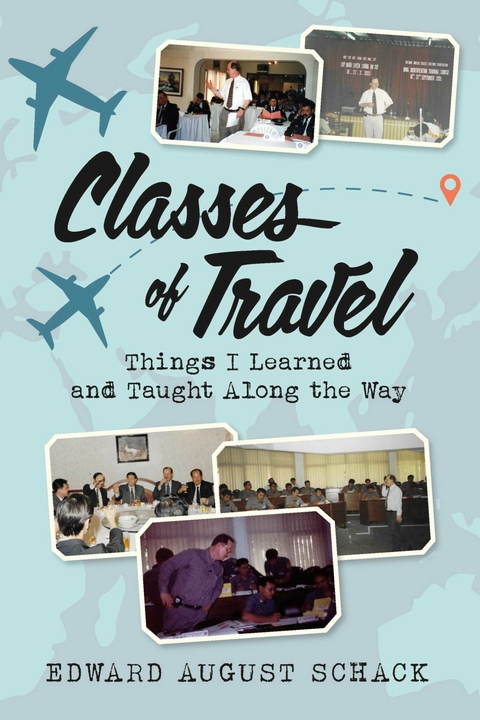
Classes of Travel (eBook)
492 Seiten
Bookbaby (Verlag)
979-8-3509-3372-7 (ISBN)
The memoir begins with Schack in semi-retirement working as a receptionist at the U.S. Department of State controlling access to the department headquarters during which he interacts with foreign diplomats and people of note. Schack then takes the reader back to his beginnings in the Detroit, Michigan area where he struggles in school but finds escape in theatrical and musical performances and early experimentation with recreational drugs. He is one of the last of the pre-lottery inductees into the Army and after training is assigned as a chaplain's assistant stateside during the height of the war in Vietnam. The G.I. Bill facilitates his undergraduate studies at the university where he excels and receives appointments as a graduate assistant and teaching fellow. Degrees in hand, the author is deployed with the Peace Corps to Thailand where he spends a year teaching English at a secondary school in Chiang Rai and then a second year training teachers in the four predominantly Muslim provinces in the far south of the country. After leisurely travel home through Burma, Nepal, India, Rome and London, the author moves to Washington State to teach English to newly arrived Indochinese refugees and to work for the state government. He next takes a job teaching English and basic electronics to Saudi military personnel at a military base in Taif, Saudi Arabia. The author accepts an offer of a graduate assistantship and fellowships to study International Affairs at Ohio University and The University of Michigan during which time he meets his future wife. He moves to Washington, DC to live with her and takes a job as Santa Claus at a downtown department store where he has some humorous experiences described in the memoir. He follows this mythical gig with a job as an English as a Second Language Department head and teacher at a business college while applying for federal government positions. He is hired as a Customs Inspector in San Francisco where he eventually becomes a member of the contraband enforcement team where his great success in interdicting drug smugglers led to his assignment as an international training team leader training border law enforcement personnel all around the world. His memoir describes in detail his work and other adventures in far flung parts of the world. He followed those years with some time working on bilateral issues with the governments of Mexico and Canada before leaving Customs to join his wife on her foreign service officer assignment in Thailand. The author describes his family's time there where he also starts his work with the State Department. He returns to counternarcotics work overseeing law enforcement foreign assistance to the Former Soviet Union and then is assigned to the embassy in Armenia to manage law enforcement assistance in Armenia, Georgia and Azerbaijan. This is followed by a frustrating assignment working on development of the National Police in war-torn Afghanistan. The author returns to the U.S. and to Customs under the Department of Homeland Security to develop training before transitioning back to the State Department for work at the embassy in Croatia. The memoir describes his life there and a few years later when he returns to the Balkans. The author completed his government career as an inspector for the State Department Inspector General.
As I begin this, I spend three days a week as a receptionist at the U.S. Department of State greeting visitors and providing badges to allow them access to the building. I see and sometimes chat a bit with famous or infamous people, mostly from past or present government administrations. Of late, it seems the ghosts of President Reagan have been hovering with his Secretary of Education William Bennett in for lunch with Secretary of State Pompeo one day, and Bennett’s Undersecretary Gary Bauer, another ultra-conservative who ran for President in 2000, another day. I chatted with Bauer a bit and asked his opinion of the Secretary of Education and Bauer’s friend, Betsy DeVos, and he said she is a lightning rod. I watched the Saudi Foreign Minister as he was interviewed after a ministerial meeting on ISIS. When I was checking in an activist, Rania Kisar, Christine Legarde, then Head of the International Monetary Fund (shortly thereafter President of the European Central Bank), appeared and the activist ran toward her, saying she knew her; fortunately, she did. This was the same day that Callista Gingrich appeared in the lobby, and my elderly colleague said she hated her because she slept with a married man (whom she later married: Newt). A fellow named Abramowitz appeared before me, so I asked if he was related to the Ambassador Abramowitz I met as a Peace Corps Volunteer in Thailand, and he said Mort is his uncle. On June 5, Neil Bush, the brother and son of presidents, came up to the C Street reception desk with Louis Freeh, the Director of the FBI during the eight years of the Clinton presidency. We had trouble finding their contacts in the building, so I chatted at length with both of them. They asked about my career and thanked me for my service. Bush reached over the counter to shake my hand. Freeh told me about his early days as an FBI Agent in New York before becoming a prosecutor and judge. Earlier that day the son of Ambassador Charles Twining appeared, and I told him how much I appreciated his father from my time with him in Cambodia.
Before my time on this receptionist perch and before my time at all, there were those from whom I descended.
My mother’s father, Albert Carl Skarjune, was born in Detroit in 1895, and died of cancer at the Allen Park, Michigan Veterans Hospital in 1939 at the age of 44 when my mother was just 10 years old. My grandfather received an honorable discharge from the Army after serving only from October 4, 1918 until January 1, 1919 and this apparently made him eligible for veterans’ medical benefits. Albert’s father was Fred Skarjune, who was born in Germany in 1863 and his mother was Anna Sepull, who was born in Prussia in 1855.
Albert’s brother, Frederick Adolph Skarjune, was born in Essen, Germany in 1882, so the family must have emigrated to Detroit between then and when Albert was born. Frederick Adolph had 14 children with two wives. One of Frederick Adolph’s children, Otto, is notable or perhaps ignoble for his military service. He was a U.S. Army infantry private who shipped from New York to Tientsin, China in 1929. Sixty-four years later I would be just about 300 miles southeast from there in Qingdao, also on the Yellow Sea, on the second of my five trips to China. He must have been a member of the Tientsin Garrison, the only U.S. Army forces stationed on foreign soil from 1912 to 1938. He then shipped from Ft. McDowell California to the Philippines in 1930 and was apparently among the troops sent from there to Shanghai in 1932. He was a military prisoner shipped from Chinwangtao, China to San Francisco in 1932. Otto might have been involved in the Shanghai Incident, a conflict between China and the Emperor of Japan that occurred from January 28 to March 3, 1932, during which he must have misbehaved to become a prisoner. His ship left Chinwangtao on March 10, 1932.
My mother’s mother was born Margarete Branstetter in Austria in 1891. Margarete’s father was Frank Branstetter and her mother was Anna Stelman. If Anna Stelman was Jewish, I could claim to be Jewish as a matrilineal descendent.
My mother, Dorothy Margaret Skarjune, had four brothers, one of whom, Edward Skarjune, was killed as a U.S. Marine on Guadalcanal in 1942 at the age of 19, and two sisters. Dorothy was born in 1928. She was in sightsaving classes for the years of her schooling. At that time it was thought that those with poor vision needed to be treated differently to preserve their remaining sight. I think she only completed somewhere between fifth and eighth grade. In addition to raising four sons, Dorothy had some low-paying jobs including working for a candy company filling boxes of chocolates. Her last jobs were as a security guard for her next-door neighbor, retired Wayne County Sheriff Don Megge’s security company. Dorothy and some other late-middle-aged friends of hers manned the doors at Cobo Hall in Detroit for various shows, and she was proud that she was able to keep vendors and Teamsters from entering at the wrong place. She crocheted large, colorful afghans and throw rugs and painted kitschy ceramics including porcelain dolls. She was always paranoid of people she didn’t know coming to the door of our house, and would have all of us kids hide away from the windows instead of answering the knock or bell.
My father’s father, August Schack, was born in 1884 and arrived in Baltimore from Bremen, Germany in 1902. August’s World War I registration of September 12, 1918 says on the line “if not a citizen of the U.S. of what nation are you a citizen or subject”, Suwalke, Russia was written. August became a naturalized U.S. citizen in 1938. The 1940 census says that August completed sixth grade of elementary school. August’s registration for the draft in World War II lists his birthplace as Poland. His father’s name was Andrew and his mother was Mary Berger. August was a self-employed metalworker who designed and built railings and fences and reputedly ran a speakeasy in his basement during Prohibition.
August’s brother, Matthew Schack, was born in 1873 and died in 1919 from a fractured skull “due to fall from scaffold.” Matthew worked as a laborer at Great Lakes Engineering Company. Matthew was the father of four children, one of whom, Edward, was the minister at Mount Hope Lutheran Church where he baptized me and conducted the marriages of my parents and members of my extended family. Edward had begun his ministerial work as a missionary in Saskatchewan, Canada. August also had three sisters.
My father’s mother was Anna Brandt. She was born in Poland in 1888, and died in 1926 when she was run over by a car when my father was three years old. Anna’s parents were Ferdinand Brandt and Marianne (Mary) Neubacher/Brandt. Mary’s father (my great-great grandfather) was August Juan Christian Neubacher, who was born in 1828 in Kaliningrad, Russia. Mary’s mother (my great great grandmother) was Christine/Krystina Balbach Neubacher, who was born in 1835 in Szillenen (Szillen/Schillen), East Prussia.
My father had two brothers. The first, Edward, was born in 1909 and died of diphtheria in 1912, eleven years before my father was born. My father had four sisters, three of whom married during the Great Depression.
My father was born in 1923. He graduated from Western High School in Detroit and reported to the military immediately after. He served in the Army in the infantry during World War II in France at, I think, St. Lo at perhaps the Battle of the Hedgerows (he once told me a story of shooting from behind bushes at the enemy behind other bushes), which occurred from July 7 to 19, 1944. My father’s battles and campaigns listed were Northern France, Normandy and Rhineland. He was a member of Company G of the 134th Infantry Regiment. He earned two purple hearts for war injuries, and other medals. He was wounded on September 10, 1944, in Nancy, France, during the Battle of Nancy which ran from September 5 to 15, 1944 and liberated the city from the Nazis; and on December 31, 1944 in Belgium. He reached the rank of Private First Class. His Army report of separation shows that he entered the Army on January 28, 1943 and got out on October 11, 1945 (24 years and 2 days before I reported to the Army) at Camp Polk, Louisiana. Ted’s civilian occupation was listed as “ornamental iron worker apprentice.” Ted first worked with his father’s welding business. His employment was inconsistent in the 1950s with lack of tenure and layoffs. To keep the family fed between regular jobs, Ted unloaded trucks across the street from our house on Beard, for which he had to join the Teamsters Union. His brother-in-law Billy Ewing finally got my father employed by the Chevrolet Spring and Bumper plant in Livonia, Michigan, where he stayed for 30 years. He became a tool and die maker there. My father was a religious man and he read the church – provided “Portals of Prayer” which was a Bible reading and prayer for the day.
My parents married in 1946 when my mother was about 17 years and 4 months old, and my father two months shy of 23.
I came along in 1950, and I would go from there to a life working in 36 countries, visiting an additional 22 countries, and working in 20 U.S. states, the District of Columbia and Puerto Rico and still counting.
The 1950 census shows that I was living in my grandfather August Schack’s house at 7035 Whittaker in Detroit, with my father, who was working as an assembler at an auto factory; my mother who wasn’t working; my brother Randy; and my father’s...
| Erscheint lt. Verlag | 7.2.2024 |
|---|---|
| Sprache | englisch |
| Themenwelt | Literatur ► Biografien / Erfahrungsberichte |
| ISBN-13 | 979-8-3509-3372-7 / 9798350933727 |
| Informationen gemäß Produktsicherheitsverordnung (GPSR) | |
| Haben Sie eine Frage zum Produkt? |
 EPUB (Ohne DRM)
Größe: 12,2 MB
Digital Rights Management: ohne DRM
Dieses eBook enthält kein DRM oder Kopierschutz. Eine Weitergabe an Dritte ist jedoch rechtlich nicht zulässig, weil Sie beim Kauf nur die Rechte an der persönlichen Nutzung erwerben.
Dateiformat: EPUB (Electronic Publication)
EPUB ist ein offener Standard für eBooks und eignet sich besonders zur Darstellung von Belletristik und Sachbüchern. Der Fließtext wird dynamisch an die Display- und Schriftgröße angepasst. Auch für mobile Lesegeräte ist EPUB daher gut geeignet.
Systemvoraussetzungen:
PC/Mac: Mit einem PC oder Mac können Sie dieses eBook lesen. Sie benötigen dafür die kostenlose Software Adobe Digital Editions.
eReader: Dieses eBook kann mit (fast) allen eBook-Readern gelesen werden. Mit dem amazon-Kindle ist es aber nicht kompatibel.
Smartphone/Tablet: Egal ob Apple oder Android, dieses eBook können Sie lesen. Sie benötigen dafür eine kostenlose App.
Geräteliste und zusätzliche Hinweise
Buying eBooks from abroad
For tax law reasons we can sell eBooks just within Germany and Switzerland. Regrettably we cannot fulfill eBook-orders from other countries.
aus dem Bereich


