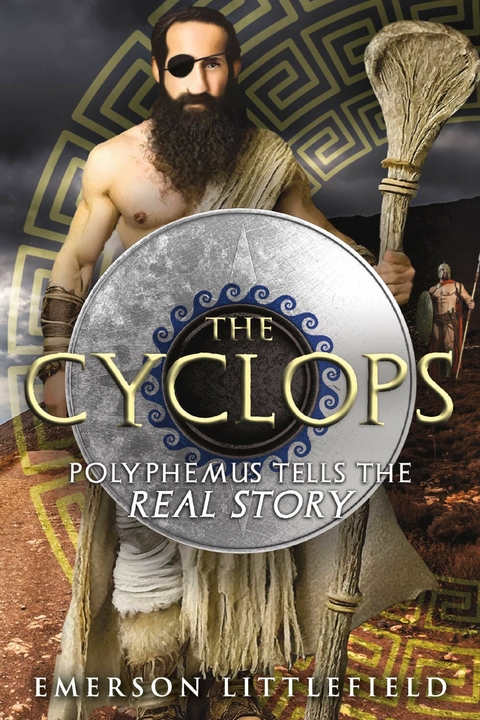
Cyclops (eBook)
240 Seiten
Bookbaby (Verlag)
979-8-3509-3476-2 (ISBN)
The "e;Cyclops"e; of Greek myth tells the story of his life, including his famous encounter with Odysseus. He is a man, not the monster of myth, although he is extremely large, very powerful, and has but one good eye. He tells the story of his troubled childhood; his friendship with his little sister, Anastasia; his love for his mother, Thoosa; and his fraught pursuit of the beautiful island shepherdess, Galatea. It is a story of loneliness, banishment, suffering, love, and triumph. You will love Galatea's down-to-earth character and Anastasia's boundless energy and endless tricks. Just as he is not the monster of myth, neither is Odysseus the great hero. In fact, Odysseus is a piratical raider who plunders cities like the city of the Cicones. He comes to Polyphemus's island not because he is blown off course by unfavorable winds, but because he wishes to steal food and wine for himself and his crew. Although the encounter with Odysseus takes only two days of his life, Polyphemus's take on that encounter is very different from the Homeric version and makes fascinating reading.
II
My Birth
and
Background
My name means “many songs.” I was born with a vocal range even broader than I am tall. My mother says that from the time I was squeezed out of her womb, I was squalling like nothing she had ever heard. Later in my lonely youth, I kept this vocal ability, and I sang to myself, often because I had no other company. Oh, I could sing! I still do.
According to legend, I am the son of Poseidon by the nymph Thoosa. I laugh at this when I hear it. It gives me a certain nobility, I grant, but I am no more the son of a god than you are. My mother really is named Thoosa, but she is no nymph. She was an island girl here in Thrinacia.2 Just an island girl, and very fair in her youth, a raven-haired and dark-eyed beauty. A shepherdess, like most girls on this island. She’d tend her father’s sheep on the rugged hillsides during the day and spin the wool into thread at night. And when she had acquired the skill, she would weave the threads into clothes—shirts and cloaks for men and women. Women wove linen, too, but the linen was imported by trade from Egypt. We did not grow flaxseed here in Thrinacia.
My father appeared one day on a ship from Achaea. The Achaeans, like the Kena’ani,3 who came both before and after them, were always raiding along the coastlines of the Mediterranean. They traded, too, and founded towns and cities, but when they wanted to be, they were not traders but pirates. You think of them as the founders of civilization? So they are, though no more so than the Egyptians, who are far more ancient. The Achaeans built the best ships and were the best sailors, so they sailed about various parts of the Mediterranean, sometimes trading, sometimes on honest business, but just as often plundering. My father was the captain of one of those ships, a great sailing craft with twenty oars and a tall mast on which to raise a sail.
Like most raiders, he was ruthless. They landed to plunder our little coastal village about nine months before I was born. That was all. There was no trading, no bartering—just pitiless raiding. They didn’t care for what they did. They killed the men and took the boys and girls into captivity. When they took boys into captivity, they either sodomized them or castrated them right there on their ship’s deck, or both. Then they sold them to the Egyptians as eunuchs. The women they inevitably stole away into bondage, either to be used mercilessly at sea and disposed of there, or else sold at the courts of Mycenae or Knossos or Ilium. There, they would be used severely and age quickly.
It is said, I have heard, that my father was a very big man—six and a half feet.4 A rarity in my day—a man so large. But he had managed his size and strength during an adventurous youth very well, and in his seafaring life, he had risen through the ranks from oarsman to mate and finally to commander of his own vessel. It isn’t spoken of often, but I learned through piecing together bits of various tales that he got his command through a mutiny.
I believe he rose up against his captain after a failed raid on a well-defended Egyptian town and slew him in a fight. The crew were too frightened to take up their own arms against him; he was so large and fierce. So in a moment of furious glory, he took command of the ship on which he sailed, whose name I do not know, and he decided that trading in oil and wine was not lucrative enough. The most prized commodity in the world in those days was not oil or wine, nor salt, nor gold or precious gems. It was slaves.
When he came to our island, we were woefully unprepared, so I was told. We were then a humble village, though we have grown since then and now boast an actual fortification—a wall around the town. We grow grapes in the hard soil—Inzolias, Grecanicos, you would call them. We grow olive trees that dig their roots down into the rocks. The only grain we had in those days was barley.5 We would go fishing in the nearby sea, as we still do. And we herd sheep and goats. The sheep and goats supply us with milk, with which we make an excellent island cheese. With the barley, we make either bread or porridge or beer. The grapes become wine, our island staple. It is a simple life, and we work very hard at it, but it is good.
As an island girl, my mother worked very hard. She shepherded her father’s flocks over the neighboring parts of the western side of the island. Her father was not Phorcys, as the stories tell—a primitive sea god. He was a fisherman, a shepherd and a farmer—all three! For most of the year, he tilled his rocky patch of soil and grew barley. He had a small vineyard from which they made their own wine. Thoosa went prancing like a sheep herself amongst the rocks and hills, napping under the olive trees, drinking from the flask of wine she took with her to quench her thirst and help her swallow her hard barley cake and goat cheese. It was a hard life, but as she tells it, she was happy.
When she grew older, sixteen or seventeen years, she turned from a skinny, gawky, dark-eyed girl into a ravishing beauty. With some girls, it is this way. What had been the plain and somewhat mismatched features in the gawky ten – or twelve-year-old suddenly merged into a balanced and fabulous symmetry. The dark, rustic brows of the little girl now shaded large, dark brown eyes. Her hair, always wild, curled around her face in glorious abandon. Her olive complexion became smooth and flawless. Her many years of hard exercise amongst the hills following the flock gave her strength and a comely shape.
Unfortunately, it was not just the shy island boys of our village who noticed. The Greek pirate noticed, too. Had the raid happened when she was out in the hills above the village with our flock, he would never have seen her—and I would never have been born. But this is not as it happened. She was at home. It was very early. She had just arisen to begin her day’s work. The pirates came, just the one ship, landing before dawn when everyone was just awakening or was sitting around their hearth fires in the morning chill, preparing to set out on the day’s work. There were only, I think, twenty-two of them—not an army. Hardly a raiding party! But they were hardened men, used to battle and the hard ways of the sea. And they had swords and spears. Some had shields and even armor.
I think the origin of the story that my father was Poseidon arose because the gigantic man landed and waded ashore out of the shallow sea wearing full bronze armor—a breastplate, greaves, a fine round shield, or a hopla, embossed with bronze inlay and painted in a brilliant red with blue swirls meant to imitate waves. He had on a helmet that must have been specially made because no ordinary man’s helmet would have fit a man of his leviathan stature. And he kept his armor gleaming with its golden sheen. In fact, its color was not easily distinguishable from gold from a distance, though bronze tarnishes with green verdigris when not constantly polished, whereas gold, of course, does not.
How, you might ask, can twenty-two desperate seafarers overcome a whole village by themselves? The answer is simple: surprise and better weapons. There were a few bronze implements in our village, but not very many. Many of our farmers still harvested their barley with wooden scythes that used sharp flakes of flint inlaid along the blade as a cutting edge. Literally, in some points, we were still living in the Stone Age! Plus, we were not really fighters. Had we been prepared, we might have fended them off, even if it was with slings and clubs and wooden pitchforks. But we were not prepared. They struck like lightning. A few boys out by the beach in that early hour saw them coming and ran into the village ahead of them, crying in alarm, “Poseidon is coming!” then headed for the hills so as not to be taken. My grandfather was not fast enough. He grabbed a wooden stave he kept by the hearth to accompany him into the hills for fending off wolves and killing snakes, but the big man fended off a couple of blows from the staff and cut him in two with his heavy bronze sword.
My maternal grandfather! One of the elders of the village. A man of substance and wisdom I could have known had he lived.
And the pirate captain? Poseidon indeed!
Then, I’m sad to say, he saw my mother, just a young girl of seventeen years, cowering behind a stone and mud wall under a leather awning, the place where they stored their wooden wine press, made partly with canes from the vines themselves. Needless to say, he wasn’t the least bit dissuaded by her cries for mercy but forced himself on her ruthlessly and brutally right there in their house. The only fortunate thing for her was that he wanted her just for himself; she was so beautiful, so he wouldn’t let any of the other sailors touch her.
Thus, she was taken. I was conceived during that first rape. The ship set sail only hours after the pirates landed. Half the men in our village were dead, houses burned, the older women were dead, too, and about twenty girls and young boys from the village were tied and roped together and taken on board, saving only those awake and fleet enough to run into the hills.
The fact that the monstrous captain wanted to take Thoosa on the deck of his ship again after he’d already had her in her house, just to show his crew what a man he was, oddly saved her life. She was unbound, and he tried to force himself on her again, such were his...
| Erscheint lt. Verlag | 23.1.2024 |
|---|---|
| Sprache | englisch |
| Themenwelt | Literatur ► Historische Romane |
| ISBN-13 | 979-8-3509-3476-2 / 9798350934762 |
| Informationen gemäß Produktsicherheitsverordnung (GPSR) | |
| Haben Sie eine Frage zum Produkt? |
 EPUB (Ohne DRM)
Größe: 842 KB
Digital Rights Management: ohne DRM
Dieses eBook enthält kein DRM oder Kopierschutz. Eine Weitergabe an Dritte ist jedoch rechtlich nicht zulässig, weil Sie beim Kauf nur die Rechte an der persönlichen Nutzung erwerben.
Dateiformat: EPUB (Electronic Publication)
EPUB ist ein offener Standard für eBooks und eignet sich besonders zur Darstellung von Belletristik und Sachbüchern. Der Fließtext wird dynamisch an die Display- und Schriftgröße angepasst. Auch für mobile Lesegeräte ist EPUB daher gut geeignet.
Systemvoraussetzungen:
PC/Mac: Mit einem PC oder Mac können Sie dieses eBook lesen. Sie benötigen dafür die kostenlose Software Adobe Digital Editions.
eReader: Dieses eBook kann mit (fast) allen eBook-Readern gelesen werden. Mit dem amazon-Kindle ist es aber nicht kompatibel.
Smartphone/Tablet: Egal ob Apple oder Android, dieses eBook können Sie lesen. Sie benötigen dafür eine kostenlose App.
Geräteliste und zusätzliche Hinweise
Buying eBooks from abroad
For tax law reasons we can sell eBooks just within Germany and Switzerland. Regrettably we cannot fulfill eBook-orders from other countries.
aus dem Bereich