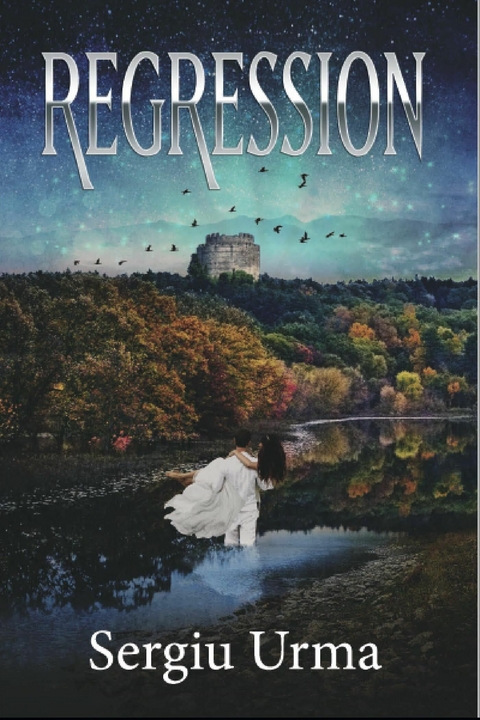
Regression (eBook)
160 Seiten
Bookbaby (Verlag)
979-8-3509-3660-5 (ISBN)
Sergiu Urma was born in Romania, where he earned an MA in English Literature. After a two-year stint as a reporter for the state-run Radio Bucharest, he joined the Associated Press as a correspondent. Forced to leave the country by Romania's communist authorities, he worked in Vienna, Austria, as an AP reporter covering Eastern Europe and the anticommunist revolutions occurring there. After arriving in the United States in 1990, he worked on AP's International Desk in New York as a reporter and business news editor until 2014, when he retired after 40 years with the company. His first book, 'Screwed: Dancing with the Generals,' published by Amazon in 2015, is a memoir that takes the reader inside Ceausescu's Romania and sheds light on Urma's time as an AP reporter there, highlighting just how dangerous the political climate was during this ill-fated chapter of modern history. His two-act play 'Chessgame' is an ingenious parable of a mechanical, on-command murder. As it progresses in the epic and historical matter, it becomes a violent indictment of totalitarianisms of any kind through grotesque, stylized, and shocking formulas. The author can be reached by email at viorelurma@yahoo.com
Chapter 2
“Pride in taking on difficult challenges was shown. Your greatest fear was rejection. It devastated you, especially in romance. There was a fast pace when falling in love.” (Past Lives Report)
Striking up a conversation with Sofia on Facebook went more smoothly than I thought. I asked her approval to become “friends,” I pressed “add friend” and almost instantly I got the confirmation “friend request sent.” Zuckerberg, the youngish-looking lad with the lubricious face of a foxy army recruiter, did such an ingenious and lucrative job (a personal accomplishment for which many curse and revile him out of envy) that it would be a shame not to get into touch with those wishing to exchange opinions and judgments on one of the most widely used social platforms. Only that you must be careful to associate yourself with smart, honest, and informed people and avoid the countless obnoxious characters populating the network service.
The next day I saw that Sofia approved my request to join her circle of virtual friends. (She: “Thank you for your request,” Me: “Thank you for your accept,” and that was it.) According to my plan, I started to click “like” on all her thought-provoking posts, which like many educated people in Moldova dealt with books that she read, books which should be read, books that will be read, books that she liked, books that are so-so, books that you shouldn’t waste your time with, books that … And when she didn’t talk about books and her reading experiences, she talked about movies, paintings, and homemade clothes. I was astonished to see that schooled Moldovan readers, who have a Facebook account, followed the same recipe: books, photos, movies, foods and music. I consulted a statistic of the most devoted readers in that country and I saw that many of them are members of Goodreads, the world's largest site for readers and book recommendation. My goodness! I admit that I cannot put up with these information-hungry Moldovan women when it comes to fiction books and their campaigns to promote reading, so I thought this would be a good opportunity to educate myself and fill up the gap. I had never heard of Coetzee, Philp Roth, Vodolazkin, Fernando Pessoa, José Saramago, Murakami – and the list is even longer. I’d heard of Kafka and Proust though I never read anything authored by them. I was more familiar with Orwell and I am proud to say that Animal Farm and Nineteen Eighty-four stand on a bookshelf at home. Same with Faulkner and Hemingway, not to mention my fellow national Kazantzakis, whom I read from cover to cover. Had I told Sofia about my gaps in literature, I am afraid she would have stopped paying any attention to me.
To appear more interesting in her eyes, I asked what book by Coetzee she’d recommend and she said that Disgrace would be a good one to start with. She was certain that I would like it. Why she said that, I had no idea. And I did like it, because of the symbolism and the fluidity of his style, though I find Coetzee too willfully ambiguous, leaving the reader alone to think whatever he wants. What I didn’t like was Lucy’s resignation and her stubbornness to not report to the police the house burglary and rape she suffered. That is something very un-American, but Coetzee is not an American writer. I’d like to read another book by him so I can better understand his philosophy, but not about politics, apartheid, and the conflict between blacks and whites in South Africa, because I am dispirited with what I see and hear in America every day on this topic.
How many books they read in Moldova! True, it’s a minority of the population, the crème de la crème. Still I bow myself with respect and humility. To not look less competent and fill the knowledge gap, I bought myself several books about the history of Bessarabia, where Romanians have always formed the majority of the population. Before entering a dialogue with Sofia, I tried to explain my situation: a Greek guy married for many years to a Romanian woman. Although I speak Romanian fluently, I can nonetheless make mistakes in writing, for which I apologize. She said she understands it. I began to post details about what seemed more interesting for people outside America: the intolerant cancel culture of withdrawing support for U.S. public figures and companies when they say something considered objectionable or offensive; the red-hot issue of gender identity; the “woke” doctrine on social and racial justice promoted by the left; the resurgence of neo-Marxism which some millennials see as “hip” and even “sexy”; and the gender-neutral pronouns used by people who don’t identify as a man or a woman.
After a while, during which I clicked “like” as often as possible after reading her interesting and consistent posts, I thought it was about time to send her a private message. Only that I was waiting to find a more memorable subject to avoid looking like a moron. And I did find it. One day, I chanced upon several little bags of Cyshku c Makom at a supermarket near where I live, pretzels with poppy seeds from Franzeluţa S.A., a bakery in Chișinău. I could not believe my eyes. Pretzels from Moldova at a U.S. supermarket run by a South Korean food chain. I found out that for 2.25 dollars a small bag, the pretzels were a bit too hard to chew, but they tasted good especially if you dipped them in a glass of wine. I don’t think that most Americans will try them as there is such a wide variety of pretzels on the market. The problem is that they cannot read and pronounce what’s written on the bag, Cyshku c Makom, which is Russian spelled in the Latin alphabet, tying the tongue of Americans who speak only English. Yet, those who came from other cultures, like me, are more open to foreign languages and culinary experiences.
Sofia asked me if one can buy Moldovan wine in the United States, as the wine-producing East European country boasts one of the largest cellars in the world, carved underground in limestone mines and extending for one hundred miles, and housing roughly 1.2 million bottles. I answered that there are several good wines priced at about 8-12 dollars a bottle, better than the French wines in the same price range. The best that one can try is Negru de Purcari, a dry, red wine which can set you back as much as 40 dollars a bottle. Too bad that Sofia can buy only seven bottles on her monthly salary of a school teacher. I bet that in Moldova this wine costs a lot less, since the best vintage goes for export and few people can afford its Western price. Some Moldovans call it the "Queen of England’s wine," because Queen Elizabeth II was said to regularly order the 1990 vintage. Now it was my turn to savor it as a mere mortal.
After that I asked her to let me know if she wants to read a particular title that she cannot find in Moldova or in neighboring Romania. In America you can find whatever books you want, though we are doing less great when it comes to the number of books we read, much under what bibliophiles in Moldova usually do. Americans don’t spend too much time opening tomes, we’re more interested in opening bank accounts. Men don’t read more than four books annually on average, the most avid readers being the educated American women with fifteen books a year. I also told her about the Hollywood great movies that were made, and are not made any longer, due to the cultural shifts and the political correct times we live in. Bye-bye John Wayne and Clint Eastwood, accused of racism and sexism by some. Now they make lots of movies featuring dinosaurs, dragons, avatars, and the immortal Godzilla, or epic outer space battles, flying creatures and aliens from other galaxies which attack and destroy America’s big cities.
In her turn, Sofia asked me if I like Tarkovsky (who the heck was he?). She caught me on the wrong foot with her question since I didn’t know if Tarkovsky was a writer or a movie actor, and, honestly, I had no idea who Tarkovsky was. (He was an influential Russian filmmaker and writer, I later learned.) I thought that this would be the end of the story for me due to my serious lapses in education. But I was wrong.
This was our first contact. More exactly, this was the beginning of our online dialogue. Following the same thread of conversation, Sofia told me one day that she started reading at the age of five, so that when she began school she already had finished several storybooks she found in her parents’ home. I felt obliged to tell her that I also started with fairy tales: I was so fond of the Greek mythology (of course!), a bulky book full of illustrations that stole my mind when I was looking at the pictures of semi-naked goddesses and their sublime statues. The problem was that I had to read many pages to understand the context, but that was fine. I was motivated to learn all the details. So if you start with popular fairy tales, or you feel attracted to the goddesses from the Greek mythology, completely naked like Aphrodite, the goddess or sexual love and beauty, or only partially clad, like Thalia, Calliope or Terpsichore, the goddess of dance, it does not matter. It’s important to get motivated to read, to discover and be informed.
Iulia, my wife, was a passionate reader as a child too. Her...
| Erscheint lt. Verlag | 25.12.2023 |
|---|---|
| Sprache | englisch |
| Themenwelt | Literatur ► Romane / Erzählungen |
| ISBN-13 | 979-8-3509-3660-5 / 9798350936605 |
| Informationen gemäß Produktsicherheitsverordnung (GPSR) | |
| Haben Sie eine Frage zum Produkt? |
 EPUB (Ohne DRM)
Größe: 662 KB
Digital Rights Management: ohne DRM
Dieses eBook enthält kein DRM oder Kopierschutz. Eine Weitergabe an Dritte ist jedoch rechtlich nicht zulässig, weil Sie beim Kauf nur die Rechte an der persönlichen Nutzung erwerben.
Dateiformat: EPUB (Electronic Publication)
EPUB ist ein offener Standard für eBooks und eignet sich besonders zur Darstellung von Belletristik und Sachbüchern. Der Fließtext wird dynamisch an die Display- und Schriftgröße angepasst. Auch für mobile Lesegeräte ist EPUB daher gut geeignet.
Systemvoraussetzungen:
PC/Mac: Mit einem PC oder Mac können Sie dieses eBook lesen. Sie benötigen dafür die kostenlose Software Adobe Digital Editions.
eReader: Dieses eBook kann mit (fast) allen eBook-Readern gelesen werden. Mit dem amazon-Kindle ist es aber nicht kompatibel.
Smartphone/Tablet: Egal ob Apple oder Android, dieses eBook können Sie lesen. Sie benötigen dafür eine kostenlose App.
Geräteliste und zusätzliche Hinweise
Buying eBooks from abroad
For tax law reasons we can sell eBooks just within Germany and Switzerland. Regrettably we cannot fulfill eBook-orders from other countries.
aus dem Bereich