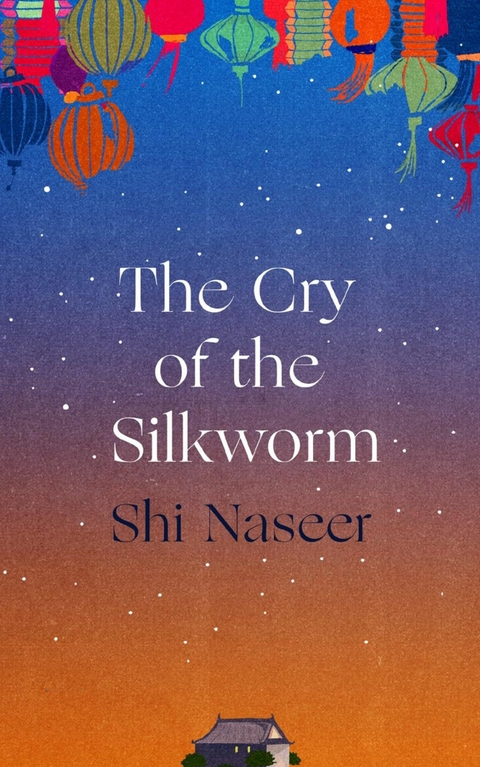
Cry of the Silkworm (eBook)
416 Seiten
Allen & Unwin (Verlag)
978-1-83895-968-5 (ISBN)
Shi Naseer grew up in China under the one-child policy before immigrating to Australia as a teenager and subsequently earning a master's in mathematics from Cambridge University and PhD in black-hole physics from Harvard University. She currently divides her time between Connecticut and Pakistan, and lives with her husband and son.
1994, rural China: Twelve-year-old Chen Di loves and protects her long-awaited little brother, but when she witnesses an unforgettable scene with her aunties and the authorities, everything she thought she knew about her community is ripped away from her. 2002, Shanghai: A gutsy young aikido-practising Chen Di is utterly transformed from her naive younger self. Now hardened by experience, her determination to avenge her mother's killer is stronger than ever - and she has steeled herself against affection of any kind. Alone in the big city, and with the unwanted attentions of a cocky, wise-cracking teenage boy and a martial arts teacher intent on peace over violence, her toughness starts being chipped away - planting a seed of doubt about going through with her plan for revenge. Spanning a decade at the turn of the twenty-first century, The Cry of the Silkworm is an emotional and thought-provoking tale of one young woman's coming of age - and a stark look at the impact of China's one-child policy, from a strikingly fresh new voice.
Shi Naseer grew up in China under the one-child policy before immigrating to Australia as a teenager and subsequently earning a master's in mathematics from Cambridge University and PhD in black-hole physics from Harvard University. She currently divides her time between Connecticut and Pakistan, and lives with her husband and son.
1
Shanghai
Winter 2002
Chen Di came to Shanghai to kill.
She hid behind a plane tree on the bustling pavement and fixed her gaze across the road on the sign: Shanghai Family Planning Commission.
She raised her arm to check and recheck her green watch and pulled up her green jacket’s hood to hide her face. Any minute now, he could stride through the gate into the government building. It had ten storeys but was still more wide than tall, its glass walls allowing officials to see out but no one to see in. On a pole at the front fluttered a national flag as red as the jeep that had abducted Chen Di’s beloved mother, her eight-month pregnant body folded away like a quilt. Hours later, they’d brought her back, limp, lifeless, her belly still bulging.
Motorcycles whizzed between honking cars. Plumes of exhaust permeated the grey city air at the start of another year. Nothing like Chen Di’s village, nothing like the cotton field she’d left behind at age seventeen – three years ago today. Dusty wind whipped her in the face as parents sped past on bicycles. On each of their back carriers sat a single, precious little one. Cared for. Doted on. Loved. Boy or girl. A sting inside her, she tore her eyes away from the passing children.
Mission first.
Chen Di gripped the handlebars of her tricycle. The attached cart was cluttered with DVDs that she couldn’t care less about selling, each one in a plastic sleeve. All Hollywood, all bootlegs. She focused on the gate, the plane tree’s leafless branches hovering over her, the north wind pricking her bones like wet needles. She rubbed her cold hands together and bent to rearrange the DVDs, assuring passers-by she was out hawking, and hawking only.
Across the road, the silver sliding gate opened just enough for one person to fit, or two if they were as petite as Chen Di. Officials arrived on foot and on bicycles, greeted by a guard. A bald man grinned as he sauntered inside, his mouth open like a puppet.
Which unlucky family would they destroy today?
Her muscles tensed. She had felt the small man approach from the right almost before she saw him. He wore a black overcoat and a knitted hat, and swung his briefcase like he had good news to report. His heart-shaped face was the one cemented in her mind, which had haunted her village like a malevolent spirit. The face of Mother’s murderer.
Chen Di shuddered, a high-pitched chuckle echoing in her head, and she felt tears building. Mother! she almost cried like that morning in the village, alongside the bare field, slapping the window of the red jeep. They had both reached out to the glass, Mother’s wrists tied, their fingertips matching before the vehicle had rumbled away.
Now Chen Di wiped her eyes fiercely as she registered the man’s every movement, every swing of his arms and legs. After all this time in Shanghai, going up mountains of knives, down seas of fires, she had found him!
Finally, she was about to avenge Mother’s death.
She stepped forward from the pavement to the road. A bicycle almost rolled over her foot and she dug her hand in her pocket, her fingers climbing around her Voyager flick-knife. Her only valuable. Made in America, its drop-point steel blade and fiberglass-reinforced nylon handle allowed for hand-to-hand combat and short-range throws. She felt the inscription on the handle, ’98 Lantern Fest. The Lantern Festival of 1998.
The man passed through the gate.
He pulled off his hat, revealing a pair of square ears.
The wrong ears. It wasn’t him.
A sudden emptiness settled inside her, her limbs stiffened. Slowly, Chen Di backed onto the pavement. Her fingers loosened around the Voyager and she pulled out her hand, her palm showing a pink line marked by the spine of the folded blade. She held the tricycle grip to steady herself, then punched the seat. She breathed. In. Out.
Every so often, she dreamed of being in Shanghai for something else, perhaps university. Once or twice, she’d even entertained the thought of getting a degree from America, as Teacher Jia had. She still remembered his Statue of Liberty paperweight. But that would have to wait until her next lifetime. In this one, Mother had died.
‘What are you daydreaming about, girl?’ a shrill voice behind her said in Shanghainese, which Chen Di understood but couldn’t yet speak well.
Chen Di spun around with the finesse of a martial artist. Before her stood a big-boned woman around forty. Putting on a smile, Chen Di replied in Mandarin, ‘What would you like to buy?’ To appear polite and friendly, she added to the stranger, ‘Big sister.’
The woman stared at her, frowning. Everyone did. Chen Di raised her hand to hide the brown birthmark that covered a quarter of her face, from her forehead to her left cheek. Despite being female and twenty, thanks to the birthmark, she was rarely harassed. But she knew she wasn’t ugly. Her large eyes held a rare shade of light brown, and her long brows complemented her jawline. Mother had told her once that her high forehead symbolised fortune.
‘You wouldn’t even know if your DVDs got stolen.’ The woman’s eyes flicked to a tall boy idling under another plane tree. He looked fifteen or sixteen, blatantly skipping school, a cigarette dangling from his lip. He puffed upward, trying to show off, but ended up coughing. His indigo blazer was the uniform of Wende Private Secondary School around the corner.
Little emperor.
‘Whatever you want, I got it,’ Chen Di said.
‘I don’t care for American films, hard to relate.’ The woman clicked her tongue, scanning the cart, just as another woman came along, about Chen Di’s age. The younger one grabbed five DVDs and didn’t even bargain. ‘You be careful now,’ the older woman said. ‘I’m telling you out of the goodness of my heart.’
‘Thank you, big sister.’ Chen Di put away her smile like a bank card after use.
Both women left, and Chen Di couldn’t help but glance at that little emperor again. Even though his back was to her, something about him held her attention. Was it the way he angled his head? How he rubbed the left side of his chin?
He stopped at the eatery diagonally behind her, where a dozen out-of-towners sat at flimsy outdoor tables under the worn awning that read Yuanfen Eatery. The wall menu showed a popular saying on top: yuanfen brings together those thousands of miles apart; without yuanfen we come face to face only to pass each other. Chen Di laughed. As if a shabby eatery could set the stage for fateful encounters.
The boy raised his cigarette at the young waitress. ‘I want a couple fried dough sticks.’
‘Yes, brother.’ The waitress’s accent announced she was from Chen Di’s home province, Sichuan, and she blushed, probably taken by the boy’s good looks. Chen Di wanted to knock some sense into her. ‘One yuan for two.’
‘I said I want some, not to buy some.’
Two customers turned. One rose and tapped the boy’s shoulder. ‘Oi, young man.’
‘Don’t you touch me, xiangwuning!’
Disgust surged through Chen Di and she pushed her tricycle towards the eatery, her eyes fixed on the boy’s back. Too many times she herself had been called a ‘xiangwuning’, a Shanghainese term reserved for the poorest out-of-towners: street sweepers, all kinds of labourers, those running cheap eateries, those eating at cheap eateries, hawkers on tricycles.
‘Young brother, young brother.’ The old owner rushed over, a towel around his neck, the mole above his lip symbolising ample food in life. He nodded at the boy. ‘What’s the problem? You tell me, and I’ll do all I can to serve you.’
A motorcycle zipped into the nearby cycle lane. The boy brushed the dirt off his shoulder, dropped on a plastic stool, and crushed his cigarette on the table. ‘As a Shanghainese, I’m giving you face by wanting your xiangwuning food. And you need me to pay?’
This was getting ridiculous. Spectators gathered, and Chen Di was so close to the boy she could touch his back. As if he could see behind him, he whipped his head around.
She flinched. His eyes, as black as burnt bark, were like her little brother’s. And he looked at her the way her brother had, head tilted as if casting a judgement. These eyes knew her darkest secrets, secrets she’d buried deep and told no one, secrets that had forced her to leave Sichuan, brought her to Shanghai, and made her who she was today.
The world darkened as the boy rubbed his chin again with the back of his fingers. She found it hard to breathe, the past rushing back, engulfing her. In her chest she felt a wet, chilly wind, like the howl of a female ghost.
Little Tiger…
Then her heart softened. It softened so much, so unexpectedly, that she bent down and reached out with an impulse to pull away the boy’s hand as she had her brother’s. All those years ago, Little Tiger had rubbed his chin because of a constant drool rash…
But this boy couldn’t be her brother! He was far too old.
The boy didn’t speak or move, just held her eyes. No, he was studying her face – her birthmark – though not in the way others did. As if in pain, he pressed a finger to his temple. She almost blurted, Are you okay? But he’d...
| Erscheint lt. Verlag | 6.6.2024 |
|---|---|
| Verlagsort | London |
| Sprache | englisch |
| Themenwelt | Literatur ► Romane / Erzählungen |
| Schlagworte | A Thousand Splendid Suns • beekper of aleppo • China • Coming-of-age • Family Saga • Grief • Love • Modern China • One-Child Policy • pachinko • Reading Group Fiction |
| ISBN-10 | 1-83895-968-8 / 1838959688 |
| ISBN-13 | 978-1-83895-968-5 / 9781838959685 |
| Informationen gemäß Produktsicherheitsverordnung (GPSR) | |
| Haben Sie eine Frage zum Produkt? |
 EPUB (Wasserzeichen)
DRM: Digitales Wasserzeichen
Dieses eBook enthält ein digitales Wasserzeichen und ist damit für Sie personalisiert. Bei einer missbräuchlichen Weitergabe des eBooks an Dritte ist eine Rückverfolgung an die Quelle möglich.
Dateiformat: EPUB (Electronic Publication)
EPUB ist ein offener Standard für eBooks und eignet sich besonders zur Darstellung von Belletristik und Sachbüchern. Der Fließtext wird dynamisch an die Display- und Schriftgröße angepasst. Auch für mobile Lesegeräte ist EPUB daher gut geeignet.
Systemvoraussetzungen:
PC/Mac: Mit einem PC oder Mac können Sie dieses eBook lesen. Sie benötigen dafür die kostenlose Software Adobe Digital Editions.
eReader: Dieses eBook kann mit (fast) allen eBook-Readern gelesen werden. Mit dem amazon-Kindle ist es aber nicht kompatibel.
Smartphone/Tablet: Egal ob Apple oder Android, dieses eBook können Sie lesen. Sie benötigen dafür eine kostenlose App.
Geräteliste und zusätzliche Hinweise
Buying eBooks from abroad
For tax law reasons we can sell eBooks just within Germany and Switzerland. Regrettably we cannot fulfill eBook-orders from other countries.
aus dem Bereich