


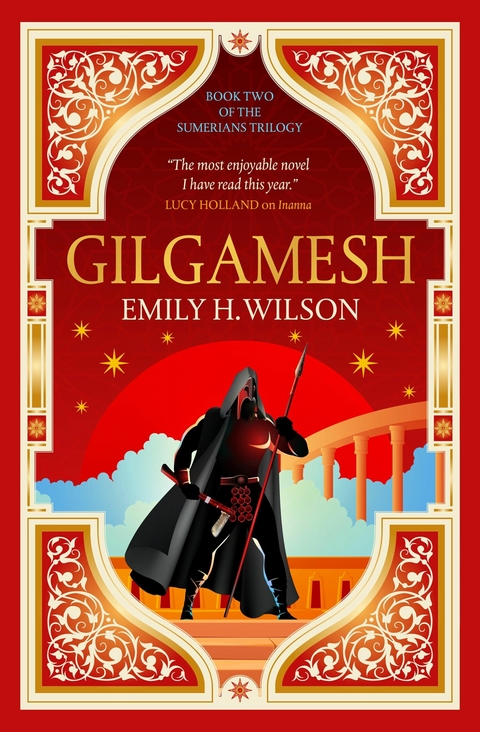
Gilgamesh (eBook)
512 Seiten
TITAN BOOKS (Verlag)
978-1-80336-443-8 (ISBN)
Emily H. Wilson is a full-time writer based in Dorset, in the south of England. Emily was previously a journalist, working as a reporter at the Mirror and Daily Mail, a senior editor at the Guardian and, most recently, as editor-in-chief of New Scientist magazine. You can follow her on X (formerly known as Twitter) @emilyhwilson or on Instagram @emilyhwilson1, and you can find her website at emilyhwilson.com.
PROLOGUE
MARDUK
In Kish, capital city of Akkadia
I was mopping up after an elderly dog when the news swept through the court.
The great Sumerian hero, Gilgamesh, had been captured in battle.
Taken prisoner by King Akka himself, on the banks of the River Tigris, and brought to Kish with his hands and feet bound, slung over the back of a mule.
The Lion of Uruk was here, a prisoner in this very palace!
For some long minutes, I leaned on my mopstick, ears straining for every detail of the hero’s capture. Only when I felt royal eyes falling on me did I return, most reluctantly, to my mopping.
The dog had done its sloppy business on a mosaic of some ancient goddess. In truth, I was doing more to spread the muck over this holy scene than to in any way clean it. But I had no ambition to be good at mopping.
Two blue slippers appeared in the path of my mopstick. The king’s sister, Hedda, stood with her hands on her hips. She was a small creature, lightly made, and handsome in her blue velvet.
“I have a job for you, slave-boy,” she said. “Go find out what you can about the prisoner Gilgamesh. And then come straight back and tell us everything.”
I began to mop with some vigour around her feet. It was my firm policy never to do anything for anyone unless either threatened or bribed. “I must clean up after your dog,” I said.
Hedda stepped back to protect her slippers. “At least find out if he is going to live.” She gave me her most playful smile. “Marduk, I will pay you in figs.”
“Oh, very well,” I said.
* * *
Mopstick in one hand, sloshing bucket in the other, I made my way, circuitously, to the palace kitchens. It was my intention to slip through the bakery and out into the palace gardens, where I was sure to run into friends.
But as I stepped into the gloom of the bread-proving room, Biluda, the king’s ancient steward, loomed up before me in his kingfisher-blue robes.
“Where in all of Akkadia have you been, Marduk? I have sent out three messages for you.”
I held out my filthy mopstick and quarter-filled bucket. “I was clearing up dog mess in the ladies’ quarters, sir. As you ordered me to.”
Biluda dismissed my story with a wave of one crooked hand. “You have heard the news, I presume?”
“I have been working.”
“Of that I am fairly doubtful. However. We have a Sumerian prince here as our prisoner and I would like you to take him some necessaries.”
I set down my bucket. “I did hear he was dying.”
“Not presently,” he said. “Although he is somewhat dented.”
Biluda pointed one long, bony finger at a glass and a large clay jug. “You will take these to the captive.”
I leaned on my mopstick. “Why?”
“Marduk, you are a slave, not a prince of this household. I have told you to take these two things to the captive, so take these two things to the captive.”
“You are a slave, I am a slave. Why not go yourself?”
Biluda smoothed down his long, grey beard, and lowered his voice. “He likes pretty boys, that is what they say. Perhaps he will say something interesting to you if you take him his water.”
“And what sort of interesting thing might he say?”
Biluda clawed out his fingers, as if about to strangle me. “Men forget themselves when someone takes their fancy. You would not know that, being so high-minded.”
“All right, I will take the water,” I said. “I would like to see this great hero of Sumer.”
* * *
I put my head around the door. The Lion of Uruk was lying on his back in a narrow bed, with a sheet pulled up over his hips.
Black hair and a close-cut beard; tortoiseshell eyes. I had not expected him to be so young. He could not have been more than two or three years older than me; twenty perhaps.
His chest was the colour of dark honey; his arms and face a rich, mahogany brown. His throat looked badly bruised and he had a belly wound that ought to have been bandaged.
All the same he looked very powerful and gleaming, against the linen bedding. A lion of a man, indeed.
“My lord, may I check on you?”
“Certainly.” A deep voice; a searing smile. Such very bright eyes.
I made my way into the room, the glass and jug held out before me. It occurred to me then, for the first time, that the Lion of Uruk might be dangerous.
Of course I did not have a weapon, but I could cut his throat with the glass, if I could find a way to smash it first. Or I could hit him with the jug.
“Do you know how I got here?” Gilgamesh said. Again, the dazzling smile.
I paused, glass and jug held out before me. “You passed out entirely, my lord. They had to carry you from your mule.”
I could see, from the way he was holding himself, that he was thinking about getting out of bed. I took two steps backwards. “They thought you would be thirsty, my lord, after having slept so long, and I am to bring you a robe after this, and to tell you that as soon as you are recovered, the king hopes to see you at dinner.”
All the tension seemed to drain out of him.
“What does that mean, at dinner?”
“The king eats with all the court in the evenings, and you will join him there, sir.”
“Does he eat well, King Akka?”
“Yes, my lord. They eat a lot. There is always meat.”
“You can put the jug down,” he said. “I will not hurt you.”
“Very good, my lord.” I put the glass and jug down next to him, and poured him some water, careful to keep one eye on him.
“Where am I?” he said, reaching with a grimace for the glass.
“Kish, my lord.” I glanced back at the door, knowing that Biluda would have his ear pressed to it. “You are in the palace of King Akka, first amongst the Akkadians, and sworn enemy of your people.”
“And do you know where my man is? Harga?”
“He has ridden south, sir, with the news of your capture and the details of the ransom they are asking for you. They told your man to take the tablet to your father.”
“Ah, but of course,” he said. “My father.”
* * *
When I had safely delivered the water to the hero Gilgamesh, I went back out into the corridor. Biluda sprang up from the bench there, one finger to his lips.
“What did he say?” he whispered.
“He was interested in dinner. I told him what to expect. I think he’s hungry.”
“Keep your voice down! And what else?”
I leaned in close to whisper. “He asked after his man Harga.”
“That’s all?”
“Perhaps he finds me less pretty than you do.”
Biluda, looking hugely irritated, handed me a linen robe. “Go back in and give him this. And this time ask him about the war, that kind of thing.”
“I think that would be very odd. He will guess I have been told to do it.”
“And yet you are a slave, and just this once you will do as you are asked, Marduk.”
“I will take him the robe. But I’m not going to ask about the war.”
* * *
Gilgamesh was lying with his eyes shut, as if asleep, as I opened the door. That line in the old temple poem came to me: the sleeping and the dead, how alike they are.
I was about to back out, but he said: “No, come, come.” He turned his head to smile at me. “I am only resting.” He had one hand on his belly.
I put the linen robe down at the foot of his bed. “For you to wear at dinner.”
“What are you?” he said, lifting his chin at me. “A prince? A spy?”
“A slave.”
“Ah! How do they treat their slaves, in Kish?”
“Better than the slave trader who brought me here.”
“There are no good slave traders,” Gilgamesh said. “That’s what my father says. It brutalises your spirit, to buy and sell men like animals.”
“I’ve been told your father is a god. Perhaps he could stop men from selling each other.”
Another flash of the hero’s smile. “The gods are not as powerful as people think. But you are quite right, they should do more.” He patted the bed next to him. “Come, sit down a moment. Where are you from? I’ve never seen anyone so pale before, or with such red hair.”
After a moment’s hesitation, I sat down at the very end of the hero’s bed, careful not to sit on his feet. “Do you know it is rude to ask a slave where he is from?”
Gilgamesh laughed, and then grimaced again, breathing in slowly, one hand stretched out over his belly wound. “I think I have been told that and forgotten it.”
“I remember snow along a shoreline. And perhaps my mother’s face. But I was taken from my family very young.” I lifted my hands and let them fall again. “I’ve been told there are people who look like me in the far north.”
“And who took you from your family?”
“I don’t remember. I have travelled all over the world since then, passed from this person to that. Most recently I was in Egypt.” I pulled up my left sleeve and showed him the tattoo of the lion-headed eagle on my shoulder. “This is the sign of the god they worship in Abydos. Have you heard of Abydos?”
“Only that it’s a holy place.”
“It’s an evil place.”
He lifted his eyebrows at that. “You talk a lot, for a slave.”
“I am not a good slave. I have disappointed all my owners.” I paused a moment. Well, what harm would it do to speak it? “My plan is to...
| Erscheint lt. Verlag | 6.8.2024 |
|---|---|
| Reihe/Serie | Sumerians Trilogy | Sumerians Trilogy |
| Verlagsort | London |
| Sprache | englisch |
| Themenwelt | Literatur ► Fantasy / Science Fiction ► Fantasy |
| Schlagworte | a. c. wise • Ancient Myths • Annunaki • A Thousand Ships • Babylon • Circe • classic stories • Darling • Epic Poetry • Fairytales • Fantasy retelling • fantasy trilogy • Hooked • Lucy Holland • Madeline Miller • Maria Dahvana Headley • Marian Womack • Mesopotamia • Mythology • Neil Gaiman • New Scientist • Norse mythology • Retelling • Sistersong • The Epic of Gilgamesh • The Mere Wife • the song of achilles • The Swimmers • Trilogy • Veronica Roth • Wendy |
| ISBN-10 | 1-80336-443-2 / 1803364432 |
| ISBN-13 | 978-1-80336-443-8 / 9781803364438 |
| Informationen gemäß Produktsicherheitsverordnung (GPSR) | |
| Haben Sie eine Frage zum Produkt? |
 EPUB (Wasserzeichen)
DRM: Digitales Wasserzeichen
Dieses eBook enthält ein digitales Wasserzeichen und ist damit für Sie personalisiert. Bei einer missbräuchlichen Weitergabe des eBooks an Dritte ist eine Rückverfolgung an die Quelle möglich.
Dateiformat: EPUB (Electronic Publication)
EPUB ist ein offener Standard für eBooks und eignet sich besonders zur Darstellung von Belletristik und Sachbüchern. Der Fließtext wird dynamisch an die Display- und Schriftgröße angepasst. Auch für mobile Lesegeräte ist EPUB daher gut geeignet.
Systemvoraussetzungen:
PC/Mac: Mit einem PC oder Mac können Sie dieses eBook lesen. Sie benötigen dafür die kostenlose Software Adobe Digital Editions.
eReader: Dieses eBook kann mit (fast) allen eBook-Readern gelesen werden. Mit dem amazon-Kindle ist es aber nicht kompatibel.
Smartphone/Tablet: Egal ob Apple oder Android, dieses eBook können Sie lesen. Sie benötigen dafür eine kostenlose App.
Geräteliste und zusätzliche Hinweise
Buying eBooks from abroad
For tax law reasons we can sell eBooks just within Germany and Switzerland. Regrettably we cannot fulfill eBook-orders from other countries.
aus dem Bereich


