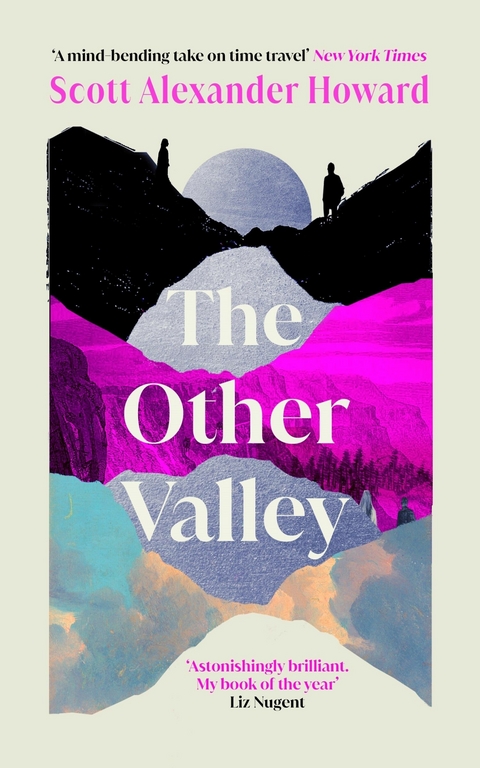
The Other Valley (eBook)
304 Seiten
Atlantic Books (Verlag)
978-1-83895-964-7 (ISBN)
Scott Alexander Howard has a PhD in philosophy from the University of Toronto, where he wrote an award-winning dissertation on literary emotions and the passage of time. His articles have appeared in journals such as Philosophical Quarterly and Analysis. Upon completing a postdoctoral fellowship at Harvard, he decided to pursue fiction. He now lives in Vancouver.
Scott Alexander Howard has a PhD in philosophy from the University of Toronto, where he wrote an award-winning dissertation on literary emotions and the passage of time. His articles have appeared in journals such as Philosophical Quarterly and Analysis. Upon completing a postdoctoral fellowship at Harvard, he decided to pursue fiction. He now lives in Vancouver.
On Monday morning I left my nomination essay on Pichegru’s desk and hurried to my seat before he came in. More students filed to the front to do the same. I soon regretted leaving my paper face-up, because I noticed Henri Swain and Jo Verdier pausing to skim it before putting theirs on top. Henri gave me a smirk on the way to his desk. When Pichegru entered the room he stuck the essays in a drawer.
Lumped into our normal lessons that morning was a short visit from the druggist’s assistant, who was there to answer apprenticeship questions. A few people eagerly raised their hands. It seemed like it would be all right working at the counter and pouring tinctures, but the main druggist was Lucien’s father and one of the available spots was bound to go to him. I tuned out the assistant. As little as the vetting program appealed to me, I had no idea what I would do if Pichegru turned me down. I’d prepared no alternatives because of my mother’s insistence on the Conseil. Her ambition for me was vicarious, I knew. Anything else I might do with my life would fall short of the life she’d wanted for herself.
*
I was standing against the wall, eating my sandwich outside, when a crack went off near my head. Stucco granules sprayed into my collar. I flinched and looked around.
Out on the lawn, Henri and Tom were stifling laughter. A rubber ball, dusted white, landed in the grass.
Sorry about that, Odile—I missed. Henri gave an exaggerated shrug.
I reddened, stepping away from where the ball had left its mark. The shoulder of my navy blazer was speckled with grit. I brushed it off and pulled a fragment out of my hair. There was a sandwich lying on the pavement, and darkly I recognized my lunch. I was deciding whether or not it was salvageable when the ball struck a second time.
You missed again, said Tom, dissolving into giggles.
This time I hadn’t startled as much. I stayed with my back to the wall and took a second small step to the right, but as I did, I felt my mistake. There was something too automatic about the way I’d moved, too much like a clock figurine. Henri’s laughter trailed off and he regarded me oddly. He scooped up the ball.
I shut my eyes to the next shot, winced, and took another side-step.
That’s so funny, Henri remarked.
Sensing an event, other kids started to watch. Each time he threw the ball, I dodged from the waist up, but only shuffled a bit farther down the wall. The laughs around the lawn grew louder. Some of the spectators were younger but some were in my class. I saw Justine Cefai looking disgusted; beside her, Jo wore an incredulous grin. Sitting under a tree at the far edge of the grass, Edme Pira and Alain Rosso were watching too. A teacher squinted from the playing field but didn’t come over.
I’m not sure why I kept stepping along the wall when that was the whole problem. I could have dashed for cover in the backwoods, in fact I longed to run for the trees, but running felt like the greater humiliation. Sickeningly, I began affecting a distant smile as they hooted at me, as though I was in on the joke.
Then Henri let out a curse. I looked up and saw Edme and Alain marching across the lawn toward him. They’d untucked the fronts of their uniform shirts to use as pouches, and the pouches were full of sticks.
Hey, Henri! Edme called in a cheerful voice. He whipped a stick over the grass and hit Henri in the shin. Alain threw another, this time striking his shoulder. Swearing and covering his head, Henri retreated and Tom followed. Edme and Alain chucked their remaining sticks after them, a fusillade that fell well short. They wiped their hands and strolled back to their tree.
I cleaned my uniform in the bathroom and spent the rest of the lunch hour indoors. My blazer and pinafore were damp from the sink, and my head hurt, not from the ball, which never actually hit me, but from clenching my teeth, the afterache of shame.
It was hardly the first time I’d been harassed, and usually the worst of it happened at the start of the school year, before Henri and the others got bored and turned to other games. But my dejection made me realize that I’d been hoping things would have finally changed. Apparently, I was still what I was.
Edme’s desk was ahead of mine in the next row over. That afternoon Pichegru was teaching geology. Slate, schist, gneiss. There was a leather case sitting at Edme’s feet. He played violin in the humble school orchestra. His neck was the color of sand in the shade, and his hair was blacker than shale.
Edme and Alain didn’t talk to me, but they didn’t tease me either. The two of them were a pair, friends since before school began. Alain’s house was a little ways down from mine. He was a ruddy-cheeked loudmouth, red-haired like me, though more orange than my ruby frizz. Years ago, before I went quiet, Clare and I had sometimes played with him in the neighborhood. He’d been eager to throw apples at cars, and I’d been too scared to do it. He seemed the same now as he was then: hyper, irreverent, hard to predict. Alain’s antics earned him the switch from Pichegru more often than most, which was part of why people liked him.
Edme lived past the school. His parents worked at the packing house, crating apples and peaches in the harvest months. In the winter I would see them shoveling snow and salting sidewalks downtown, always together. People never referred to M. and Mme Pira individually; they were, fondly, the Piras. My mother and I sometimes passed them doing their odd jobs, and they invariably said hello.
Their son was soft-spoken and sharp-boned, with a haircut that hung in his face. I didn’t see Edme around the neighborhood much, except for with Alain. Their friendship might have been surprising if it hadn’t always been there. Where Alain was blustering, Edme seemed thoughtful, with slender, dancing eyes. On the other hand, he wasn’t really shy: if Alain did something outrageous, Edme would join in with an abstract smile, like it was the only thing to be done. One morning in our second year, when we were eight or nine, Alain shimmied up a birch tree in front of the school. The tree wasn’t any good for climbing and wobbled from his weight. But he got near the top, pulled out his flute, and began mangling one of the Cherishment hymns that we had to learn in music class. Poised at the base of the tree, Edme raised his violin. Eyes closed, he came in screeching and off-key, which had to be on purpose, since everyone knew how well he could play. I hid a smile and walked to my wall, but I could still hear the dreadfulness echoing, and eventually a teacher yelling at them to stop. They got beaten for it, but not badly, because Pichegru didn’t know quite what to think.
After school I delayed going home to avoid walking near Henri and Tom. I stayed in my desk long enough that Pichegru noticed. He addressed me from the front of the room.
I’ve read your essay. I’m not going to nominate you.
My teacher slid his books into his leather bag. It seemed like all he intended to say.
Why not?
It was effrontery to ask; in the swiftness of my failure I’d forgotten my place. Pichegru looked irritated, as if I shouldn’t need to be told.
I asked you a question—east or west—and you didn’t answer it. All you did was add some pity.
He flipped off the overhead on his way out, leaving just the depleted light from the window. I blinked at the playground and field and pond, all blurring together and threatening to flood, but I tightened my jaw and didn’t let myself cry.
I yanked my bookbag from my cloakroom peg and went outside. Everyone else had left the schoolgrounds. At my house, all that awaited me were hours of fear before my mother got home and asked how things had gone with Pichegru. I tried not to imagine how she would react. Across the sunny lawn was the forest where I’d wished I could escape at lunch. I shouldered my bag and crossed the grass, leaving the school behind, letting the pine trees swallow me.
The backwoods had an amber smell, a tang of warm earth and resin. The ground was a motley mix of reddish anthills, fir sheddings, and stumps decomposing into soil. The path felt spongy and hollow underfoot. Creaking branches replied to the sound of my breath, and slowly my breathing settled.
It was a while since I’d been in the backwoods. I didn’t remember my way around. If I went far enough I knew I’d hit the border fence, but that was at least another mile up the mountain. Down here, the trees were still dense and the incline was mild. I followed the trail in the pine stubble. The soil was the soft grey of a cat’s belly.
After several minutes the slope above the path became barer, dotted with sedge and loose stones. Farther up was a rocky ridge where I could see a thin wall of brush positioned on the edge. Something about it seemed too isolated to be an accident, so I stepped off the path to explore. The hill bristled with tiny coral lichens that crunched as I climbed. Without many trees to filter the sun I had to shield my eyes with my hand. I walked along the crest of the ridge toward what looked like a small fort.
It was children’s work, either half-finished or half-ruined. There was a big log forming the base of a single wall, and on top of it a sagging heap of branches like a dam or a bird’s nest. Protruding from that heap was the vertical brush that I’d spotted: dead copper bushes rustling in the breeze, circular leaves spinning like paper coins.
The abandoned fort was...
| Erscheint lt. Verlag | 18.4.2024 |
|---|---|
| Verlagsort | London |
| Sprache | englisch |
| Themenwelt | Literatur ► Romane / Erzählungen |
| Schlagworte | Cloud Atlas • David Mitchell • dystopian • dystopian books • Dystopian Fiction • Dystopian fiction books • dystopian fiction young adult • Haig • ishiguro • literary fiction • midnight library • Never Let You Go • One Day • Science Fiction • science fiction books • science fiction books for adults • Sci Fi • sci fi books • scifi books • sci fi books bestsellers 2024 • sci fi books bestsellers 2025 • Severance • speculative • The Anomaly • Time Travel • time traveler's wife • time travel romance |
| ISBN-10 | 1-83895-964-5 / 1838959645 |
| ISBN-13 | 978-1-83895-964-7 / 9781838959647 |
| Informationen gemäß Produktsicherheitsverordnung (GPSR) | |
| Haben Sie eine Frage zum Produkt? |
 EPUB (Wasserzeichen)
DRM: Digitales Wasserzeichen
Dieses eBook enthält ein digitales Wasserzeichen und ist damit für Sie personalisiert. Bei einer missbräuchlichen Weitergabe des eBooks an Dritte ist eine Rückverfolgung an die Quelle möglich.
Dateiformat: EPUB (Electronic Publication)
EPUB ist ein offener Standard für eBooks und eignet sich besonders zur Darstellung von Belletristik und Sachbüchern. Der Fließtext wird dynamisch an die Display- und Schriftgröße angepasst. Auch für mobile Lesegeräte ist EPUB daher gut geeignet.
Systemvoraussetzungen:
PC/Mac: Mit einem PC oder Mac können Sie dieses eBook lesen. Sie benötigen dafür die kostenlose Software Adobe Digital Editions.
eReader: Dieses eBook kann mit (fast) allen eBook-Readern gelesen werden. Mit dem amazon-Kindle ist es aber nicht kompatibel.
Smartphone/Tablet: Egal ob Apple oder Android, dieses eBook können Sie lesen. Sie benötigen dafür eine kostenlose App.
Geräteliste und zusätzliche Hinweise
Buying eBooks from abroad
For tax law reasons we can sell eBooks just within Germany and Switzerland. Regrettably we cannot fulfill eBook-orders from other countries.
aus dem Bereich