Ocean Liner Series (eBook)
Allison & Busby (Verlag)
978-0-7490-3121-3 (ISBN)

Edward Marston has written well over a hundred books, including some non-fiction. He is best known for his hugely successful Railway Detective series and he also writes the Bow Street Rivals series featuring twin detectives set during the Regency; the Home Front Detective novels set during the First World War; and the Ocean Liner mysteries.
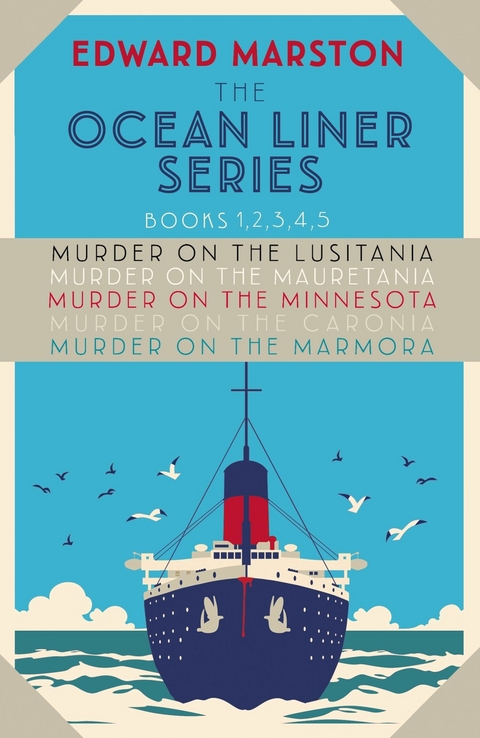
The Ocean Liner series by Edward Marston, author of the bestselling Railway Detective books, sets sail on some of the iconic vessels of the early twentieth century and each voyage takes a journey into ... murder. In book one, Murder on the Lusitania, George Dillman is aboard the Lusitania's 1907 maiden voyage from Liverpool to New York. While posing as a passenger, Dillman is in fact an undercover detective hired to keep an eye out for petty crimes. But after some uneventful days aboard, the ship's blueprints are stolen and then a body is found. As Dillman works to get to the bottom of the crimes, he makes an unusual friend, first-class passenger Genevieve Masefield, and the two uncover secrets aboard the ship that prove explosive. In book two, Murder on the Mauretania, Dillman and Masefield must endure a nightmare voyage in which severe weather batters the vessel. When a passenger is washed overboard, it is at first assumed it was a case of death by misadventure, but the detective pair come to realise that a very calculated murder has been carried out. In Murder on the Minnesota, Dillman and Masefield continue their travels as private detectives bound for the Far East. While a smuggling operation on the route is at first their focus, the voyage is blighted by a murder that will require all their investigative powers to solve. In Book four, Murder on the Caronia, Dillman and Masefield's Atlantic crossing is shared with a man and woman bound for England to face trial for murder. Over the course of the journey, Dillman and Masefield come to believe that the captured couple are not the vicious criminals many believe, but proving that hunch becomes harder when a killer strikes on board. Murder on the Marmora, the fifth instalment in the series, sees Dillman and Masefield set sail for Egypt, alongside royal passengers requiring security. And when a dead body turns up, the voyage proves to be one to remember.
Edward Marston has written well over a hundred books, including some non-fiction. He is best known for his hugely successful Railway Detective series and he also writes the Bow Street Rivals series featuring twin detectives set during the Regency; the Home Front Detective novels set during the First World War; and the Ocean Liner mysteries.
Few cities in Europe had as impressive a maritime history as Liverpool and none could match the pride and fervour with which the port sent off each successive ship on its maiden voyage. But even Liverpool had never known such an occasion as the departure of the Lusitania on its first Atlantic crossing. The latest addition to the Cunard Line excited such curiosity and inspired such patriotic feeling that people came from all over the country to witness the event. Huge crowds milled along both banks of the Mersey, swelling in numbers until they passed the two hundred thousand mark. The object of their veneration, the elegant giant known as the Lusitania, had been anchored in midstream throughout most of the day while the Lucania took on passengers. Once the pride of the line, the latter now looked small, old, and dowdy when seen beside the looming beauty of the new vessel.
When the Lucania set sail at 4.30 p.m. the Lusitania moved slowly into its vacant berth, drawing a gasp of awe from the spectators as they watched a ship that was longer than the Houses of Parliament glide effortlessly over the water. It was a marvel of marine engineering. Many in the crowd wondered how a vessel with a gross weight of 31,500 tons could remain so buoyant in the water. Here was a ship that was not only the biggest and most luxurious in the world; its quadruple screw propellers were powered by four direct-acting steam turbines and were capable of generating speeds in excess of anything ever seen in an oceanic liner.
None of those now staring at the huge vessel with its four red funnels gleaming in the sunshine doubted for a moment that it would regain the Blue Riband – the unofficial prize for the fastest Atlantic crossing – from the unworthy hands of the Norddeutscher Lloyd Line. British pride had been severely dented when its maritime ascendancy was usurped by Germany with technically advanced liners such as the Kaiser Wilhelm der Grosse and the Deutschland. Centuries of dominance came to a juddering halt, a situation compounded by the fact that the German navy was now growing at an alarming rate. Political motives came into play. Government subsidies were hastily offered to Cunard. The Lusitania and its sister ship, the Mauretania, due to have its own maiden voyage in November, were built expressly as a means of reasserting British supremacy on the high seas and of sending a clear message to the German government.
Activity around the ship reached a peak as passengers converged eagerly on the pier. The customs sheds worked at full stretch, port officials were out in full numbers, a sizeable police presence had been drafted to control the crowds, and a small army of hawkers moved among the spectators to sell food, drink, flags, postcards, and assorted souvenirs. The majority of passengers arrived by train but several were delivered by horse-drawn cabs or spluttering automobiles, each competing for space in the congested traffic. Electric trams brought those who could afford no better transport, and open carts emblazoned with the name Lusitania were pulled by pairs of horses from the hostels where emigrants had stayed overnight with their meagre belongings.
Rich and poor alike streamed aboard the vessel, caught up in the heady excitement and determined to savour what was self-evidently one of the most important events in their lives. Coal barges had already filled the bunkers, and the decks had been swept clean of any lingering dust. The crew looked smart and alert. There was a reassuring sense of readiness about them. Wearing trim uniforms and welcoming smiles, stewards waited to conduct passengers to their cabins and to provide basic information about the regimen aboard. In the ship’s kitchens, the chefs and their staff were already preparing the first meal. Saloon bars were well-stocked and barmen were at their stations.
George Porter Dillman gazed around the pier to take it all in. As he strolled towards the ship, he looked at the shining faces of well-wishers and listened to the constant barrage of noise. He had never known such an atmosphere of excitement. It was intoxicating. When the shadow of the Lusitania fell across him, Dillman paused to stare up at its massive hull and shook his head in wonder. Unlike most of the other passengers, he had already had a privileged tour of the vessel, but its sheer proportions still took his breath away. With an overall length of 785 feet and a breadth of 88 feet, she dwarfed every craft in sight. The river was dotted with steamboats, fishing smacks, motor boats, yachts, and dozens of rowing boats that had come to wave the Lusitania off. Against the great Cunard liner, they were minnows beside a whale.
‘Awesome, isn’t she?’ said a voice at Dillman’s elbow.
He turned to see Cyril Weekes standing there with his wife on his arm. The two of them looked up at the ship with controlled glee.
‘Incredible!’ said Ada Weekes. ‘Quite incredible!’
‘Yes,’ agreed Dillman. ‘Truly magnificent.’
‘We are so fortunate to be here.’
‘It is a great day for all of us, Mrs Weekes.’
‘Let us see if she has an interior to match,’ suggested Weekes, moving forward. Dillman fell in beside them and joined the queue for the first-class gangway. ‘I must say, I did not expect to see crowds as large as this. Liverpool is such a friendly city. Rather drab and undistinguished in many ways but undeniably friendly.’
‘You have been here before, sir?’ said Dillman.
‘Oh, yes, Mr Dillman. We come to Aintree every year.’
‘Aintree?’
‘For the Grand National.’
‘A famous steeplechase,’ explained his wife.
‘I know that, Mrs Weekes,’ said Dillman. ‘Its fame has spread across the Atlantic. I am just grateful that it was not mentioned in the presence of Mr Rymer,’ he added wryly, ‘or he would no doubt have felt obliged to lecture me on the whole history of the turf in England and the mysteries of bloodstock. With the very best of intentions, of course.’
They shared a laugh. Weekes gave an apologetic shrug.
‘Do not be too harsh on us, Mr Dillman,’ he said. ‘Not all Englishmen are quite so arrogant as Rymer. I fear that he suffers from the national disease of insularity. This voyage may broaden his mind, though I beg leave to doubt it. You may have to endure more tutorials from him.’
‘I don’t mind,’ said Dillman. ‘I just wish he didn’t raise his voice every time he speaks to me. Mr Rymer seems to think that being an American is akin to being both deaf and stupid.’
‘Whereas you are patently neither,’ observed Weekes shrewdly.
‘Indeed not,’ reinforced his wife.
Dillman acknowledged the compliment with a smile then followed them up the gangway. He liked Cyril and Ada Weekes. They struck him as a pleasant couple with a marriage that was happy without being too cosy. Weekes was an educated man, a Classical scholar from Oxford, yet he carried his erudition lightly. His wife was a quiet, watchful woman with a twinkle in her eye. Though he liked the Rymers less, Dillman nevertheless found them more intriguing. They seemed to be carrying a lot of emotional problems with them and Dillman looked forward to finding out exactly what they were. Behind the easy pomposity of Matthew Rymer, he sensed, was a bristling anger, and he wondered what had caused it. One thing was certain. Both his wife and daughter were afraid of him. And something even more than fear lurked in the eyes of Violet Rymer.
There were eighty-seven special cabins in the first class, most of which were situated on the promenade deck. The remainder of the first-class cabins were on the main, upper, and boat decks, all of them accessible by the grand staircase, which more than justified its name. The entrance to the staircase was on the main deck and thus convenient for gangways from docksides, landing stages, and tenders. When they left the amiable turmoil of the quayside, first-class passengers entered a palatial world of woven carpets, embroidered curtains, panelled walls, dazzling mirrors, ornate light fittings, windows glazed with specially etched glass, and upholstered furniture of the highest quality.
It was truly a luxury hotel on the water.
Genevieve Masefield stepped aboard with an elation tempered with mild regret. Travelling alone, she was looking forward to the voyage and to setting foot on American soil, but a few uncomfortable memories still clung to her. Genevieve accepted that it might take time to shake them all off. Meanwhile, she could enjoy the pleasures of being a first-class passenger on the most remarkable ocean liner ever constructed. The steward who led her to her cabin on the upper deck was a tall man in his thirties with brilliantined hair and a flashy handsomeness that was kept in check by a submissive manner. One glance at Genevieve was enough to ignite his interest and he did his best to ingratiate himself with her, carrying her valise and assuring her that the rest of her luggage had already been brought aboard and stowed in her cabin.
A veteran of Atlantic crossings, he knew the importance of first impressions....
| Erscheint lt. Verlag | 21.12.2023 |
|---|---|
| Reihe/Serie | Ocean Liner Mysteries | Ocean Liner Mysteries |
| Verlagsort | London |
| Sprache | englisch |
| Themenwelt | Literatur ► Anthologien |
| Literatur ► Krimi / Thriller / Horror ► Krimi / Thriller | |
| ISBN-10 | 0-7490-3121-2 / 0749031212 |
| ISBN-13 | 978-0-7490-3121-3 / 9780749031213 |
| Informationen gemäß Produktsicherheitsverordnung (GPSR) | |
| Haben Sie eine Frage zum Produkt? |
 EPUB (Adobe DRM)
Kopierschutz: Adobe-DRM
Adobe-DRM ist ein Kopierschutz, der das eBook vor Mißbrauch schützen soll. Dabei wird das eBook bereits beim Download auf Ihre persönliche Adobe-ID autorisiert. Lesen können Sie das eBook dann nur auf den Geräten, welche ebenfalls auf Ihre Adobe-ID registriert sind.
Details zum Adobe-DRM
Dateiformat: EPUB (Electronic Publication)
EPUB ist ein offener Standard für eBooks und eignet sich besonders zur Darstellung von Belletristik und Sachbüchern. Der Fließtext wird dynamisch an die Display- und Schriftgröße angepasst. Auch für mobile Lesegeräte ist EPUB daher gut geeignet.
Systemvoraussetzungen:
PC/Mac: Mit einem PC oder Mac können Sie dieses eBook lesen. Sie benötigen eine
eReader: Dieses eBook kann mit (fast) allen eBook-Readern gelesen werden. Mit dem amazon-Kindle ist es aber nicht kompatibel.
Smartphone/Tablet: Egal ob Apple oder Android, dieses eBook können Sie lesen. Sie benötigen eine
Geräteliste und zusätzliche Hinweise
Buying eBooks from abroad
For tax law reasons we can sell eBooks just within Germany and Switzerland. Regrettably we cannot fulfill eBook-orders from other countries.
aus dem Bereich