


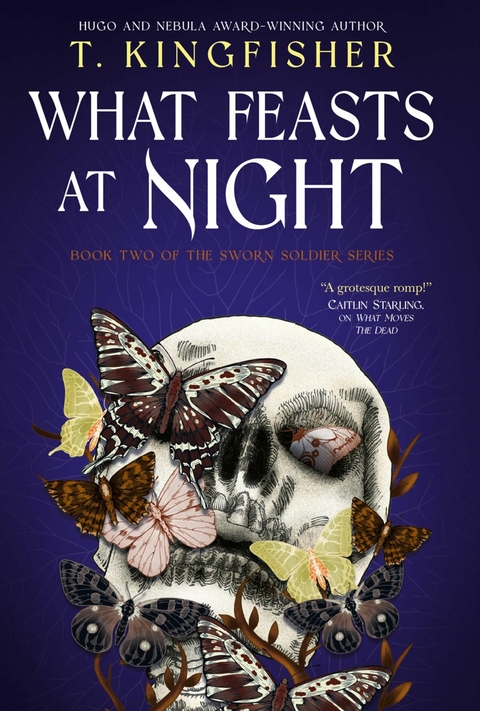
Sworn Soldier - What Feasts at Night (eBook)
160 Seiten
TITAN BOOKS (Verlag)
978-1-80336-969-3 (ISBN)
T. Kingfisher is the adult fiction pseudonym of Ursula Vernon, the multi-award-winning author of Digger and Dragonbreath. She is an author and illustrator based in North Carolina who has been nominated for the Ursa Major Award, the Eisner Awards, and has won the Nebula Award for Best Short Story for 'Jackalope Wives' in 2015 and the Hugo Award for Best Novelette for 'The Tomato Thief' in 2017. Her debut adult horror novel, The Twisted Ones, won the 2020 Dragon Award for Best Horror Novel, and was followed by the critically acclaimed The Hollow Places.
1
A poet once wrote that the woods of Gallacia are as deep and dark as God’s sorrow, and while I am usually skeptical of poets, I feel this one may have been onto something. Certainly the stretch of my homeland that I found myself riding through was as deep and dark as something out of a fairy tale.
Autumn was nearly spent, which meant that many of the trees had lost their leaves. You might think that would mean that the woods had opened up, but if you think that, you have likely never been to Gallacia. Serrated ranks of pine lined the road, with the bare branches of oaks thrusting out between them like arthritic fingers. The sky was the color of a lead slug and seemed barely higher than the trees themselves. Combined with the wagon ruts that left a ridge down the center of the road, I had the unpleasant feeling that I was riding straight down a giant throat.
Everything was damp. Water dripped from the trees, and the fallen leaves had formed a slick brown mush that coated the ground like cheap gravy. Only the evergreens retained their elegance. If this was a fairy tale, it was the kind where everyone gets eaten as a cautionary tale about straying into the woods, not the sentimental kind that ends with a wedding and the words, “And if they have not since died, they are living there still.”
The road sloped upward and the trees on the right-hand side thinned out, to be replaced by a high stone cliff. This is normal. Gallacia is, above all, compact. Our cliffs are very high and usually directly on the road, the trees crowd close on all sides, and while we do have more than our fair share of small waterfalls breaking quaintly over mossy boulders, if you try to step back to admire one from a distance, you’re likely to fall off a different cliff and break your neck.
Also there are bears.
“You know,” I said to Angus, “we could still be in Paris right now.”
Angus grunted. He was my batman in the war, and now served as a combination valet, groom, and voice of reason. I inherited him from my father, along with my chin, my hair color, and my cast-iron liver.
“I didn’t force you to come,” he said.
“You blackmailed me.”
“I most certainly did not.”
“There was guilt. I distinctly remember guilt being involved.”
He grunted again. Angus’s mustache is sometimes capable of its own independent expressions, and was currently expressing its disdain for my complaints. “I, at least, remember what we owe Miss Potter.”
“Believe me, I haven’t forgotten.” Miss Potter, that redoubtable British mycologist, had more or less saved the world from the monstrosity lurking in the Ushers’ lake. An American doctor and I had done a lot of the heavy lifting, but without Eugenia, we would probably still be sitting in the house and wondering why we had started growing strange white filaments out of our ears.
(It had been long enough now that I could joke about it, but only just.)
“I could hardly let her stay in your hunting lodge without a translator,” Angus added. “She doesn’t speak Gallacian.”
No one speaks Gallacian if they can avoid it. Our language is as complicated and miserable as everything else in this country. I couldn’t fault Angus’s logic. And there was no reason not to use the hunting lodge. I had inherited it years ago, and certainly no one else was using it. Still …
“Tell me the truth, Angus. Is this a romantic getaway I sense?”
Angus’s mustache gave me a quelling glare. “I have nothing but the highest respect for Miss Potter,” said the rest of Angus stiffly.
“As do we all. The one doesn’t preclude the other, you know.”
My oldest and dearest friend muttered something that I didn’t quite catch, and let his horse drop back so that I couldn’t needle him any longer.
Honestly, it was hard to imagine a less romantic setting than Gallacia in autumn. I edged Hob away from the side of the road, where a tangle of vines draped over a bare tree like spilled entrails. The road swallowed another hill and we started down it. I stared between my horse’s ears and felt generally ill-used.
Paris, when we left, had been in full glory. Much is made of springtime there, but for my money, a warm autumn is just as spectacular and you don’t trip over nearly as many poets. The window boxes of red geraniums glow like embers, and if it rains, it only makes the sunlight glitter more beautifully off the windowpanes.
Not a week earlier, I had been leaning on the windowsill, the smell of fresh bread wafting up from the bakery below my apartment, listening to the sound of two coachmen fighting over a fare. They had called each other the most extraordinary names, but because they were screaming in French, it sounded like a declaration of love delivered in the heat of a grand passion. Truly, Paris was the city of my heart.
And now I was here, back in Gallacia. The country of my birth, such as it was. Riding down a road that made me feel as if I was being swallowed whole.
We started up another rise. Hob, my horse, sighed as only a disaffected horse can sigh. I patted his neck. Hob was an old trooper, but technically so was I and I didn’t enjoy it either. “Don’t worry, boy. There’ll be a nice hot mash at the end for you.” I hoped there would be, anyway. I’d written to Codrin, the man who kept up the hunting lodge, to tell him that we were coming. He hadn’t written back. I was hoping that it was just because Codrin had never been terribly easy with his letters, but between the grim gray road and the grim gray trees and the grim gray sky—not to mention the profound lack of Paris—I was starting to feel distinctly worried.
“Don’t sulk,” said Angus.
“I’m not sulking.” I didn’t want to admit to baseless anxiety, so I added, “It’s my tinnitus.” This was true, so far as it went. Changes in altitude always set it off, and the train from Paris to the capital had been nothing but altitude changes. I lost most of the trip to a high-pitched whine somewhere inside my head.
Still, it could have been much worse. According to the doctor who told me the name of that ringing in my ears, a few hundred years ago they thought that it was caused by wind getting trapped in your ears. They used to treat it by drilling a hole in your skull to suck the trapped wind out. Now they just said, “Can’t help you, sorry,” and prescribed laudanum to help you sleep.
Laudanum sounded lovely about now. Maybe that would make the growing knot in the pit of my stomach go away.
There’s nothing wrong, I told myself. You’re just tired and cross. Codrin’s letter is probably sitting somewhere in Paris, having just missed us. You know what the mail’s like here, once you get out of the capital.
This was all true and it still didn’t make me feel any better. Hob clearly sensed my anxiety, but was either too well-mannered or too tired from the trip to make anything out of it.
We’d left the capital behind about five hours ago—me with a splitting headache, Angus with his usual unflappable calm, the horses with the deep suspicion that most horses feel about train rides. Angus had collected the horses, arranged for our luggage to be delivered separately, and we set out immediately. (The greatest city in Gallacia is fine, I suppose, but I didn’t feel the need to linger. Imagine if an architect wanted to re-create Budapest, but on a shoestring budget and without any of the convenient flat bits. While fighting wolves.)
The devouring road began not long after we left the city. We traveled from smell to smell, the road rising up into the scent of pines and down into woodsmoke and damp, then back up to the pines again. The smell of woodsmoke usually preceded a small village built in the Gallacian style, the houses clay-plastered wattle, all sporting weathered wooden shingles. Since our local clays are mostly gray, this means that our villages are mostly gray as well. (For a short period after the war, we had lost so many young men that our male population was also gray, which led to the popular tragic song “Silver, Clay, and Frost” that every musician played for about a decade, until we were all heartily sick of it.)
When we finally reached the road leading to the lodge, I nearly missed it. The edges had become overgrown and the potholes were deep enough to lose a sheep in. I turned Hob’s head toward it and his ears flicked skeptically. Was I sure about this? Really?
In truth, I wasn’t sure. The anxiety in my gut was starting to acquire the metallic taste of fear. Which is ridiculous. It’s an overgrown road, not enemy soldiers coming over the ridge. Get hold of yourself.
“I could swear that I was paying Codrin to keep this place up,” I muttered as Hob began to pick his way along the narrow road. Frost-killed weeds choked the edges. “I send money back twice a year.”
“Codrin’s older than I am,” said Angus, which told me very little since I still don’t know how old Angus is. (My guess is late fifties, early sixties, but that was also my guess a decade ago, so I can’t be certain. His hair used to be red and is now silver, but that’s the only concession he has made to age.)
“Still. He should have been able to hire a few village lads to come hack this stuff down.” I paused for a moment, trying to do math in my head. “Err … we do have village lads now, right? All the ones that were being born back when I signed up? Nobody conscripted them?”
Angus shrugged as if to indicate that the life...
| Erscheint lt. Verlag | 13.2.2024 |
|---|---|
| Verlagsort | London |
| Sprache | englisch |
| Themenwelt | Literatur ► Fantasy / Science Fiction ► Fantasy |
| Literatur ► Krimi / Thriller / Horror ► Horror | |
| Literatur ► Romane / Erzählungen | |
| Schlagworte | Central Europe • Dark Fantasy • feminist • Folklore • Folkloric horror • ghost • ghost story • Gothic • Gothic Fantasy • Gothic Horror • haunting • historical horror • Horror • Humorous horror • Insects • LGBTQ+ • lgbtq+ horror • Moroi • Moths • Mushrooms • Mycology • Mystery • non-binary • PTSD • Queer • Trans • Trauma • Ursula Vernon • vampires • war |
| ISBN-10 | 1-80336-969-8 / 1803369698 |
| ISBN-13 | 978-1-80336-969-3 / 9781803369693 |
| Informationen gemäß Produktsicherheitsverordnung (GPSR) | |
| Haben Sie eine Frage zum Produkt? |
 EPUB (Wasserzeichen)
DRM: Digitales Wasserzeichen
Dieses eBook enthält ein digitales Wasserzeichen und ist damit für Sie personalisiert. Bei einer missbräuchlichen Weitergabe des eBooks an Dritte ist eine Rückverfolgung an die Quelle möglich.
Dateiformat: EPUB (Electronic Publication)
EPUB ist ein offener Standard für eBooks und eignet sich besonders zur Darstellung von Belletristik und Sachbüchern. Der Fließtext wird dynamisch an die Display- und Schriftgröße angepasst. Auch für mobile Lesegeräte ist EPUB daher gut geeignet.
Systemvoraussetzungen:
PC/Mac: Mit einem PC oder Mac können Sie dieses eBook lesen. Sie benötigen dafür die kostenlose Software Adobe Digital Editions.
eReader: Dieses eBook kann mit (fast) allen eBook-Readern gelesen werden. Mit dem amazon-Kindle ist es aber nicht kompatibel.
Smartphone/Tablet: Egal ob Apple oder Android, dieses eBook können Sie lesen. Sie benötigen dafür eine kostenlose App.
Geräteliste und zusätzliche Hinweise
Buying eBooks from abroad
For tax law reasons we can sell eBooks just within Germany and Switzerland. Regrettably we cannot fulfill eBook-orders from other countries.
aus dem Bereich


