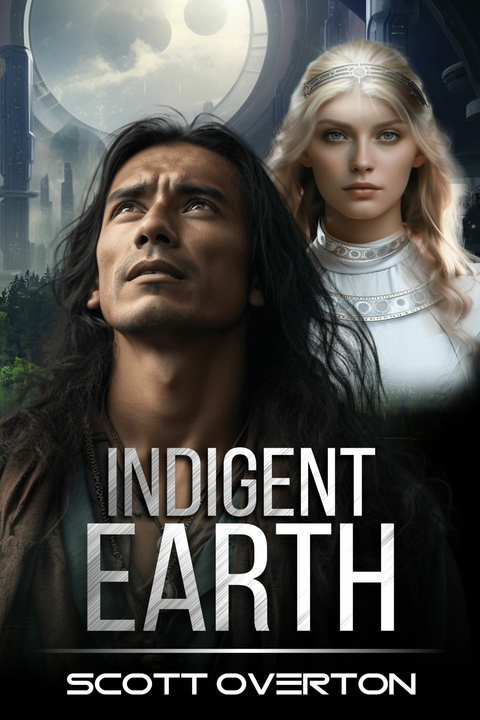
Indigent Earth (eBook)
462 Seiten
No Walls Publishing (Verlag)
9781778284441 (ISBN)

The crimes of the past-the perils of the future.
500 years ago, the world's wealthiest abandoned a ravaged Earth and left billions to die of plagues and climate disasters. Now the space colonists plan to return.
Killian Morningcloud, a discontented Earth man from the stagnating communities known as Allocations, and Natira Celestia, a video celebrity of the off-world ruling class, are on a collision course. When they discover a secret that powerful people are desperate to hide, they face a brutal test of endurance and shattered dreams.
And their fire-and-water pairing will shape the course of the whole human race.
The crimes of the past-the perils of the future.500 years ago, the world s wealthiest abandoned a ravaged Earth and left billions to die of plagues and climate disasters. Now the space colonists plan to return.Killian Morningcloud, a discontented Earth man from the stagnating communities known as Allocations, and Natira Celestia, a video celebrity of the off-world ruling class, are on a collision course. When they discover a secret that powerful people are desperate to hide, they face a brutal test of endurance and shattered dreams.And their fire-and-water pairing will shape the course of the whole human race.
|
| 3 |
The CCC’s producer bot sent a “go ahead” tone into Natira’s cochlear chip to indicate that video and audio feeds were optimal, and to begin the program. For some reason, the cue always gave her the urge to fiddle with the camera lens affixed by a circlet of metal in the middle of her forehead, but she’d learned to resist the impulse.
With the confirmation of her appointment by Hind just hours earlier, and her departure only a day away, she fretted about not using every moment to prepare for the excursion to Earth. But in truth there wasn’t much left to be done—the Confederacy’s planned return had literally been part of her whole life. She’d taken care of every contingency that could be planned for, only awaiting Hind’s official word that she would go along.
The interview segment she was about to record was part of her commitment to Confederacy Central Communications in return for the time away from her regular duties. There was never a question of the CCC turning down her request for a leave endorsed by the famous Basu Hind, but her promise to produce some short documentary segments showcasing real Earth humans and their lives on the harsh planet would keep her bosses happy. As one of the Confederacy’s best known I&I personalities, her series would be a big draw in the outer colonies, too. “Inform and Influence”—the more, the better.
The assignment was no hardship—she loved her job. The distasteful part was the executive producer’s insistence that the story include the elements of Natira’s own background that made her qualified to visit Earth, especially her genetic status as a Tantum, colloquially know as a Big One. Most of her audience probably knew, but she never talked about it—had never been comfortable doing so, even if adults were much more subtle in their exclusion than school-ground bullies.
She pushed aside her discomfort. If the series was going to include such a germinal component of her life, it needed to show where that life had begun.
A shiver went up her spine as she entered the Parturition Institute. Not just because she was a Big One. Almost anyone would find the place disquieting. Though every citizen knew the clinical facts about how they were brought into existence, very few would ever have seen the process. That was why her producer had been so determined to include it. He said it was because Tellurians loved to celebrate their superior technology, but she wondered if it was really only for titillation.
Shrugging off her repugnance, she strode to meet her guide, the Institute’s deputy director, Alyss Laster, and thanked the woman profusely for arranging the interview and tour on such short notice. Then, giving a three-count to begin the segment, Natira launched into a technical description of the building and its operations that she’d researched earlier in the day, and turned to her hostess.
“Where should we start?” she asked, for the benefit of the audience. Laster looked confused by the question, since the itinerary had already been arranged by the network.
“Uh, well, are you still sure you want to show your viewers the actual parturition facilities? Most people are more interested in seeing the babies after decanting. They’re so cute then.”
“They are, but we feel it’s important to show the whole process. After all, this is about the return of our people to the planet Earth; and getting our citizens ready for that starts right here.”
“Oh, you’re absolutely right. Well, then, follow me.” Any lingering reservations faded behind a smile of genuine enthusiasm as Laster led the way to the Genetic Computing Department.
Afraid that the explanation would be horribly dry, Natira instead found herself fascinated by all the permutations involved in mixing the DNA of future Tellurian citizens. Although the number of distinct family lines of the original colonists had been large, it was nothing like the variety of the home planet’s population; so it was important to ensure that the smaller gene pool didn’t promote the rise of autosomal recessive disorders. The mechanism of most genes had already been well understood by the time of the Exodus, so the shift to deliberate breeding had taken firm hold by the fourth generation in space, first with surrogate human mothers, then wholly independent of any biological container. The Institute’s supply of basic DNA provided ninety-nine percent of the coding required for a new human being, and the remaining one percent was carefully selected and arranged by computer. Mandatory collection from all citizens provided plenty of raw material, and the robot technicians of the splicing vats had a success rate as close to perfect as five centuries of refinement could make it.
The splicing vats themselves just looked like hundreds of identical plasglas cylinders; but when Laster led Natira into the next room, the shiver in her spine returned.
These cylinders were larger, and their contents were clearly alive.
Why should that affect her? Even as a schoolchild she’d seen pictures of the procedure. Perhaps it was the strangeness of the shapes—she’d forgotten how alien they looked. Still, this was merely a processing plant like dozens she’d seen before, not very different from the manufactories of the Nutrition Department where her favorite meats and cheeses were cultivated. Her voice betrayed no emotion as she described what she saw for her viewers.
Soft music filled the air, and as she opened her mouth to ask about it, she recognized it as a piece remembered from her schooldays. Study music—one of several dozen compositions that inevitably were played while she and her classmates worked quietly at memory exercises or research assignments. If she remembered correctly, this particular piece had been written not long before the Exodus by a man named Mozart.
Could subtle rhythms and soaring melodies stir even the rudimentary occupants of this place?
The first rows of containers looked empty except for a milky yellow-brown fluid and off-white tendrils veined with purplish grey that dangled from their top ends. Only a close look revealed tiny fledgling embryos at their tips, like an afterthought.
A system of overhead pulleys advanced the cylinders through different sections of the room as gestation progressed. Subsequent rows held larger and larger fetuses. About midway down the long enclosure, one of the dangling forms give a brief wriggle that made Natira jump and drew a laugh from Laster.
That would definitely be cut from the video during editing!
“You probably expected our facility to be larger,” Laster said. “It was, until this century. But since the outer colonies took over their own population control, we only have to produce citizens for the five Tellurian colonies; so that just means replacing those people lost through death.”
“Replacing?”
“Oh, not in the sense of replacing them genetically. Just the numbers, I mean. No, we never make exact copies of previous citizens—the Council of Five decided against that centuries ago.”
Natira knew that to be true, but there continued to be rumors that the five leading families nonetheless occasionally commissioned reproductions of some of their most notable ancestors. Even her newest Celestia cousin, only two years old, was already beginning to look suspiciously like a famous Patriarch of two hundred years earlier whose 3D portrait hung in the Palace’s Hall of Prime Councilors.
“And are the genetic combinations performed entirely by computer, with no human interference?” she asked.
A frown crossed Laster’s face. “You make ‘interference’ sound like a dirty word. In fact, sometimes interference is necessary when, for instance, Telluria has an extra need for mathematicians to undertake the planning of new industrial planetoids. Or mechanical engineers when the government decides it’s time to revamp the fleet. Specialized human skills are still required, you know.”
“Of course.”
It seemed as if the question had struck a nerve. Maybe as Deputy Director, Laster really didn’t know about the copying of former notables, but Natira had it on good authority that there was also a black market that allowed powerful families not only to select for certain traits among the offspring produced, but even to include DNA from the familial bloodline—a serious infraction of the Reproduction Statutes. Word was, they’d follow the child that came from the modified fetus through all of its early life right up to the highest standard level of education at age nineteen. If the child had performed to expectations, they’d adopt the young man or woman into their clan with great fanfare. If not, their interest ended.
The black market was a poorly kept secret, so those not adopted were left wondering if it was because they’d been randomly bred, like the majority, or had been a disappointment to a wealthy patron.
Natira couldn’t help but wonder if that was how she’d become a Celestia. Only someone highly placed within the family would know the answer, but would likely never admit it.
Should she pursue the black-market question with Laster?
As she considered it, a suggestion from her producer appeared in the corneop of her left eye.
With an acquiescent tap of a finger at her temple, Natira asked, “When are the fetuses redirected to become Tantas?”
“That has to be done from the very beginning, of course. When the genes are mixed. Haven’t you noticed the differences among these cylinders coded in green?”
She hadn’t. A closer look still showed nothing...
| Erscheint lt. Verlag | 30.9.2023 |
|---|---|
| Sprache | englisch |
| Themenwelt | Literatur ► Fantasy / Science Fiction ► Science Fiction |
| Literatur ► Krimi / Thriller / Horror | |
| Literatur ► Romane / Erzählungen | |
| Schlagworte | Colonialism • compelling • exciting • journey • privilege • strong female protagonist • thought provoking |
| ISBN-13 | 9781778284441 / 9781778284441 |
| Informationen gemäß Produktsicherheitsverordnung (GPSR) | |
| Haben Sie eine Frage zum Produkt? |
 EPUB (Ohne DRM)
Digital Rights Management: ohne DRM
Dieses eBook enthält kein DRM oder Kopierschutz. Eine Weitergabe an Dritte ist jedoch rechtlich nicht zulässig, weil Sie beim Kauf nur die Rechte an der persönlichen Nutzung erwerben.
Dateiformat: EPUB (Electronic Publication)
EPUB ist ein offener Standard für eBooks und eignet sich besonders zur Darstellung von Belletristik und Sachbüchern. Der Fließtext wird dynamisch an die Display- und Schriftgröße angepasst. Auch für mobile Lesegeräte ist EPUB daher gut geeignet.
Systemvoraussetzungen:
PC/Mac: Mit einem PC oder Mac können Sie dieses eBook lesen. Sie benötigen dafür die kostenlose Software Adobe Digital Editions.
eReader: Dieses eBook kann mit (fast) allen eBook-Readern gelesen werden. Mit dem amazon-Kindle ist es aber nicht kompatibel.
Smartphone/Tablet: Egal ob Apple oder Android, dieses eBook können Sie lesen. Sie benötigen dafür eine kostenlose App.
Geräteliste und zusätzliche Hinweise
Buying eBooks from abroad
For tax law reasons we can sell eBooks just within Germany and Switzerland. Regrettably we cannot fulfill eBook-orders from other countries.
aus dem Bereich