


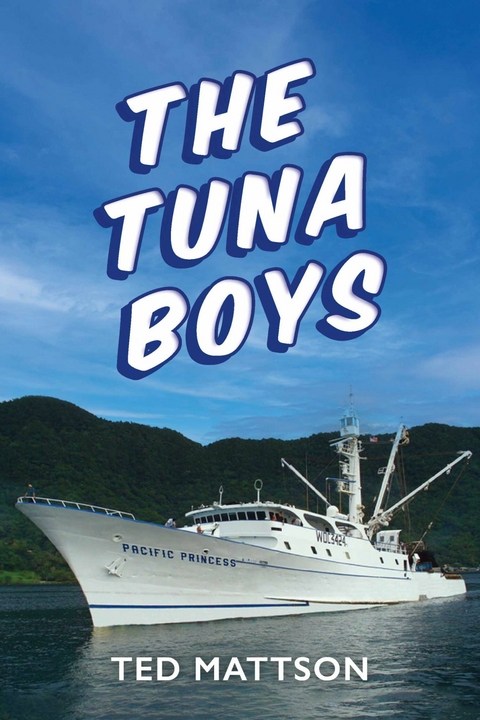
Tuna Boys (eBook)
142 Seiten
Bookbaby (Verlag)
978-1-6678-8158-4 (ISBN)
An adventure story about life at sea in the southern Pacific Ocean and west of Samoa. It revolves around supplying tuna for the world but more specifically to StarKist. Living in a closed society with many different personalities. This applies to sea going vessels anywhere in the world. Boat captains make all the decisions because it works best that way. Every boat that has ever gone to sea operates under that system. No matter, the crew is always at the mercy of the captain. As for myself, who served as captain of his own fishing boat for many years while never losing sight of land, going out to sea was an eye opener that lasted a little over three months. A million dollars of experience has enriched my life immeasurably.
Chapter 1
Getting Started
Tuesday, December 27, 1984
(Palmer, Alaska)
A year after the call from Gene, I was still trying to get on a tuna boat. I knew now I needed to be down where the action was. I would give myself thirty days to get a job or give it up. I bought an airline ticket to Seattle and packed my bags.
Sometime prior to Christmas, I got the urge to stop in at Wilbur’s Flight Service in Anchorage and get some flying time. I bought a couple of hours in their Bell 47, the workhorse of piston-driven choppers that have been around since the Korean War. If you’ve ever watched MASH, you’ve seen the early version of the Bell 47. They’ve been upgraded a lot since then. Surprisingly, it went pretty well. Not unlike riding a bicycle because it did come back. I actually did a couple of run-on autorotations on a frozen lake after the instructor demonstrated one to me. An autorotation is where you land the helicopter by disengaging the rotor blades from the power of the helicopter’s engine and then use the inertia of the spinning blades to cushion your landing. The trick is to not use up all the inertia in the blades before the helicopter is safely down where you want it to land.
In Seattle, I retrieved my old Ford camping van I’d stored at Magnar Warness’, another Bristol Bay fishing friend, where I’d spent the night. Next day, I was on my way to Dana Point in Southern California where my cousin Dahlin and her four kids lived. With my van, I had a place to sleep as well as a base of operations. Lots of tuna activity along the coastline and I planned to explore every bit of it I could find.
Friday, January 11, 1985
(Dana Point, CA)
Nearly two weeks and 3,000 miles of driving up and down the coast behind me, I was getting antsy. Like treading water with no place to go—just waiting for something to happen. The tuna business is tough but there was something inside me that wanted me to get in. Maybe just the challenge. I plugged along some more and kept stumbling onto leads and knew if I had enough perseverance, it would come together eventually. Whether that is this year or not remained to be seen at this point. I evidently needed to meet Bud Levit in San Diego. He is supposed to be the man that all tuna boats look to for pilots.
Wednesday, January 16, 1985
(At Golles’ in San Diego)
It was very pleasant walking around the Golles’ back yard this morning. Birds singing, warm smell of spring in the air, plants flourishing, lemons for the picking. Really homey and nice.
Also, nice to catch up on some of my mail. Although my phone bill wasn’t so nice.
Friday, January 18, 1985
(Bud Levit’s office, Brown Field Municipal A/P)
Bingo! Finally at the right place at the right time. The phone rang in Bud’s office and Bud answered it. He put his hand over the receiver, and asks, “Do you have Bell 47 time?”
“Yes.” At the same time, I was thanking God for the urge I had to stop in at Wilbur’s.
It was Captain Avey Gonsolves of the Pacific Princess and he needed a pilot and needed one now. Avey and I spoke a few minutes on the phone getting a feel for each other. I told him I’d done most of my 2,500 hours of flying in Alaska but had also done some crop dusting with a 12-E Hiller in Oregon before that. I was forty-six now and had my own fishing business in Alaska but had never been on a tuna boat.
“How about Bell 47s? You’ve flown them?” Avey asked.
“Sure, no problem.” I knew I was stretching the two hours I had at Wilbur’s. Sometimes you can make yourself sound more confident than you are, but I hadn’t lied. There had been no problems, or at least Wilbur’s didn’t mention any.
We met for coffee the following morning. Avey showed up in his bright red Porsche, sporting an open-neck shirt with his gold chains showing off nicely against his dark tan. Fortunately, he was many years my junior, so I grabbed at the opportunity to let him know I must have been flying when he was a little boy. He never did ask me straight out how much time I had in a Bell 47.
“We’ll be leaving for Samoa in a few days,” Avey said when I quizzed him. “Probably the middle of the week.” I gave him Golles’ number and got his.
“I’ll be ready,” I said as we shook hands and went our separate ways.
A JOB! I’D JUST GOTTEN A JOB! And while I hadn’t a clue where Samoa was, it was finally dawning on me the immensity of what I’d just gotten myself into. My back was up against the wall. Talking was all done. The burden was now on me.
The instant Avey was out of sight, I headed for the nearest telephone. Somewhere in my travels these past weeks, an ad for learning to fly a Bell 47 (D model) had caught my attention. “$800 for ten hours of instruction.” Fortunately, I’d jotted down the number. It was in Riverside, California, nearly 200 miles away.
When the instructor answered the phone, I felt comfortable explaining the situation I was in. No matter what, I had to learn to fly that chopper this weekend.
“Come on up and we’ll give her a go,” he said.
I was there that evening and handed over the $800. We only had time to get some preliminaries out of the way and would start flying first thing in the morning. Two and a half hours into the instruction, he stopped me. “Look, Ted, to be honest with you, I can’t teach you how to land on a tuna boat without one to practice on. You fly the helicopter fine, so I’m giving you the rest of your money back. I truly wish you the best of luck.”
As I packed up my stuff and was about to head out the door, he added. “Oh yeah, let me know how it goes out there. I’ve always wanted to try that myself sometime.”
It was a nice gesture on his part, giving me the money back like that. It certainly helped my sagging confidence, which had taken a downturn when the reality of what I’d gotten myself into actually took hold. Here I was about to go further out into the world than I’d ever been and into the Southern Hemisphere, where I’d never set foot, to be with people I knew nothing about, to fly a helicopter off a tiny moving platform on which I had no experience. I had literally put my life on the line. Not unlike free rock climbing where the climber scales cliffs with only his bare fingers. Or the NASCAR race driver going 200 mph within two inches of the wall. And what about the bull rider who climbs on the back of 2,000 pounds of fury, fully expecting to still be alive eight seconds later? I can’t imagine doing any of those things and yet, inside me was that same force—the one that’s inside anyone who willingly experiences life on the edge. I also fully expected I could learn to do what anyone else who flies helicopters had learned to do.
And while I may have said to Avey, “I’ll be ready” like I heard the word Samoa every day, I was also thinking, “Where the hell’s Samoa?” I left Alaska to get a winter job flying off a tuna boat out of the harbor in sunny San Diego. I soon found out Samoa is nearly 2,000 miles more distant than Hawaii and is located in the Western Pacific. The tuna boats out of San Diego fish the Eastern Pacific. Roughly speaking, the Pacific Ocean is divided into the North Pacific, which borders the U.S., and the South Pacific bordering South America. North and South are again divided into the Eastern and Western Pacific. North being north of Hawaii and South being south of Hawaii. Papua New Guinea and Fiji are in the Western Pacific. Samoa is just a bit north and east of Fiji.
Fishing for tuna in the Eastern Pacific is entirely different than fishing for them in the West with some similarities. Yellowfin tuna like being under some kind of cover. Anything on the surface like whales, schools of dolphin or porpoise. Even boats, which is another story entirely. The technique to catch the tuna when a school of porpoise is spotted is to launch powerful high-speed, outboard-equipped skiffs from the tuna boat, which then race around and around the school to herd them into a tighter bunch. It is at that point the big seiners circle them with their net and hopefully trap the tuna under the dolphins. If there’s any chop at all, it’s a kidney-pounding ride for the skiff drivers who I later learned often peed blood after a session of rounding up a school of porpoise or dolphins. We’ll talk about pursing the net details later, but once the net circles the rounded-up school of dolphins or porpoise, they then have to be herded back out of the net, which can be challenging as they are quite intelligent. In the process of getting them to swim or jump over and out of the net, an occasional animal might get entangled and die.
The media was quick to jump on the fact that tuna boats kill porpoise so StarKist and other companies can make money. The evening news zeroed in on such events when they happened. “Dolphin Free” became a big selling point for tuna everywhere.
It was the Japanese with their sophisticated electronic equipment who figured out a solution. The floating...
| Erscheint lt. Verlag | 12.11.2023 |
|---|---|
| Sprache | englisch |
| Themenwelt | Literatur ► Biografien / Erfahrungsberichte |
| ISBN-10 | 1-6678-8158-2 / 1667881582 |
| ISBN-13 | 978-1-6678-8158-4 / 9781667881584 |
| Informationen gemäß Produktsicherheitsverordnung (GPSR) | |
| Haben Sie eine Frage zum Produkt? |
 EPUB (Ohne DRM)
Größe: 6,9 MB
Digital Rights Management: ohne DRM
Dieses eBook enthält kein DRM oder Kopierschutz. Eine Weitergabe an Dritte ist jedoch rechtlich nicht zulässig, weil Sie beim Kauf nur die Rechte an der persönlichen Nutzung erwerben.
Dateiformat: EPUB (Electronic Publication)
EPUB ist ein offener Standard für eBooks und eignet sich besonders zur Darstellung von Belletristik und Sachbüchern. Der Fließtext wird dynamisch an die Display- und Schriftgröße angepasst. Auch für mobile Lesegeräte ist EPUB daher gut geeignet.
Systemvoraussetzungen:
PC/Mac: Mit einem PC oder Mac können Sie dieses eBook lesen. Sie benötigen dafür die kostenlose Software Adobe Digital Editions.
eReader: Dieses eBook kann mit (fast) allen eBook-Readern gelesen werden. Mit dem amazon-Kindle ist es aber nicht kompatibel.
Smartphone/Tablet: Egal ob Apple oder Android, dieses eBook können Sie lesen. Sie benötigen dafür eine kostenlose App.
Geräteliste und zusätzliche Hinweise
Buying eBooks from abroad
For tax law reasons we can sell eBooks just within Germany and Switzerland. Regrettably we cannot fulfill eBook-orders from other countries.
aus dem Bereich


