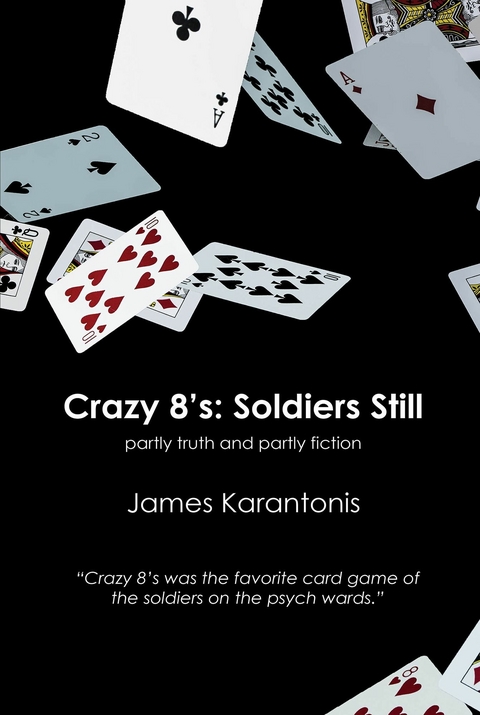
Crazy 8's: Soldiers Still (eBook)
207 Seiten
Bookbaby (Verlag)
978-1-6678-8830-9 (ISBN)
Crazy 8's: Soldiers Still(A novel of interrelated short stories.)Dedication: For the soldiersThe longer the Vietnam War went on the more soldiers came to the psych wards. Sometimes it seemed that more came than went. In my storytelling I have never nor would I ever use the real names of the soldiers. And here is another truth: I . . do . . not . . remember . . the soldiers' names. But I remember them. Jim Karantonis, Medic and Psych Tech, 1966-1969. (Crazy Eights was the favorite card game of the soldiers on the psych wards.)SynopsisIt's October 1967 during the Vietnam War. Zack Tonakis (White) is a young medic/psych tech, who along with his buddy, Robert Turner, (Black), is assigned to the psychiatric ward of an Army hospital in the hills of Pennsylvania. The ward houses young soldiers who are depressed; paranoid; obsessive-compulsive; a sociopath; and even a catatonic. Others, like Joker Berkowski who's described as "e;crazy funny,"e; are there for a "e;failure to adjust"e; to Army life. A major, not of the medical profession, was brought in on temporary assignment while a qualified replacement is sought. The major, a short-timer, wants nothing to jeopardize his coming retirement. His right hand, Sergeant Helms, views patients as cowards and phonies. An inept ward psychiatrist is of little help to the patients. An escape by a patient during a ball game prompts the major to shut down all outdoor activities. His mantra becomes: "e;Keep them invisible."e;The refusal of the major to allow outdoor activities causes the patients to act out. A sympathetic ward sergeant compensates for the restrictions by sending the soldiers to indoor activities. But following a second escape the major expands the off-limits to include even the base chapel. The first short story "e;The Ball Game"e; introduces the soldiers who will have their own stories told in the collection. The main protagonist, psych tech Zack Tonakis, will follow the soldiers throughout the novel. Zack carries his own demons from the past: a violent alcoholic father. Stories include a trip to the mess hall and a food protest; a beer truck hijacking; a trip to the base bowling alley; an escape from the chapel; a Red Cross dance; ECT shock treatment; a pool game that goes awry: family room flashbacks; a suicide, and more. The novel's holiday conclusion delivers a message of hope and recovery for the patients, soldiers still.
Play Ball
Abbott: “Well, let’s see, we have Who’s on first, What’s on second, I Don’t Know is on third …”
Costello: “That’s what I want to find out.”
Abbott: “I said Who’s on first, What’s on second, I Don’t Know’s on third.”
The psychiatric unit’s ballfield was exclusive. To become a member, a soldier had to lose his mind, or at least have the Army believe he had. The ballfield was across the narrow base road from the main hospital and connected to the psych building. Two medics, officially psychiatric technicians, were enjoying the warmth of an autumn sun as they sat in the grass leaning back against the keep-them-in-here and do-not-let-them-out-there, fifteen-foot-high chain-link fence. The fence surrounded three quarters of the field and abutted the two-story psych building that defended the rest of the perimeter. A side door of the building opened directly to the ballfield. The building was last used during World War II, then Korea, but now reopened for the new war, Vietnam.
The two techs, Zack Tonakis and Robert Turner, were careful not to get grass stains on their white pants and white smocks that announced they were the caring side of the military. Buddies and bunkmates since both were inducted into the Army, and then months of training as medics and then more training as psychiatric techs, and now by luck of the draw here they were a year later at the same Army hospital, bunk mates. Bad times encouraged making friends quickly, even for the short term.
To impress women, the psych techs emphasized that they were “psychiatric techs” believing it made them sound more intelligent than the average medic. Zack thought it sounded as if they repaired TVs, as if the horizontal and the vertical holds of the soldiers were on the blink. And today the psych techs responsibility was to monitor these patients, soldiers still, as they enjoyed a game of softball.
Zack, older at twenty-two; Turner was twenty. There was one obvious difference between the two techs, information the Army considered necessary by including the question of “Race” on the first form. Tech Zack Tonakis checked “Caucasian.” Tech Robert Turner, “Negro.” Zack with his Greek ethnic background on display had olive skin, dark hair, and thick eyebrows. Turner had tightly curled black hair and thin eyebrows almost invisible against his brown skin.
For Zack, not only the current situation but his deep-seated rebelliousness may have served as an added incentive as to why he took to the “Negro” Turner so easily. For Turner it was the young man’s faith in the goodness of people that made it easier to bond with Zack the “Caucasian.
Robert Turner preferred to be called by his last name, that’s why the neighbors back home referred to him as, “Turner’s boy.” “Say hello to your dad, Turner.” This may have sounded strange to strangers but seemed okay to him since he respected his father. That was unlike what Zack told Turner he felt about his own father. Robert Turner’s father was somewhat of a leader in speaking out and organizing for better treatment in the community now that new laws had been passed, civil rights laws. Also, unlike Zack, Turner never had the college opportunity. He went to work straight from high school. He had two younger brothers and a younger sister, and it was expected by his parents that he, being the first-born, would work to help the others.
For the patients in the field, there were similarities in age and uniform. Most were nineteen or early twenties, with a few in their thirties, the Army lifers. They all wore dark blue cotton shirts and pants over thinner and lighter blue scrubs. Their dark blue outfit was referred to as patient blues. White plastic wristbands and nametags pinned to their shirts personally announced who they were. Almost all wore black shoes, polished or unpolished. A few wore white cotton open-back slippers, which made it difficult to run to catch fly balls even if they made the attempt.
Ball games for the psych wards were reminiscent of pre-little league games, peewee leagues, where boredom overtakes a five or six-year-old and he sits down in the field, picks at the grass, plays with ants, or moseys over and talks to a friend. And like peewee ball, a psych ward game could have as many patients on a side as could walk out on the field and stand.
“Okay, two outs, two outs, get one more.” Pacing the sideline was Tech Krupp, the self-appointed manager of ward 2A’s team. Krupp always saw himself as a manager, director, boss, the top dog. It could have been overcompensation for all the early years when he was the shortest kid in class, and now, still was the shortest. As far back as elementary school, the boy Krupp was usually overlooked when the other boys chose sides for baseball, football, or any of the sports. It wasn’t until he watched an old film on late night TV of Edgar G. Robinson playing the famous hoodlum, Little Caesar, that the boy saw how intimidation of others didn’t depend on how big you were. You had to act as if you were in charge and be tough about it. And Krupp got away with acting tough because so few boys were willing to challenge him, to fight about it knowing he was more than willing to fight, no matter how much bigger they were. Soon Krupp’s demeanor and personality became one and the same, a bully.
On the ward Krupp was the senior tech, proof that not all those dressed in white cared about the patients. How he got to be a medic and tech in the first place is one of those ‘Hey It’s a war and it’s the Army.’ Every aspect of life for Tech Krupp was a game. But a game where there was one winner and all those others: the losers. Whatever got you the prize was justified. Even as a young boy when the neighborhood kids got together to play monopoly Krupp would stuff his pockets with play money from his own board game so he could slip in an extra hundred or a twenty when he needed it, anything for an edge. Anyone can do it was the boy’s reasoning, so why not him?
“One more out, one more.” Krupp barked instructions. “Be ready! Be ready!” He suddenly pointed emphatically to the first baseman and yelled, “Hey, First Base! Catch the damn ball if they throw it to you. Catch the damn ball!”
The first baseman was a patient that Zack and Turner and other techs referred to as Cherry Pie Stover. He was Private Stover when he came here, but rank was left behind when soldiers entered this building. And as for officers, the Army sent them elsewhere for treatment. Stover with his long arms and legs and well over six-foot frame belonged on a basketball court instead of a ball field. For softball games, the psych patients weren’t issued ball gloves, but Stover didn’t need one, not with hands the size of catchers’ mitts. The soldier was tall enough to catch an errant throw before it reached the clouds. As for the cherry pie in front of Stover’s name, Zack gave him that moniker after an incident at the mess hall where the soldier showed an exaggerated enthusiasm for a single subject. The Greek word is monomania. For Stover it was for cherry pies. But that wasn’t why he was on the psych wards.
“Hey, Greek.” Tech Turner nudged Tonakis. “Do you see the patient standing a little behind Cherry Pie Stover?”
Zack tried to focus on the guy who was partially hidden by Stover’s large frame at first base.
“Name game!” Turner said.
“Damn.” Zack was caught. “Okay, give me a minute.” He searched for the name of the patient Turner had pointed out.
Previous psych techs had invented the name game and passed it on to newcomers who readily adopted it. The game was modeled after the comic duo Abbott and Costello’s “Who’s on first” routine. For the techs, it seemed more new patients came to the wards than old ones left, and unless the techs were standing next to the patients their nametags were of no help.
To recall a patient’s name, the techs used a crutch that tied the soldier to a behavior or an incident. The pet names weren’t cute sounding in the same way Grumpy, Bashful and Sneezy were, but the names worked. The game was only played by the techs; they knew it wouldn’t be a good thing if the patients heard their nicknames.
Zack Tonakis was certainly used to nicknames. He was called Greek by almost every student throughout high school. “Hey Greek;” “How’s it going, Greek;” “Where you going, Greek?” There was also an indirect benefit for Zack. When a friend called his home and asked, “Is Greek home?” it really pissed-off Zack’s dad that they didn’t use his son’s first name. More than once Zack’s father told him and told him loudly, “It’s a lack of respect for me, not using the name I gave you, my name!” This lack of respect for the father was okay by Zack the son.
Zack also knew being called Greek was an uncomfortable reminder to his dad that he couldn’t run away from his ethnic background. His father had shortened his original surname from Karantonakis so as not to sound so foreign. As if the name Tonakis didn’t get Zack the question, “What are you, Greek or Italian?” It wouldn’t have surprised Zack if his father had taken the last name “Jones” or “Smith” leaving no clue of Mediterranean roots. Zack figured his dad had issues with his own father in the same way Zack had issues with him.
Zack was proud of his ethnicity, even if he didn’t know much about it. He knew from the history texts that Greeks started democracy, had a lot of Gods, and what gave Zack bragging rights, Greeks had started the Olympic Games. He knew that movies showed Greeks as loud and always...
| Erscheint lt. Verlag | 30.5.2023 |
|---|---|
| Sprache | englisch |
| Themenwelt | Literatur ► Romane / Erzählungen |
| ISBN-10 | 1-6678-8830-7 / 1667888307 |
| ISBN-13 | 978-1-6678-8830-9 / 9781667888309 |
| Informationen gemäß Produktsicherheitsverordnung (GPSR) | |
| Haben Sie eine Frage zum Produkt? |
 EPUB (Ohne DRM)
Größe: 8,3 MB
Digital Rights Management: ohne DRM
Dieses eBook enthält kein DRM oder Kopierschutz. Eine Weitergabe an Dritte ist jedoch rechtlich nicht zulässig, weil Sie beim Kauf nur die Rechte an der persönlichen Nutzung erwerben.
Dateiformat: EPUB (Electronic Publication)
EPUB ist ein offener Standard für eBooks und eignet sich besonders zur Darstellung von Belletristik und Sachbüchern. Der Fließtext wird dynamisch an die Display- und Schriftgröße angepasst. Auch für mobile Lesegeräte ist EPUB daher gut geeignet.
Systemvoraussetzungen:
PC/Mac: Mit einem PC oder Mac können Sie dieses eBook lesen. Sie benötigen dafür die kostenlose Software Adobe Digital Editions.
eReader: Dieses eBook kann mit (fast) allen eBook-Readern gelesen werden. Mit dem amazon-Kindle ist es aber nicht kompatibel.
Smartphone/Tablet: Egal ob Apple oder Android, dieses eBook können Sie lesen. Sie benötigen dafür eine kostenlose App.
Geräteliste und zusätzliche Hinweise
Buying eBooks from abroad
For tax law reasons we can sell eBooks just within Germany and Switzerland. Regrettably we cannot fulfill eBook-orders from other countries.
aus dem Bereich