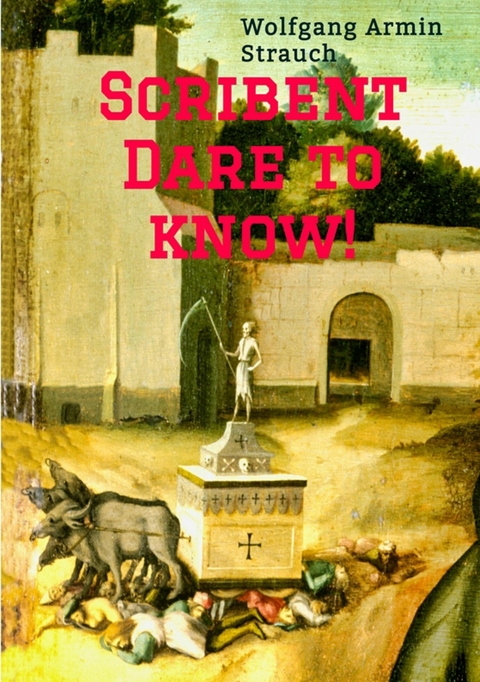
Scribent - Dare to know! (eBook)
660 Seiten
tredition (Verlag)
978-3-384-00454-3 (ISBN)
Wolfgang Armin Strauch wurde 1953 geboren. Bereits in der Schule schrieb er erste Gedichte, mit denen er sich an lokalen und überregionalen Wettbewerben beteiligte. Es folgten Liedtexte, zu denen er auch die Musik komponierte. Nach dem Abitur wollte er Musik studieren. Wegen fehlender Studienplätze entschied er sich zu einem Jurastudium. Nach seinem Abschluss 1985, begann er sich mit der Entwicklung von Software zu beschäftigen. Einige seiner Programme sind bis heute bundesweit im Einsatz. Ab 1990 schrieb er wieder Songs und trat mit ihnen als Solokünstler auf. Eine Auswahl seiner Titel nahm er 2010 im RedCube-Studio Hamburg auf und veröffentlichte sie 2011 auf dem Album 'NESAYA - Wie soll ich Leben'. 2012 bekam er den VDM-Award beim internationalen Grand Prix für Musikschaffende. Im selben Jahr wurde ein Titel bester Funk- und Soul- Song beim Deutschen Rock- und Pop-Preis. 2014 nahm er das Debütalbum von Denise Blum 'Denise im Radio' auf. Der Titel 'Radio' wurde zum Durchbruch für die junge Sängerin. Eher zufällig stieß er beim Schreiben der Familiengeschichte auf interessante Schicksale. Sie veranlassten ihn, sich intensiv mit europäischer Geschichte zu beschäftigen. Im Ergebnis umfangreicher Recherchen in deutschen, polnischen, britischen und schwedischen Archiven veröffentlichte er 2018 die umfangreiche Biografie 'Dr. Aegidius Strauch: Gefangener des Kurfürsten Friedrich Wilhelm von Brandenburg'. Auch der Roman 'Der dicke Mann' basiert auf Informationen aus deutschen und polnischen Archiven sowie Aussagen von Zeitzeugen. Der Roman "Scribent - Sapere aude" entstand, nachdem er Kupferstiche gefunden hatte, die nachweisen, dass das Grabmal von Hadrian VI. entstellt wurde. Das deutsch-spanische Kinderbuch "Der hölzerne Vogel" betrachtet das Thema Heimat aus ungewöhnlicher Sicht. Ein deutsches Kind findet in Nicaragua eine neue Heimat.
Wolfgang Armin Strauch wurde 1953 geboren. Bereits in der Schule schrieb er erste Gedichte, mit denen er sich an lokalen und überregionalen Wettbewerben beteiligte. Es folgten Liedtexte, zu denen er auch die Musik komponierte. Nach dem Abitur wollte er Musik studieren. Wegen fehlender Studienplätze entschied er sich zu einem Jurastudium. Nach seinem Abschluss 1985, begann er sich mit der Entwicklung von Software zu beschäftigen. Einige seiner Programme sind bis heute bundesweit im Einsatz. Ab 1990 schrieb er wieder Songs und trat mit ihnen als Solokünstler auf. Eine Auswahl seiner Titel nahm er 2010 im RedCube-Studio Hamburg auf und veröffentlichte sie 2011 auf dem Album "NESAYA – Wie soll ich Leben". 2012 bekam er den VDM-Award beim internationalen Grand Prix für Musikschaffende. Im selben Jahr wurde ein Titel bester Funk- und Soul- Song beim Deutschen Rock- und Pop-Preis. 2014 nahm er das Debütalbum von Denise Blum "Denise im Radio" auf. Der Titel "Radio" wurde zum Durchbruch für die junge Sängerin. Eher zufällig stieß er beim Schreiben der Familiengeschichte auf interessante Schicksale. Sie veranlassten ihn, sich intensiv mit europäischer Geschichte zu beschäftigen. Im Ergebnis umfangreicher Recherchen in deutschen, polnischen, britischen und schwedischen Archiven veröffentlichte er 2018 die umfangreiche Biografie "Dr. Aegidius Strauch: Gefangener des Kurfürsten Friedrich Wilhelm von Brandenburg". Auch der Roman "Der dicke Mann" basiert auf Informationen aus deutschen und polnischen Archiven sowie Aussagen von Zeitzeugen. Der Roman "Scribent - Sapere aude" entstand, nachdem er Kupferstiche gefunden hatte, die nachweisen, dass das Grabmal von Hadrian VI. entstellt wurde. Das deutsch-spanische Kinderbuch "Der hölzerne Vogel" betrachtet das Thema Heimat aus ungewöhnlicher Sicht. Ein deutsches Kind findet in Nicaragua eine neue Heimat.
The fire
1914. Leuven in Belgium.
Friedrich Stein had already exceeded the usual period of study by two years. Instead of studying, he preferred to hang out with friends from the fraternity who let him put up with them. They repaid him with flattery that catered to his ego. He attached great importance to his appearance. His suit was made of fine twine. He regularly tugged at his watch chain to make sure that everyone saw the gold timepiece.
He was certainly not stupid. He liked to talk about topics his fellow students had no idea about, but avoided technical discussions. If he noticed that someone knew more about the subject, he quickly changed the subject to ramble on about something else. Eventually, he only found receptive listeners among the freshmen. His face was rather average, except for his beard, which he twirled like Kaiser Wilhelm II. He was not a ladies' man, as his smarmy manner was off-putting. So he had no choice but to visit disreputable establishments and blow his money there.
Unfortunately, this lifestyle displeased his parents. Only when he was picked up in a raid and the local police called the principal did he become meek. His father came from Berlin by car to avert his expulsion at the last moment. He gave him an ultimatum. If he did not complete his studies this year, his parents would cut him off. By the beginning of July 1914, he was already late with his final paper. In his distress, he went to François Gaspard, who had already done several papers for him, and asked for support.
His professor had given him a three-week grace period to turn it in. The only problem was that he hadn't written a line yet. For a history topic, 21 days was more than tight. So he fell for the plan of choosing a book that was as unknown as possible as the topic. The professor would hardly be interested in reading up on him, if only it was boring enough.
François Gaspard's situation was completely different: the little money he received from his scholarship was not enough. In the time he had spent studying, he had never once visited a pub. Dating girls was out of the question, since he couldn't even buy them a beer. But that didn't mean he had no contacts. Fortunately, he had landed a job in the university archives, which helped him get over the worst of the hardship. Word of his talent for languages had spread. As a result, he was occasionally able to earn some money doing proofreading work. He loved books and used every free minute to read. However, he wanted to finish his studies as quickly as possible so as not to be on his parents' pocket.
Friedrich Stein knew of his need. He offered him money for a suitable book. François hesitated, since the lending of historical books was only allowed with special permission. Moreover, the specification "any old boring book" seemed too vague for him to search for it purposefully. In the end, he decided to take Stein to the archive so that he could choose a book for himself.
They went to the far end of the bookshelves. Although the new Lipman shelving system had already been set up everywhere, there was an old shelf in a niche. Obviously, it hadn't been worthwhile to commission a custom-made unit for the eighty centimeters. So it had been left in place. At random, Stein pulled a thick book from the shelf. Presumably the tome had acted like a keystone. Two boards gave way and freed themselves from their burden. Like dominoes, books smashed against each other to land crashing on the floor. Dust swirled up. Spider webs floated through the hallway. Only with difficulty did the two students manage to get one board back into its holder and fill it with the old writings. The other hung warped on the shelf and could not be moved. Full of panic, they jerked at it until they realized it was connected to the floor above. A gap revealed that there was a cavity behind it. Carefully, they removed the jammed writings and, with light force, pulled out the board. The partition could now be removed. A whole row of books became visible. François tried to push the partition to its old spot. He did not succeed. The contents had become completely wedged in.
They decided to clear out the compartments and refill them. To make room, they took out a stack of books, loose writings, and a cardboard box. They moved everything into the anteroom. Here they sorted it by size and shoved the misshapen piles of paper into the compartment. In the end, there was only one book left that could no longer be squeezed in.
"I take that for my work," Stein said.
François looked at him in amazement.
"Don't we want to get everything in order first?"
Stein, however, already had the book under his arm and said, "That's why we're here. You can do the rest on your own."
François held him and said, "I still have to write it down in the proof book."
"Scribent I. Volume" he wrote in the line. To determine the author, he flipped through the first pages. The book was written entirely by hand. An author could not be determined. In the cover there was a letter with an illegible writing. On it was a seal imprint with a coat of arms. François added to the entry in the proof book: "Contains letter with unknown seal". Then Stein signed and left François alone, who set about sorting the books.
François was now sure that he had made a serious mistake. Although at first glance the old shelf looked just as they had found it, remorse plagued him. That night he slept fitfully. Finally, he went to the archives an hour early. The chief archivist, Quentin Mertens, was already there.
"I have something very bad to confess to you."
Tears came to his eyes as he told the story. He had certainly lost his job. He might even be expelled from the university.
Mertens looked at him punishingly. Then he fetched the loan book.
"It was a serious mistake. You cannot imagine what you have done. But I am also to blame."
He tore out the page with the loan note.
"It's imperative to keep the story between us!"
François looked at his supervisor in disbelief. Mertens pulled him into the rows of shelves.
"The book never existed! Promise me you won't talk about it with anyone."
"Yes. But why?"
"Don't ask. Go get the car, please. We have to clean up."
With determination, Mertens went to the shelf with the secret compartment. He cleared the first row and pulled out the partition. They brought the hidden contents into the anteroom. On a piece of paper, Mertens documented everything and then put the piece of paper in his pocket.
"Is there any chance we can get the book and the letter back from Stein?"
François pondered, "He still has to write his paper. Maybe he'll ask me for support."
"Go to him before he puts someone else in charge. I'll help you with the work."
François didn't have to bother, because Stein was already standing outside the archive door when he wanted to go home. He held the book out to him.
"A month's rent if you write the paper for me."
"All right. What do you want the title to be?"
"I don't care about him. The main thing is that it's about history. Yes, and I need a summary of the content, of course."
Stein handed over the book and walked away whistling.
François rushed to the archivist, who looked at the book.
"What about the letter?"
"I don't. He didn't give it to me."
"Oh my god. The book was unimportant. Only the letter was of value. I can only hope Stein can't decipher the writing."
François looked at Mertens with concern.
"Should I ask him about it?"
"No way. When you're done working, you'll have a reason. Now the demand would just draw attention."
François opened the book. "What's so important about that?"
"You will quickly realize who the author of the book is. Then you will understand it. To Stein you claim that the author could not be determined. When you're done with the work, we'll talk everything over. I doubt that his professor is interested in it. If it does happen, there will be no trace of the book. Then Stein has a problem. I'll remove it like the other books from the old shelf."
Mertens looked him firmly in the eye. François only nodded.
* * *
It was strange. The book bore a note stating that it must not be destroyed. Underneath it stuck a paper seal authenticated with an illegible signature. The author had used blank backs of pamphlets to prepare lectures. The ink of the writing was partially faded. However, one could see that it dealt with mathematical, linguistic, and theological topics. In between there were some notes about student behavior.
François compared the data he had found with the list of lectures from the period from about 1501 to 1508. Finally, he was sure that the author was Professor Adriaen Floriszoon Boeiens, called Adrian of Utrecht, who was later elected Pope Adrian VI. In the book 'Bibliotheca alcographica' from 1660 he found an engraving by Johann Theodor de Bry.
Engraving by Johann Theodor de Bry, from 'Bibliotheca Chalco-graphica', Frankfurt, 1650 © Collection W. A. Strauch
François went to Mertens with the result. "The author is obviously Adrian of Utrecht, who later became pope. As far as I can tell, there are hardly any documents about him from that time. Wouldn't it be a good idea to go to the rector with the discovery?"
"Absolutely not. The documents were hidden for a reason. Get to work and you'll be doing humanity a favor."
"Why did someone use Scribent to describe the book?"
Mertens...
| Erscheint lt. Verlag | 18.8.2023 |
|---|---|
| Verlagsort | Ahrensburg |
| Sprache | englisch |
| Themenwelt | Literatur ► Historische Romane |
| Literatur ► Krimi / Thriller / Horror | |
| Literatur ► Romane / Erzählungen | |
| Geschichte ► Allgemeine Geschichte ► Altertum / Antike | |
| Geschichte ► Allgemeine Geschichte ► Mittelalter | |
| Geschichte ► Allgemeine Geschichte ► Neuzeit (bis 1918) | |
| Geisteswissenschaften ► Geschichte ► Regional- / Ländergeschichte | |
| Geisteswissenschaften ► Philosophie ► Geschichte der Philosophie | |
| Geisteswissenschaften ► Religion / Theologie ► Christentum | |
| Geisteswissenschaften ► Religion / Theologie ► Judentum | |
| Schlagworte | British secret service • Buenos Aires • fanatical Catholics • freemasons • Hadrian VI. • Jesus • Leuven • Maria Magdalena • Nazis • Paris • Pope • Propaganda Due • Second World War • Vatikan • war criminal • Zaragosza |
| ISBN-10 | 3-384-00454-X / 338400454X |
| ISBN-13 | 978-3-384-00454-3 / 9783384004543 |
| Informationen gemäß Produktsicherheitsverordnung (GPSR) | |
| Haben Sie eine Frage zum Produkt? |
 EPUB (Wasserzeichen)
DRM: Digitales Wasserzeichen
Dieses eBook enthält ein digitales Wasserzeichen und ist damit für Sie personalisiert. Bei einer missbräuchlichen Weitergabe des eBooks an Dritte ist eine Rückverfolgung an die Quelle möglich.
Dateiformat: EPUB (Electronic Publication)
EPUB ist ein offener Standard für eBooks und eignet sich besonders zur Darstellung von Belletristik und Sachbüchern. Der Fließtext wird dynamisch an die Display- und Schriftgröße angepasst. Auch für mobile Lesegeräte ist EPUB daher gut geeignet.
Systemvoraussetzungen:
PC/Mac: Mit einem PC oder Mac können Sie dieses eBook lesen. Sie benötigen dafür die kostenlose Software Adobe Digital Editions.
eReader: Dieses eBook kann mit (fast) allen eBook-Readern gelesen werden. Mit dem amazon-Kindle ist es aber nicht kompatibel.
Smartphone/Tablet: Egal ob Apple oder Android, dieses eBook können Sie lesen. Sie benötigen dafür eine kostenlose App.
Geräteliste und zusätzliche Hinweise
Buying eBooks from abroad
For tax law reasons we can sell eBooks just within Germany and Switzerland. Regrettably we cannot fulfill eBook-orders from other countries.
aus dem Bereich