Introduction
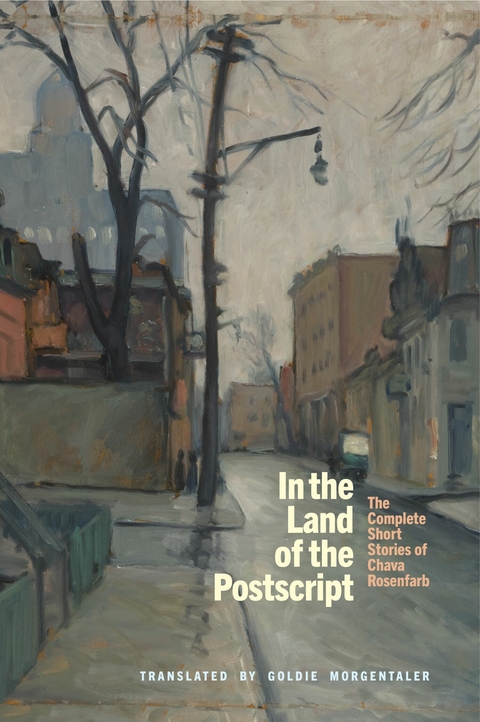
IN THE LAND OF THE POSTSCRIPT
Much has been written about the Holocaust, but comparatively little about its aftermath and the lives of the survivors. How did the horrific experiences they lived through affect those who migrated from Europe to find safe haven in North America? How did they deal with their memories of the traumatic past once they had established new lives in a new country?
Between 1974 and 1995 the Yiddish-language novelist Chava Rosenfarb wrote a series of short stories in Yiddish that explored the afterlife of Holocaust survivors. Most, but not all, of these stories were published in the prestigious Yiddish literary journal Di goldene keyt. With one exception—“Serengeti,” which is set in Africa and features an American protagonist—all of Rosenfarb’s stories deal with Holocaust survivors who have settled in Canada after the war. This volume collects all of the short stories that Rosenfarb, herself a Holocaust survivor, published after the war when she had settled in Canada and begun her literary career.
The roots of Yiddish literature in Canada go back to the turn of the twentieth century, when Eastern European Jews, seeking refuge from persecution and poverty, began arriving in large numbers, settling primarily in the cities of Montreal, Toronto, and Winnipeg. Montreal, where most of the immigrants settled, provided particularly advantageous conditions for the establishment of a literature written in Yiddish. From 1900 to the outbreak of World War II, Jews made up Montreal’s largest immigrant community, and Yiddish was, after French and English, the city’s most widely spoken language. The result was a Yiddish-speaking culture of remarkable self-sufficiency and vitality, which earned Montreal a reputation among Jews as “the Jerusalem of North America.” After World War II, Canadian Yiddish literature was given another boost by the arrival of survivors of the European conflagration—among them Chava Rosenfarb, who settled in Montreal in 1950.
In general, Yiddish literature written in Canada focused on Europe and on European concerns, despite the fact that many Canadian Yiddish writers lived the greater part of their lives in North America. Even J. I. Segal, arguably the most Canadian of the major Yiddish writers who settled in the country, was essentially European in outlook, filtering his vision of Montreal through the sieve of an Old World sensibility.
In her novels, Chava Rosenfarb—the youngest of the major Yiddish writers to settle in Canada—conforms to this pattern of Canadian creation and European subject matter. But her short fiction does not. Rosenfarb’s novels tend to be conceived in epic terms, dealing as they do with the impact of the Holocaust on the Jews of her hometown, Lodz, Poland. Her three novels, The Tree of Life, Bociany, and Letters to Abrasha, are European works by an essentially European writer who just happened to be living in North America.
It was only in her short fiction that Rosenfarb permitted Canada, her adopted home, to play a role in her work. She did this by effecting a synthesis between her primary theme of the Holocaust and the Canadian milieu in which she found herself, so that Canada becomes in these stories the land of the postscript, the country in which the survivors of the Holocaust play out the tragedy’s last act.
Rosenfarb’s short fiction is thus a different take on a theme that has been explored by Saul Bellow in Mr. Sammler’s Planet and by Isaac Bashevis Singer in several of his short stories—namely, the afterlife of the survivor. But Chava Rosenfarb was one of the few writers on this theme who was a survivor herself and thus intimately acquainted with the subtle undercurrents of pain, confusion, anger, and despair in the lives she wrote about. Her characters may be strangers in a strange land, but they are neither ennobled by their suffering nor necessarily embittered by it. Instead they represent a gallery of all conceivable human types and all conceivable human reactions to devastation.
Chava Rosenfarb was born in Lodz, Poland, on February 9, 1923. She attended a Yiddish secular school and a Polish-language Jewish high school from which she graduated in 1941. By that time she and her family had been incarcerated in the Lodz Ghetto, and it was in the ghetto that she received her diploma. The Lodz Ghetto was liquidated in August 1944; Rosenfarb and her family were deported to Auschwitz. From Auschwitz she, her mother, and sister were sent to a forced-labor camp at Sasel, where they built houses for the bombed-out citizens of Hamburg. Rosenfarb and her family were then sent to Bergen Belsen concentration camp from which they were liberated by the British army in 1945. After the war she crossed the border illegally into Belgium, where she lived as a stateless person until her immigration to Canada in February 1950.
Rosenfarb was profoundly affected by her experiences during the Holocaust, and her prodigious output of poetry, novels, short stories, plays, and essays all deal with this topic in one way or another. She began as a poet, publishing her first collection of poetry, Di balade fun nekhtikn vald (The Ballad of Yesterday’s Forest), in London in 1947. This was followed by three other poetry collections and a play, Der foigl fun geto (The Bird of the Ghetto), which was translated into Hebrew and performed by Israel’s National Theatre, the Habimah, in 1966. It has since been performed in English in Toronto and in the original Yiddish in a Zoom production by the New York–based Folksbiene.
Finding that neither poetry nor drama could begin to express the depths of her feelings about the Holocaust, Rosenfarb turned to fiction. In 1972 she published her masterpiece, Der boim fun lebn (The Tree of Life). This three-volume epic chronicles the destruction of the Jewish community of Lodz during the Second World War. It was followed by Bociany (published in the author’s own English translation by Syracuse University Press as Bociany and Of Lodz and Love) and Briv tsu abrashn (Letters to Abrasha), which is, as yet, unavailable in English.
Rosenfarb was a frequent contributor of essays to the Yiddish literary journal Di goldene keyt, where, beginning in the early 1980s, she also began to publish a series of short stories about the lives of Holocaust survivors living in Canada and the United States. These are the stories that make up this collection.
At first glance, the stories contained in this volume belong to the general category of immigrant literature, because they attempt a synthesis of the Old World and the New. But this is immigrant literature with a difference, because the Old World in this case incorporates the stain of the Holocaust, which the New World is incapable of washing away. The stories therefore exist within a symbolic framework that addresses the relationship between Europe and North America. For instance, in the story “Last Love,” an elderly Jewish woman’s dying wish is to make love to a handsome young Frenchman. All the characters in this story are European. Amalia, the heroine, is the representative of all those survivors who found refuge in Canada after the ravages of the war. But when Amalia learns that she has only a short time left to live, she begs her husband to take her back to Paris, the city where the couple had first met after the war. Once there, she announces that her dying wish is to make love to a young man. It is as if she hopes to incorporate within herself a more innocent Europe, cleansed of atrocities and pain. Amalia herself represents the dying order of an Old World corrupted as much by the presence of its victims as by that of its aggressors.
Canada in these stories does not wipe out Europe—not even symbolically. It cannot nullify the European past. Canada here plays the role of Spam in a sandwich; it is bland, neutral territory that is nevertheless deadly, because its unflavored ahistorical terrain, like a tabula rasa, permits the intrusion of a corroding European reality. In these stories Canada is the neutral land of refuge that, like blank paper, patiently permits the survivors to impose their past on its present.
I use the blank paper analogy advisedly, because the dominant season in Rosenfarb’s depiction of Canada is winter. This is not really surprising given the harshness and duration of the Canadian winter. Furthermore, the winter season can have many meanings. In “The Greenhorn,” the earliest of the stories, originally published in Yiddish in the 1950s, the newly arrived immigrant Barukh refuses to stop wearing his winter coat even when it is long past the season for it. “He cannot seem to get warm in this country,” writes the narrator, “and he does not find the coat too heavy for spring.”
But the chill that Barukh feels is not the chill of the Canadian climate but of the memories frozen within him. In this story Montreal is portrayed as a hot place—hot with the steam of a shmateh factory and with the warmth of sexual allure. Barukh, a Holocaust survivor, is working his first day at a garment factory in Montreal. The factory foreman is also a transplanted Jew, as are several of the other workers. The Jewish workers in fact are a mix of newly arrived greenhorns, mostly Holocaust survivors like Barukh, and of Jews from earlier migrations. But the Jews are not the only inhabitants of this factory world. There are also French Canadians. One of these, a flirtatious young...


 EPUB (Ohne DRM)