


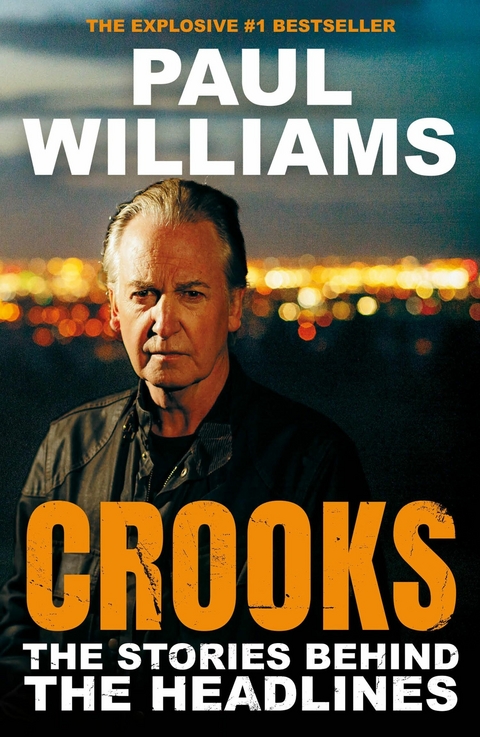
Crooks (eBook)
384 Seiten
Atlantic Books (Verlag)
978-1-80546-120-3 (ISBN)
Paul Williams is Ireland's leading crime writer and one of its most respected journalists. For over three decades his courageous and ground-breaking investigative work has won him multiple awards. He is the author of eleven previous bestselling books and has also researched, written and presented a number of major TV crime series. His first book, The General, was adapted for the award-winning movie of the same name by John Boorman. He is a former presenter on Newstalk Breakfast and currently writes for the Irish Independent. Williams holds an MA in Criminology and is a registered member of the International Consortium of Investigative Journalists based in Washington, DC.
THE #1 IRISH TIMES BESTSELLERFor almost forty years, Paul Williams has chronicled the life and crimes of some of Ireland's most notorious godfathers, killers and thieves. In Crooks he brings his readers for a ride-along, taking us behind the scenes of his most notorious scoops, describing the run-ins he's had with unsavoury, dangerous criminals and the high price of his line of work. From pursuing the General to death threats from PJ 'The Psycho' Judge, exposing the Westies and tracking the Kinahan cartel, Paul's extraordinary career doubles as an eyewitness account of the evolution of organized crime in Ireland.
Paul Williams is Ireland's leading crime writer and one of its most respected journalists. For over three decades his courageous and ground-breaking investigative work has won him multiple awards. He is the author of eleven previous bestselling books and has also researched, written and presented a number of major TV crime series. His first book, The General, was adapted for the award-winning movie of the same name by John Boorman. He is a former presenter on Newstalk Breakfast and currently writes for the Irish Independent. Williams holds an MA in Criminology and is a registered member of the International Consortium of Investigative Journalists based in Washington, DC.
CHAPTER ONE
CRIME REPORTING
It has been said that if journalism is the first rough draft of history then crime journalism has a habit of being rougher than most. I have spent the past forty years chronicling the roughest draft of history in the making – the evolution of organized crime in Ireland. From the front seat of what was often a white knuckle ride I have witnessed firsthand a lot of the seminal events which changed the face of the gangland that first absorbed me as a junior reporter. When I moved from the much more tranquil world of provincial journalism to the big city I realized that rural crime was only a small part of the complex picture.
My journey in crime reporting began while I was studying for the Leaving Cert. As an idealistic youngster looking for adventure I wanted to become a war correspondent. In 1983 I was accepted onto a two-year course in the School of Journalism at the College of Commerce in Rathmines, then part of the Dublin Institute of Technology, now known as Technical University of Dublin. It was the only journalism course in the country at the time and each year twenty-five candidates were selected out of about 300 applicants. To qualify for a place students had to get at least two honours in their Leaving Cert subjects, including English, and be successful at an interview in front of a three-person panel, consisting of the course supervisor David Rice, the then editor of the Irish Times Douglas Gageby and, appropriately enough for the profession concerned, a psychologist. When compared to other occupations journalism tends to attract a disproportionate number of eccentric people.
The panel picked the applicants who they reckoned were suited to the job of a hack. What many journalists of a certain age refer to as ‘Rathmines’ was the bedrock of Irish journalism. Amongst its alumni are several of the top names in Irish broadcasting and print media, international bestselling authors and several well known newspaper editors. My class included long-time friends John Burns and Stephen Rae. As deputy editor of the Sunday Times Burns made it one of Ireland’s biggest selling papers, and Stephen became the editor-in-chief of the entire Independent News and Media (INM) group. Another classmate was Orla Guerin, the BBC’s intrepid and much respected international correspondent. Then there was me, the guy who wanted to go to war.
I didn’t think that I had much of a chance of getting a place, especially when I had to explain why I had three secondary schools on my CV – as a rebellious kid I was expelled from two and finally settled down in the third, Carrigallen Vocational School, which, my long suffering parents reminded me, was my last chance of a formal education. The principal was Mick Duignan, an old family friend who decided to take a risk. Having to cycle ten miles a day to get there certainly focused me on my studies. I told the panel the unvarnished truth. One of the principles I always stuck by in my life and career is to tell the truth whatever the consequences. As a journalist the people you deal with must have trust in you. I said that my parents were both relieved and surprised that I had actually managed to do my Leaving and had then come out with good results.
Then there was my explanation to the panel as to how I came by the still bandaged nasty head wound. I had sustained it a few weeks earlier when I stole my mother’s new car and went for a joyride one night with a group of friends. My reckless escapade came to an abrupt end when I wrote it off after ploughing into a telegraph pole. We had a miraculous escape from what criminologists would describe as my primary act of law-breaking deviance.
To cap it all off when the interviewers asked me what kind of journalism I fancied I remember the look on their faces when I said war correspondent: This kid is mad.
My dad Benny drove me up to Dublin in the dusty pick-up truck he used in the family business which was quarry drilling. We looked a right pair of local yokels from the bog. Thanks to me the pick-up had become our primary mode of transport. Dad asked how I did. I said I had done shite and as we drove back to Leitrim we discussed what I was going to do next. I had already decided on a strategy in the likely event that I was rejected – I was determined to get a start in journalism. I had compiled a list of the names and telephone numbers of every provincial newspaper editor in the country. I planned to start at the top and work my way down. I was certain one of them would have a job for an enthusiastic rookie. Provincial newspapers have always provided the best training ground for journalists, before they can look to joining the nationals.
The telegram informing me that I had been successful was one of the most momentous experiences and biggest surprises of my life – there were no texts or emails in those archaic times.
After my first year I spent the summer on work experience at the Longford News but before I was due to go back to college I was offered a job on my local newspaper, the Leitrim Observer, by the owner Greg Dunne. The Observer had been the starting ground for David Walsh of the Sunday Times, the journalist who exposed Lance Armstrong as a doping cheat. I dropped out of my second year and my graduation. The summer months had convinced me that I could learn more on the actual job than in a classroom. In those days of high unemployment even David Rice advised that I should take the job when it presented itself.
I found myself in the strange position of reporting the news from my home town of Ballinamore. The Observer was one of the oldest papers in the country and one of the last still using the hot metal system. I loved the smells of the molten lead and the printing ink and the sound of the big very old printing press. I was witnessing a piece of publishing history which would shortly give way to new technology.
Rural crime was my first big story. However, I left the Leitrim Observer six months later when Derek Cobbe, the colourful owner of the Longford News, offered me a staff position. It was no reflection on the Observer – the News, based in a big town, was more exciting. It was one of the only full-colour newspapers in Ireland at the time. Derek Cobbe was an amazing, inspiring boss. A magician, hypnotist and artist, he was – and still is – a legendary figure in Irish newspaper history. His extraordinary flair for presentation and layout made him a pioneer. His deputy was another journalistic titan, John Donlon, a Rathmines alumnus, whose writing first attracted me to the paper. Four decades later he lives close by and still reminds me, ‘I taught you everything you know gosson, not everything I know’. In 1988 Donlon was appointed the first news editor of the Irish Star newspaper which was based close to the Sunday World, so he could keep an eye on me. Sixteen years later he became my news editor in the Sunday World where the sports editor, the late and much loved Pat Quigley, acknowledged his role in my career with the nickname ‘Bram’, as in Bram Stoker who also created a monster!
Donlon had previously trained another journalist – my future partner in life, Anne Sweeney – who was also from Ballinamore and a few years ahead of me in the business. She went on to earn numerous awards for her work and later worked for a time with the Irish Press. We met when she joined the Longford News. The paper was also the training ground of a number of renowned journalists who had departed for the bright lights of Dublin – Alan O’Keefe and Liam Collins. I always wanted to follow in their footsteps.
I had two wonderful years in the Longford News. We had a great editorial team, Donlon, Anne, me, the late Joe Donlon and photographer Willie Farrell, under the leadership of Derek Cobbe. The weekly routine included covering the local district courts and meetings of the county council, the urban council, the VEC, the agriculture committee and even local parish committees. Ciaran Mullooly was a junior reporter in the Longford Leader at the time, and would help me navigate the bewildering maze of EU-imposed agricultural acronyms. In 2024 Ciaran, who spent thirty years as an RTÉ correspondent, was elected as an independent Irish MEP.
In those years if there was a meeting the junior hack was dispatched to cover it. A lot of them were boring and it challenged our reporting skills to eke out the newsworthy angles and produce readable copy for the public. In summer there were agricultural shows, ploughing matches and festivals. I liked the festivals the best. I also did plenty of human interest stories about ordinary people’s lives. My first campaign, apart from covering rural crime in the Leitrim Observer, was highlighting the appalling living conditions of Travellers on the halting site at the edge of Longford town.
In 1986 I answered an advert looking for two junior reporters with the Sunday World. I jumped at the chance of joining the country’s most exciting tabloid. In many ways the broadsheet Longford News was as close to a tabloid as a provincial newspaper could get. I was told that a few hundred aspirant hacks had applied but in the end, much to my surprise, I got one of the jobs. I joined the paper in February 1987 with Cathy Kelly, a dear friend, who went on to become an international bestselling author. Under the guidance of our news editor, Sean Boyne, it was where I started the reporting on crime which has dominated my life ever since.
One of the unique features of...
| Erscheint lt. Verlag | 7.11.2024 |
|---|---|
| Verlagsort | London |
| Sprache | englisch |
| Themenwelt | Literatur ► Biografien / Erfahrungsberichte |
| Literatur ► Krimi / Thriller / Horror ► Krimi / Thriller | |
| Literatur ► Romane / Erzählungen | |
| Schlagworte | 9/11 • Anglo Irish Bank • Anglo tapes • cartel • Celtic tiger • Crime Reporter • Dublin • Gangland • Garda • Gardai • Gerry Hutch • Ireland • Irish true crime • John Gilligan • John O'Neill • Keane/Collopy • Kinahan cartel • Martin Cahill • McCarthy/Dundon • Michael Cleary • Mickey Greene • Phyllis Hamilton • PJ Judge • Rossi Walsh • Steve Collins • The General • The Monk • The Psycho • The Westies • True Crime • Twin Towers • Veronica Guerin |
| ISBN-10 | 1-80546-120-6 / 1805461206 |
| ISBN-13 | 978-1-80546-120-3 / 9781805461203 |
| Informationen gemäß Produktsicherheitsverordnung (GPSR) | |
| Haben Sie eine Frage zum Produkt? |
 EPUB (Wasserzeichen)
DRM: Digitales Wasserzeichen
Dieses eBook enthält ein digitales Wasserzeichen und ist damit für Sie personalisiert. Bei einer missbräuchlichen Weitergabe des eBooks an Dritte ist eine Rückverfolgung an die Quelle möglich.
Dateiformat: EPUB (Electronic Publication)
EPUB ist ein offener Standard für eBooks und eignet sich besonders zur Darstellung von Belletristik und Sachbüchern. Der Fließtext wird dynamisch an die Display- und Schriftgröße angepasst. Auch für mobile Lesegeräte ist EPUB daher gut geeignet.
Systemvoraussetzungen:
PC/Mac: Mit einem PC oder Mac können Sie dieses eBook lesen. Sie benötigen dafür die kostenlose Software Adobe Digital Editions.
eReader: Dieses eBook kann mit (fast) allen eBook-Readern gelesen werden. Mit dem amazon-Kindle ist es aber nicht kompatibel.
Smartphone/Tablet: Egal ob Apple oder Android, dieses eBook können Sie lesen. Sie benötigen dafür eine kostenlose App.
Geräteliste und zusätzliche Hinweise
Buying eBooks from abroad
For tax law reasons we can sell eBooks just within Germany and Switzerland. Regrettably we cannot fulfill eBook-orders from other countries.
aus dem Bereich


