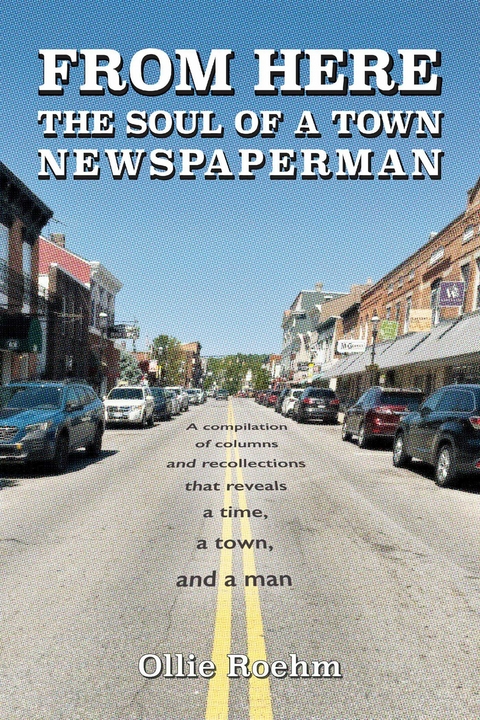
FROM HERE (eBook)
116 Seiten
Bookbaby (Verlag)
979-8-3509-0823-7 (ISBN)
There was a time when community newspapers thrived and were of great importance to the area they served. People could count on their newspaper to give them what they wanted and needed to know. They depended on the folks at the paper to put out the latest important information about their schools, mayors, city councils, planning commissions, township trustee boards, crime and other serious news. Readers also enjoyed lighter fare such as stories about community events, sports, births, weddings, engagements, feature stories and a lot more. Issues of the day were discussed and debated on the opinion page. The town newspaper was a pretty big deal. Sadly, due to many reasons, the number of community newspapers in America has dropped like a bomb. And that bomb has been devastating. Newspaper deserts have been created all over the country, leaving many communities without a paper. Most of the surviving publications have cut editorial staffing to the point where they only provide a fraction of the news they formerly delivered. Thus, a lot of people don't know what's going on where they live. Important stories that deeply affect their lives are not being reported. Public officials are not being held accountable. Ollie Roehm was part of The Harrison Press for the better part of 25 years, serving as editor for most of them. It was during a time when the town newspaper was an important part of the fabric of a community. The Harrison Press earned a combination of 30 national and state awards from 1997 until the time Ollie left in 2011. Sixteen of those awards were for his column, "e;From Here."e; Many of those award-winning columns are scattered through this book.
HEARTSTRINGS
Many of my columns were sincere attempts to touch the reader’s heart. I hope some of these touch yours.
It was 1988 and I was selling advertising for The Harrison Press. Our editor needed to fill some space on the opinion page and challenged me to write something. I accepted his challenge and wrote my first newspaper column. Unbeknownst to me, he later submitted it to the National Newspaper Association and it won a national award. Thanks Mom and Dad.
Parents thanked for prejudice-free youth
11-16-88
From here it looks like there are a couple of people I need to thank. My parents, Lou and Gladys Roehm, are a true phenomenon. They raised a son in Midwestern America who gets uncomfortable when he hears a racist joke. They raised a son who hates the N-word.
In the area where I come from and now live, it’s a very popular word. I remember teachers in my school using the word in the 1960s. Today in 1988, some teachers still use it, only more discreetly.
Most of my friends use the word. But these teachers and friends come by it naturally. They were brought up by parents who use the word because their parents used the word.
The fact that my parents aren’t racist towards black people defies logic. Most, if not all of their brothers and sisters are bigots and so were their parents. They were both raised in a time when the inferiority of “negroes” was a given. But somehow they both saw through all of this and decided that the color of one’s skin was not an accurate barometer of one’s character and worth.
My dad says the most profound incident in his life that affected his attitude happened in 1937 in New Albany, Indiana. He was playing on the local semi-pro baseball team and they played a barnstorming black team called the Zulu Cannibal Giants.
They were dressed in ridiculous cannibal garb - grass skirts, bones through the nose and barefoot. Dad says the reason they had to demean themselves and their heritage in this manner was because it was the only way they could get the chance to play against whites.
White people did not wish to play blacks on legitimate terms because they were downright afraid of getting beat by the people they thought inferior. So they set it up so that if they were beaten they could still hold on to their supremacist attitude because they had demeaned their black opponent in the process.
The Zulu Cannibal Giants beat my dad’s team badly and in the process won my dad’s respect as players and somehow as human beings.
Another situation that deeply affected my father was the way the blacks were separated from whites in the military during World War II. During his basic training there was a barracks for whites and a separate one for black soldiers. He figured that situation would change once they were overseas and in combat. He was wrong.
Even in the field of battle, blacks were separated from whites. Even though they fought alongside whites in the defense of their country, when it was time to set up camp they were made to pitch their tents in a separate area. Although most white soldiers went home with their racist attitudes reconfirmed by the U.S. Marine Corps, the situation made my dad sick.
My mom says one time my grandmother served a black man raw chicken in her restaurant. Mom says this and many other acts of bigotry began to make her uneasy as she was growing up. She says her feelings were confirmed when she met my dad and found that there was someone else in the world that was more than uncomfortable with racist attitudes. She made sure her son realized there are good and bad in all races and that equality is right.
My son is not permitted to use the N-word. He is being taught that it is a bad word right up there with the F-word and all the rest of the biggies. We are teaching him all people deserve respect and that no race of people is better than another.
I hope someday he will appreciate these lessons we’ve given him. He has his grandma and grandpa to thank for helping him break an ugly tradition based on ignorance and fear and introducing one based on love, respect and common sense.
I met and interviewed many older folks while I was at The Harrison Press. Here are a few of several columns I wrote about those encounters. I’ll never forget these three guys.
Herbie and the flags
5-31-06
He stands near his van in the cemetery grass, wearing his Legion hat and holding a handful of brochures. I haven’t seen him in a while so I walk over and say hello.
“You want one of these?” he asks.
“Sure, thanks Herbie.”
He looks a little tired, but pretty good. He’s had a couple of rough spells over the past few years, enough to kill most men. But Herb Benson is tougher than most men.
He may walk in shorter steps now but Herbie still gets there and back. And today he’s at Glen Haven Cemetery passing out programs to folks attending this year’s Memorial Day service.
A lady approaches Herb and asks, “Are those programs and can I have one?”
“Certainly honey, here you go,” Herbie replies. He turns around and leans against the van.
“Here Herb, sit down,” I tell him.
“No, no, I’m alright,” he says. He looks away, probably in search of the line of cars and people soon to appear at the top of the hill, the inevitable contingent of folks coming to the service.
Harrison always has a decent turnout at the cemetery on Memorial Day. Herb, a World War II combat veteran, is probably proud of that. I know I am.
“I guess you’ve been a busy guy the last few days,” I say to Herbie.
“Yeah, but I think this might be my last year.” He looks down at the ground for a few seconds.
Herb was here yesterday placing flags on the headstones of military veterans as he has every Memorial Day weekend for more than 40 years. Over the next few days he’ll be here taking them down.
“How many do you put up,” I ask.
“About five hundred here and another hundred across the street,” Herb says. “Then there’s the other four cemeteries.”
Herb starts chuckling, “Sometimes I used to get the kids out of bed and make them help me.”
For the last several years Herb has been getting assistance from a group of committed younger American Legion and Sons of the American Legion members.
“Speedy will probably take over next year,” Herbie says. “He’ll do a good job.”
Speedy Smith and other Sons of the American Legion members have spent the past few years learning from Herbie. Finding more than 600 headstones in five cemeteries isn’t easy, especially when the only map is inside Herbie’s head.
I sit on the back of Herb’s van and watch him hand programs to a carload of folks. He trips and winces a little as he steps from the grass to the pavement, but he’s OK.
In a few minutes everyone will join together to honor our country’s fallen heroes. Hundreds of American flags will flutter on the graves while prayers are read and speeches are given. Flags that Herbie, Speedy and the boys put there.
Flags that will appear again next year, and the year after that.
Mr. Umpire
5-26-99
Cincinnati lost a baseball legend on Monday, May 17, 1999. Alfred Wilson.
You’ve probably never heard of him, but I’m betting that Al Wilson, a Harrison native, spent more time on the baseball diamonds of the Queen City than anyone, ever.
Al began umpiring in 1946 and called his last game in August 1992 at Melvin Lake Memorial Park, home of Harrison Junior Baseball. Al was 80 years old and still the best.
It is impossible to calculate the number of young men who had the honor of playing in a game umpired by Al. Pete Rose could tell you about Al Wilson. So could other Cincinnati baseball legends like Russ Nixon, Roy Nixon, Eddie Brinkman and Dave Parker. Former Harrison hardball standouts like Daryl Back, Gene Ziegler, Craig Bachman, Mark Knose and many, many others probably remember him.
Although Al umpired a lot of softball and semi-pro baseball games, he spent a good portion of his career calling youth games. He was inducted into the Cincinnati Knothole Hall of Fame in 1982. Al’s family has instructed that memorials be sent to Harrison Junior Baseball.
I wrote a story about Al in ‘92 and he told me why he preferred the company of boys to men while on the baseball diamond.
“I quit umpiring softball. Those guys get a couple bottles of beer in ‘em and their eyes don’t focus the same way mine do. You can’t tell them anything,” said Al.
My interview with Al took place at the Junior Baseball complex while he was getting ready to umpire a league championship B-level game. He told me a story about a call he missed while umpiring a semi-pro game years before.
“Some guy out in...
| Erscheint lt. Verlag | 15.8.2023 |
|---|---|
| Sprache | englisch |
| Themenwelt | Literatur ► Romane / Erzählungen |
| ISBN-13 | 979-8-3509-0823-7 / 9798350908237 |
| Informationen gemäß Produktsicherheitsverordnung (GPSR) | |
| Haben Sie eine Frage zum Produkt? |
 EPUB (Ohne DRM)
Größe: 4,7 MB
Digital Rights Management: ohne DRM
Dieses eBook enthält kein DRM oder Kopierschutz. Eine Weitergabe an Dritte ist jedoch rechtlich nicht zulässig, weil Sie beim Kauf nur die Rechte an der persönlichen Nutzung erwerben.
Dateiformat: EPUB (Electronic Publication)
EPUB ist ein offener Standard für eBooks und eignet sich besonders zur Darstellung von Belletristik und Sachbüchern. Der Fließtext wird dynamisch an die Display- und Schriftgröße angepasst. Auch für mobile Lesegeräte ist EPUB daher gut geeignet.
Systemvoraussetzungen:
PC/Mac: Mit einem PC oder Mac können Sie dieses eBook lesen. Sie benötigen dafür die kostenlose Software Adobe Digital Editions.
eReader: Dieses eBook kann mit (fast) allen eBook-Readern gelesen werden. Mit dem amazon-Kindle ist es aber nicht kompatibel.
Smartphone/Tablet: Egal ob Apple oder Android, dieses eBook können Sie lesen. Sie benötigen dafür eine kostenlose App.
Geräteliste und zusätzliche Hinweise
Buying eBooks from abroad
For tax law reasons we can sell eBooks just within Germany and Switzerland. Regrettably we cannot fulfill eBook-orders from other countries.
aus dem Bereich