Conversation with Einstein (eBook)
364 Seiten
Bookbaby (Verlag)
979-8-3509-0784-1 (ISBN)
Scott Jacobsen is a seasoned broadcast engineer and proud alumnus of the University of Oklahoma, where he honed his storytelling skills studying journalism. In his free time, he enjoys the thrill of the open road, frequently embarking on exhilarating bicycle tours. In 1975, he not only participated in a prestigious cross-country bicycle tour, but also captured his adventure on the big screen, starring in the feature film, 'The Great American Bike Tour.' A romantic at heart, Scott fondly recalls chasing his future wife, Peggy, up Gates Pass on their first date-a testament to his love for both cycling and his life partner. Currently, Scott and Peggy enjoy the picturesque landscapes of Tucson, Arizona, which they call home. Always inspired by his journeys, both on two wheels and through the airwaves, Scott continues to share his unique experiences with a broad audience.
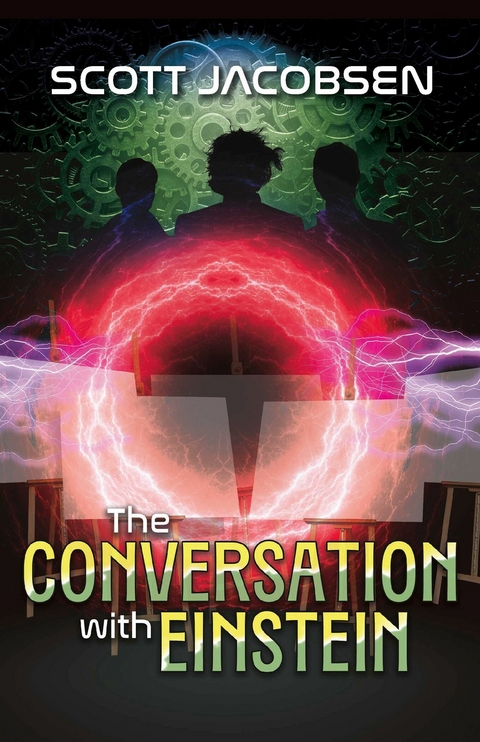
In "e;The Conversation with Einstein"e;, Jeremiah Laing is a time-travelling historian from the 42nd century, who becomes marooned in the year 1931 after saving a man named Sidney Chalmers from an accident. After an intriguing conversation at one of Einstein's lectures, the trio discover that Chalmers holds an invention capable of compressing interstellar distances into a single step - the Portal. Their journey through the Portal lands them in a tropical paradise with residents blessed with advanced nanotechnology. There, they discover a looming disaster threatening all existence - a gigantic, unstable black hole known as the Hatchery. As the team travels to Earth's late Paleocene age, they realize the Hatchery's reach extends even there, and they are running out of time. The team employs nanotechnology to create the Projector, an advanced version of Chalmers' Portal. In their escape, they find themselves in an alternate realm with malfunctioning nanotech causing accelerated aging. Only Jeremiah and his android daughter, Tamara, remain unaffected. As Einstein and Chalmers work to regain access to the realm that fuels their life-sustaining nanotech, Jeremiah and Tamara are left with their final equations. Will these cryptic solutions allow them to design a multistage Portal back to real space and evade their impending doom?"e;The Conversation with Einstein"e; is a thrilling journey across time and space, testing the boundaries of human ingenuity, persistence, and the will to survive against all odds.
1
Marooned
“Αnd now we take the value this statement and factor it in to the result of this quantity represented here, and, like a fine symphony, our equation balances.” Professor Einstein turned from his panoramic series of equation-filled chalkboards, grinning to the multitude in the Oxford lecture hall, which would have made a fine movie theater if the room were darkened. Nobody knew it yet, but his blackboard equations would be preserved for some time to come. “Any questions?”
Jeremiah could hardly keep from raising his hand—which was a thing he dare not do. A young chap, with his dark hair swept back from a pale, moon-like face which sported a rather large, straight nose, gained Einstein’s nod.
“Yes, professor, but to what dimension are you referring?”
Einstein was quick to answer. “Why, our dimension, of course.” He indicated his scrawled equations. “Isn’t that obvious?” A short burst of laughter erupted, not all students taking part, for Professor Einstein raised his short piece of chalk in a fashion that said he wasn’t finished. “Mr. …”
“Chalmers, sir. Sidney Chalmers.”
“Mr. Chalmers, I am curious; do you know of any other realm in which this definition of space-time would be useful?”
Chalmers glanced nervously side-to-side, no doubt wondering whether Professor Einstein was about to make him a fool. Jeremiah, however, waited in suspense. This Chalmers had asked the same question he would have, if he were able.
“Well,” Chalmers started, continuing to shift his eyes to his sides, clearly uneasy with the attention he had gained with his question, “what about the fourth dimension?”
“Ah,” the professor said, “you’ve been reading H.G. Wells.”
More relaxed laughter erupted, but it was cut short when Einstein put his hands on his hips, waiting for more from Chalmers.
“Aye, when I was a wee lad,” Chalmers admitted, his face reddening with embarrassment. But he quickly got past that and continued. “Nonetheless, by the look of things there,” he gestured expansively to the blackboards, “I’d say you’re suggesting a fine way of tying time to the fabric of space. Wouldn’t that by itself define another dimension if then the fabric could be manipulated?”
Einstein’s moustache twitched as he stared at the man for several seconds. Had the professor at last been dumbfounded?
“Science fiction,” he smiled patronizingly. It was not to be. The bell rang and the clatter of students rising from their seats filled the auditorium. Jeremiah thought it was over, but Einstein surprised him when he called to Chalmers over the noise of exiting attendees, “See me this afternoon at three. I would like to discuss something with you.”
Chalmers brightened, apparently as equally astonished as was Jeremiah by Einstein’s curiosity. “Of course!”
“You know where my office is?”
“Aye, professor, I’ll be there.” Chalmers waved and hurried off, following the other students to their next classes.
Jeremiah hung back while Einstein turned back to his equations as the room quieted. The man jumped when Jeremiah said, “Excuse me, professor.”
“Oh, who are you?”
“Jeremiah Laing. I was wondering…”
“Yes?”
“If I might sit in on your discussion with Mr. Chalmers?”
Einstein’s brow furled, its wrinkles deepening. “Why?” Jeremiah smiled inwardly. It was the one question every great scientist asked—repeatedly.
“It seems Mr. Chalmers and I think along the same lines. Your banter just now piqued my curiosity.”
Einstein smiled easily. “Of course, Mr. Laing, please come join us.”
“Wonderful!” Jeremiah said with feeling. “I’ll see you, then.” Einstein had already turned back to his equations and waved his piece of chalk at him absently as acknowledgement. Even with his established theories, Einstein was not one to sit on his laurels; he was a man who would say to himself, what if I made this or that modification to my statements? What would it yield? It was how every great mind hammered out the revelations that were part of human history.
Jeremiah paused on his way out to look again at the particular sequence of symbols which had already made Einstein famous for his theory of relativity. It would be interesting to see how well this Chalmers chap would follow such thinking.
And then, quite suddenly, he remembered that in his own time line, Einstein, as part of his three-chapter lecture series on relativity, was on this day to give a lecture on the expansion of the universe and demonstrate, using his eloquent mastery of mathematics, how to quantify its dimensions—not his relativity theory! No doubt because relativity was part of the series, and it was also used to determine the age of the universe, Jeremiah had not thought the subject of today’s lecture to be out of the ordinary.
And now his encounter with Chalmers, just three hours ago, resurfaced. It was raining—as it still was now—and he’d spotted a cab running in his direction but he was too distant to hail it. Chalmers was standing on the curb, looking like he was about to step into the street, either to hail the cab for himself or simply to cross over—Jeremiah didn’t know which—and he’d called to him to hail the cab for him. Chalmers had almost lost his balance as he’d stopped short of moving into the street, only to have another car—a small, maneuverable BMW by the look of it—cut over from the center lane into the curb lane to just barely miss the poor, startled Chalmers, who had said to him, after they had boarded their cab, “I believe you saved my hide back there, old man.”
“Rubbish,” Jeremiah had dismissed. “You’d have been across before that car came along.”
“Oh, I don’t think so, sir. It was scarcely a second after you called me back when it came careening by, I’d say. Look; you’ll at least let me get the fare, won’t you? It’s the least I can do.”
“Of course.”
As it happened, they were both headed to the university, and Jeremiah thought nothing of it at the time—but now…now he realized the encounter might have ramifications that would ring throughout time from here to distant futurity! And in less than two hours he might discover how much influence his encounter with Chalmers had.
But if Chalmers was a key individual, he should be able to determine that now.
Jeremiah moved to a bench near a fountain in front of the library where he could see a good distance in all directions. Eavesdroppers could not be permitted. He pulled his alt-space communicator from his inner vest pocket and thumbed it to initiate a link. There was no answer. He tried again repeatedly to no avail. Running a self-diagnostic on the communicator showed nominal status. He felt panic building which showed in his trembling fingers as they moved frantically over the communicator’s miniature panel. Alt-space interface parameters were correct to navigate to his origin time and location:
Origin endpoint: 4187.AD.June.3.15.30.GMT.-7.Tucson.NA.
There was no echo-back from his time. No beacon stream, no referent, nothing. It was impossible, unless—unless his point of origin from his current perspective had become inaccessible.
Alright, then; time to run a double-blind. He called up his current coordinates.
Local endpoint: 1931.AD.May.16.13.42.GMT.Oxford.BC.
He got up from his bench and walked through lingering drizzle to a newsstand. The header of the local newspaper showed the correct date, and when he spun around, a nearby clock tower gave the time just one minute behind that indicated by his communicator.
Unbidden, he felt adrenaline flood his system as his feeling of panic redoubled. Get a grip, man! He admonished himself. It’s not the end of the world; at least, not yet.
In all his many travels, Jeremiah had been careful in the extreme—as any Traveler should—not to disturb the continuity of his timeline. Just twenty five years or so hence, the many-universes theorem would be postulated, which was no theory at all in Jeremiah’s time. In the advent time travel’s discovery, it was proven fact. But even in his far-flung future home, man had not learned to traverse the Multiplicity of Histories, realities which closely paralleled—or largely diverged from!—their neighbors.
Jeremiah searched his memory for any other action on his part which could have so profoundly influenced his time-line and he found none. He had no choice but to conclude that Chalmers was the linchpin in the flow of time which led to his own temporal circumstance. Had the man changed futurity so drastically by his simple suggestion to Professor Einstein? Apparently he had. The many-universes postulate had already demonstrated many times to Jeremiah’s lost temporal peers that once a divergence had occurred, it was next to impossible...
| Erscheint lt. Verlag | 9.6.2023 |
|---|---|
| Sprache | englisch |
| Themenwelt | Literatur ► Fantasy / Science Fiction ► Science Fiction |
| Literatur ► Romane / Erzählungen | |
| ISBN-13 | 979-8-3509-0784-1 / 9798350907841 |
| Informationen gemäß Produktsicherheitsverordnung (GPSR) | |
| Haben Sie eine Frage zum Produkt? |
 EPUB (Ohne DRM)
Größe: 2,1 MB
Digital Rights Management: ohne DRM
Dieses eBook enthält kein DRM oder Kopierschutz. Eine Weitergabe an Dritte ist jedoch rechtlich nicht zulässig, weil Sie beim Kauf nur die Rechte an der persönlichen Nutzung erwerben.
Dateiformat: EPUB (Electronic Publication)
EPUB ist ein offener Standard für eBooks und eignet sich besonders zur Darstellung von Belletristik und Sachbüchern. Der Fließtext wird dynamisch an die Display- und Schriftgröße angepasst. Auch für mobile Lesegeräte ist EPUB daher gut geeignet.
Systemvoraussetzungen:
PC/Mac: Mit einem PC oder Mac können Sie dieses eBook lesen. Sie benötigen dafür die kostenlose Software Adobe Digital Editions.
eReader: Dieses eBook kann mit (fast) allen eBook-Readern gelesen werden. Mit dem amazon-Kindle ist es aber nicht kompatibel.
Smartphone/Tablet: Egal ob Apple oder Android, dieses eBook können Sie lesen. Sie benötigen dafür eine kostenlose App.
Geräteliste und zusätzliche Hinweise
Buying eBooks from abroad
For tax law reasons we can sell eBooks just within Germany and Switzerland. Regrettably we cannot fulfill eBook-orders from other countries.
aus dem Bereich