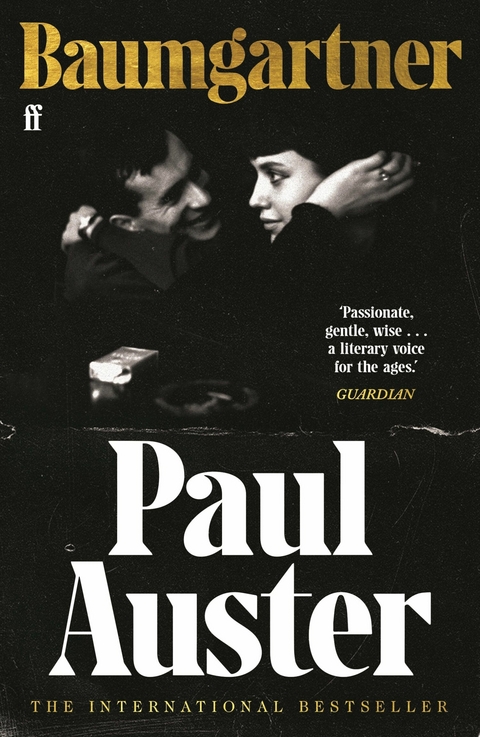
Baumgartner (eBook)
176 Seiten
Faber & Faber (Verlag)
978-0-571-38496-9 (ISBN)
Paul Auster was the bestselling author of 4 3 2 1, Sunset Park, The Book of Illusions, Moon Palace and The New York Trilogy. He and Spencer Ostrander collaborated on Bloodbath Nation. In 2006, he was awarded the Prince of Asturias Prize for Literature. His other honours include the Prix Medicis Étranger for Leviathan, the Independent Spirit Award for the Screenplay of Smoke, the Los Angeles Times Book Prize for Burning Boy, and the Carlos Fuentes Prize for his body of work. His novel 4 3 2 1 was shortlisted for the 2017 Man Booker Prize. He was a member of the American Academy of Arts and Letters, and was a Commandeur de l'Ordre des Arts et des Lettres. His work was translated into more than forty languages. His final novel, Baumgartner, was published in November 2023. He died on 30 April 2024.
And then it started, little by little it started, until they were married five years later and his real life began. 'Exquisite ... A super-abundantly gifted, big-hearted novelist.' Ian McEwan'A writer whose work shines with intelligence and originality.' Don DeLilloThe life of Sy Baumgartner - noted author, and soon-to-be retired philosophy professor - has been defined by his deep, abiding love for his wife. Now Anna is gone, and Baumgartner is trying to live with her absence. But Anna's voice is everywhere still, in every spiral of memory and reminiscence, in each recalled episode of the passionate forty years they shared. Rich with feeling, wit and an eye for beauty in the smallest, most transient episodes of ordinary life, Baumgartner is a luminous work - a tender final masterpiece from one of the world's greatest writers. 'A master.' The TimesWhat readers are saying:***** Perfect, subtle, charming, funny and sad. **** Well-written and compelling but also comforting, like catching up with an old friend. **** A, beautifully-written and intelligent piece of understated introspective fiction from Auster.
Baumgartner is sitting at his desk in the second-floor room he variously refers to as his study, his cogitorium, and his hole. Pen in hand, he is midway through a sentence in the third chapter of his monograph on Kierkegaard’s pseudonyms when it occurs to him that the book he needs to quote from in order to finish the sentence is downstairs in the living room, where he left it before going up to bed last night. On the way downstairs to retrieve the book, it also occurs to him that he promised to call his sister this morning at ten o’clock, and since it is almost ten now, he decides that he will go into the kitchen and make the call before retrieving the book from the living room. When he walks into the kitchen, however, he is stopped in his tracks by a sharp, stinging smell. Something is burning, he realizes, and as he advances toward the stove, he sees that one of the front burners has been left on and that a low, persistent flame is eating its way into the bottom of the small aluminum pot he used three hours ago to cook his breakfast of two soft-boiled eggs. He turns off the burner, and then, without thinking twice, that is, without bothering to fetch a pot holder or a towel, he lifts the destroyed, smoldering egg boiler off the stove and scalds his hand. Baumgartner cries out in pain. A fraction of a second later, he drops the pot, which hits the floor with an abrupt, clattering ping, and then, still yelping in pain, he rushes over to the sink, turns on the cold water, sticks his right hand under the spout, and holds it there for the next three or four minutes as the chilly stream pours down over his skin.
Hoping he has warded off any potential blisters on his fingers and palm, Baumgartner cautiously dries off his hand with a dish towel, pauses for a moment to flex his fingers, pats his hand with the towel a couple of more times, and then asks himself what he is doing in the kitchen. Before he can remember that he is supposed to be calling his sister, the telephone rings. He lifts the receiver off the hook and mumbles forth a guarded hello. His sister, he says to himself, finally remembering why he is here, and now that it is past ten and he has failed to call her, he fully expects Naomi to be the person on the other end of the line, his cantankerous younger sister who will no doubt begin the conversation by scolding him for having forgotten to call her again, as he always does, but once the person on the other end begins to speak, it turns out not to be Naomi but a man, an unknown man with an unfamiliar voice who is stammering out some sort of apology to him for being late. Late for what? Baumgartner asks. To read your meter, the man says. I was supposed to be there at nine, remember? No, Baumgartner doesn’t remember, he can’t recall a single moment in the past days or weeks when he thought the meter reader from the electric company was scheduled to be there at nine, and therefore he tells the man not to worry about it, he plans to be home all morning and afternoon, but the electric company man, who sounds young and inexperienced and eager to please, insists on explaining that he has no time to explain just now why he didn’t show up on time, but there was a good reason for it, a reason beyond his control, and that he will be there as soon as he can. Fine, Baumgartner says, I’ll see you then. He hangs up and looks down at his right hand, which has begun to throb from the burn, but when he examines his palm and fingers, he sees no signs of blistering or peeling skin, just a general sort of redness. Not so bad, he thinks, I can live with that, and then, addressing himself in the second person, he thinks, You stupid ass, consider yourself lucky.
It occurs to him that he should call Naomi now, on the spot, to head her off at the pass, but just as he lifts the receiver off the hook to dial her number, the doorbell rings. A prolonged sigh emerges from Baumgartner’s lungs. With the dial tone still buzzing in his hand, he hangs up the receiver and begins walking toward the front of the house, grumpily kicking aside the scorched pot as he heads out of the kitchen.
His mood brightens when he opens the door and sees that it is the UPS woman, Molly, a frequent visitor who over time has acquired the status of … of what? Not quite a friend, exactly, but more than just an acquaintance by now, given that she has been coming to the door two or three times a week for the past five years, and the truth is that the lonely Baumgartner, whose wife has been dead for close to a decade, has a secret crush on this chunky woman in her mid-thirties whose last name he doesn’t even know, for even if Molly is black and his wife was not, there is something in her eyes that makes him think of his dead Anna whenever he looks at her. It never fails to happen, but precisely what that thing is he is hard-pressed to say. A sense of alertness, perhaps, although it is a good deal more than that, or else something that could be described as a radiant vigilance, or else, if not that, quite simply the power of an illuminated selfhood, human aliveness in all its vibratory splendor emanating from within to without in a complex, interlocking dance of feeling and thought—something like that, perhaps, if such a thing makes any sense, but whatever you want to call the thing that Anna had, Molly has it as well. For that reason, Baumgartner has taken to ordering books he does not need and will never open and will end up donating to the local public library for the sole purpose of spending a minute or two in Molly’s company every time she rings the bell to deliver one of the books.
Good morning, Professor, she says, smiling her illuminated smile at him as if it were a benediction. Another book for you.
Thank you, Molly, Baumgartner says, smiling back at her as she hands him the slender brown package. How are you doing today?
It’s early yet—too soon to tell—but so far the ups are more up than the downs are down. It’s hard to feel blue on a gorgeous morning like this one.
The first good day of spring—the best day of the year. Let’s enjoy it while we can, Molly. You never know what’s going to happen next.
Ain’t that the truth, Molly replies. She lets out a short, complicitous laugh, and then, before he can think of some clever or amusing response that would prolong the conversation, she is waving good-bye to him and walking back to her truck.
That is another one of the many things Baumgartner likes about Molly. She always laughs at his lame remarks, even the most feeble ones, the out-and-out duds.
He walks back into the kitchen and deposits the unopened book package on top of the pile of other unopened book packages wedged into a corner of the room near the table. The tower has grown so high of late that it looks as if one or two more of those pale brown rectangles will topple the whole thing over. Baumgartner makes a mental note to remove the books from their cardboard enclosures at some point later in the day and transfer the naked books to the least full of the several cartons sitting on the back porch that have been set aside with other unwanted books for donation to the public library. Yes, yes, Baumgartner says to himself, I know I promised to do that the last time Molly was here, and the time before that as well, but this time I really mean it.
He looks at his watch and sees that it is ten-fifteen. Getting late, he thinks, but perhaps not too late to call Naomi and head her off at the pass before she can begin showering him with foulmouthed insults. He reaches for the phone, but just as he is about to lift it off the hook, the little white devil rings again. Again, he assumes it is his sister, and again he is wrong.
A small, trembling voice answers his mumbled hello with a barely audible question: Mr. Baumgartner? The words are spoken by someone so young and so clearly in distress that Baumgartner is flooded with alarm, as if every organ in his body were suddenly working at twice its normal speed. When he asks who it is, the voice says Rosita, and all at once he knows that something must have happened to Mrs. Flores, the woman who first came to clean the house a few days after Anna’s funeral and has been coming twice a week since then to mop the floors and vacuum the rugs and tend to his laundry and handle numerous other household chores that have prevented him from living in squalor and disarray for the past nine and a half years, the good and steady and mostly silent, walled-off Mrs. Flores, with her construction-worker husband and three children, the two grown boys and the youngest one, Rosita, a skinny twelve-year-old with magnificent brown eyes who comes to the house every year on Halloween for her little bag of goodies.
What’s wrong, Rosita? Baumgartner asks. Has something happened to your mother?
No, Rosita says, not my mother. My father.
Baumgartner waits for several moments as the girl’s pent-up tears spill out of her in a short, stifled crying fit, and because the little one is struggling to hold herself together and will not allow herself to let go completely, her breath has turned into a series of chopped-off gasps and shudderings. Baumgartner understands that because Mrs. Flores was scheduled to come to the house this afternoon, and because it is spring break and her daughter is not at school, she has instructed Rosita to call Mr. Baumgartner about the emergency while she herself goes off to confront whatever it...
| Erscheint lt. Verlag | 7.11.2023 |
|---|---|
| Sprache | englisch |
| Themenwelt | Literatur ► Romane / Erzählungen |
| ISBN-10 | 0-571-38496-X / 057138496X |
| ISBN-13 | 978-0-571-38496-9 / 9780571384969 |
| Informationen gemäß Produktsicherheitsverordnung (GPSR) | |
| Haben Sie eine Frage zum Produkt? |
 EPUB (Adobe DRM)
Kopierschutz: Adobe-DRM
Adobe-DRM ist ein Kopierschutz, der das eBook vor Mißbrauch schützen soll. Dabei wird das eBook bereits beim Download auf Ihre persönliche Adobe-ID autorisiert. Lesen können Sie das eBook dann nur auf den Geräten, welche ebenfalls auf Ihre Adobe-ID registriert sind.
Details zum Adobe-DRM
Dateiformat: EPUB (Electronic Publication)
EPUB ist ein offener Standard für eBooks und eignet sich besonders zur Darstellung von Belletristik und Sachbüchern. Der Fließtext wird dynamisch an die Display- und Schriftgröße angepasst. Auch für mobile Lesegeräte ist EPUB daher gut geeignet.
Systemvoraussetzungen:
PC/Mac: Mit einem PC oder Mac können Sie dieses eBook lesen. Sie benötigen eine
eReader: Dieses eBook kann mit (fast) allen eBook-Readern gelesen werden. Mit dem amazon-Kindle ist es aber nicht kompatibel.
Smartphone/Tablet: Egal ob Apple oder Android, dieses eBook können Sie lesen. Sie benötigen eine
Geräteliste und zusätzliche Hinweise
Buying eBooks from abroad
For tax law reasons we can sell eBooks just within Germany and Switzerland. Regrettably we cannot fulfill eBook-orders from other countries.
aus dem Bereich