


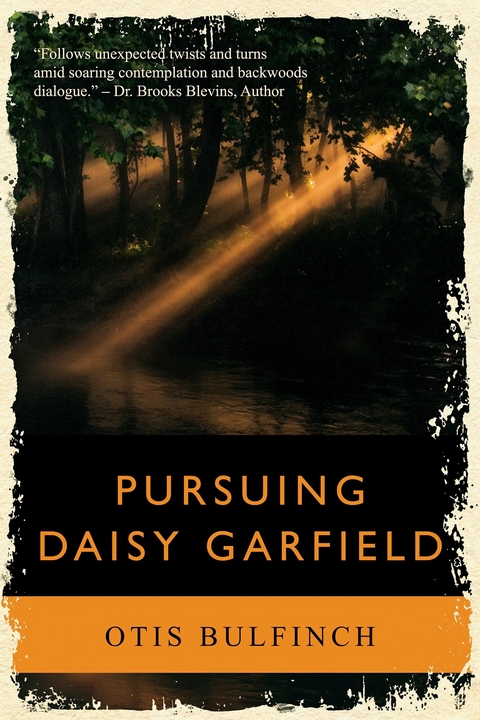
Pursuing Daisy Garfield (eBook)
408 Seiten
Bookbaby (Verlag)
979-8-9866178-1-7 (ISBN)
The beautiful and enigmatic Daisy Garfield occupies the center of this tale about a woman's search for meaning in the 19th century Ozarks backwoods. Resourceful beyond her years, Daisy fends off the predatory advances of a teacher, a preacher, and a corrupt lawman in strikingly violent ways. Her resources come to an end when her husband John accidentally splits his shin with an axe. When gangrene sets in, she asks a passing trapper, William Crawford, to end John's suffering. In the vain hope that Daisy will give herself to him, William consents to kill her husband, an act that plunges him into guilt and self-recrimination. Crawford's misgivings take an unexpected turn when a group of hardscrabble homesteaders enlist him in their search for John's killer. When they discover not just one, but two rotted corpses, the mystery deepens for them all. Meanwhile, Daisy undergoes her own search for peace and security as she navigates alone the dangers of the Ozarks. As intelligent as she is beautiful, Daisy struggles to reconcile the claims of religion with the evils inflicted upon her. Pursuing Daisy Garfield is at once a mystery and a profound meditation on the hope that "e;beauty will save the world."e; Written in the backwoods vernacular of the Ozarks, readers will be reminded of the gritty and elegiac writing found in the novels of Cormac McCarthy.
CHAPTER ONE
SYCAMORE BALD
THE MISSOURI OZARKS
MAY 19, 1890
The road was rutted by the wheels of mule wagons and washed out by the annual torrents of spring. The wallows jarred the wheels pretty rough, and the mule had to be encouraged with whip and reins, but the wagon trundled on, and the trail led upward into a mystery of green that looked very like the mystery left behind. The waggoneer cursed, as well he ought, for cursing comes natural in desolate places. God is in nature—everyone insists it is so—but He is shy and unpredictable as a hummingbird, and you’ve got to look obliquely and quickly at that, and even then, He has probably already flown. Maybe if God were more Jove-like, standing tall and majestic as an oak with mistletoe hair and the doves of Aphrodite twittering and coupling in his branches, the waggoneer might have been gentler in his admonitions. But Jehovah God is not an oak. He is a hummingbird or a beetle iridescent with green, scuttling for cover under leaf mold.
The waggoneer was not old, not yet forty—the prime of life for many. His beard was carefully cropped and still coal black, and what wrinkles he had were gained by squinting in the sun; his eyes were brown, almost black, and he wore his hat pulled down to his brows. In fact, he was a plain man of common height who fastidiously tended what God and nature had bestowed. The crazy pulse of youthful desire had settled into a kind of throbbing of perpetual pursuit, and he could not pass the Garfield place without some hope of seeing Mrs. Garfield scattering corn to the chickens or pinning laundry to the line. Once she waved at him through the window, but he wanted more than she could or would consent to give.
Mr. Garfield was not dead. A week ago, his axe had sheared away from the chopping block and delivered a bone-splitting gash to his lower shin. The leg had been doctored by an old woman who applied mayapple pap and slipped chicken bones in his pockets, but in a matter of days, the gash became a stinking wound, and either the leg would go, or Garfield would. And it was a shame. Garfield had shot dead a ruffian who raped a girl over in Notch and was threatening more mischief; it was a fair fight with a just conclusion, and Garfield had never wavered. He had simply shot the ruffian thrice through the gut and that was that. And now here Garfield was, stinking of gangrene because of a goddamned knot he failed to see while swinging an axe as he had done ten thousand times before. It was shit luck. But for the waggoneer, it wasn’t shit luck at all, at least not today, because Mrs. Garfield—Daisy—was out front of the cabin, restoring a cedar rail to the top of the split rail fence and brushing the hair from her eyes. The rail was not particularly heavy, and one end had begun to rot and fester. A couple of useless and rusty nails pointed nowhere in particular and would never be driven into anything. Still the rail could last another year or so, maybe. The fence kept nothing out nor nothing in, but once constructed, it seemed necessary.
“Mornin’, Mizz Garfield.” The waggoneer lifted his hat and smiled, and he hoped that his wrinkles might manifest his good humor and trustworthiness, along with some latent traces of youth.
“Mr. Crawford,” Daisy replied.
“Need help?”
“Not with this here, but thank you.”
“Fences is always fallin’ down, ain’t they? Rain, critters—time, I reckon. How’s Mr. Garfield?”
Tears pooled in Daisy’s eyes, and she rolled the fence rail so the rotted end faced down. “Not too good. We had a regular doctor out yesterday who gave him something for pain, and he said John wouldn’t . And a preacher came by, praying and pretending he knows things nobody knows.” Her pretty head drooped, and a curl of her hair fell forward.
“Now I’m s’prised to hear you say that, Mizz Garfield, ‘bout preachers. Most women of my acquaintance put more stock in the maunderin’ of preachers.”
“Most women, like most men, are liars.” Daisy studied William a moment before she said, “Tell me, Mr. Crawford, why do I tend my husband, do you think?”
“Well, I reckon because you’uns belong to one another by troth and Holy Writ.”
“Yes, that is true. We do belong to one other. But taking care of John is more like tending to this fence. John living, breathing, sitting at the table and touching my hand keeps away the rain and the vermin and even time. I say unto you, Mr. Crawford, that John upright and polishing his rifle fends off time while John abed, well …”. Daisy looked Crawford in the eye and resumed, “God ain’t nothin’ but time, Mr. Crawford. John upright keeps God at bay while John dying ushers God right into my bedroom.”
“Never thought about it such a way. I ain’t shore I understand.”
So Daisy said, “I have determined that ‘God’ is just a word for giving up; kind of like saying ‘uncle’ when your arm is twisted high behind your back. Likewise, Time will surely bend your arm behind your back. Therefore, Mr. Crawford, God is Time.”
William puckered his lips and considered the logic. “Huh. Whereabouts do you hail from, Mizz Garfield? You and Mr. Garfield?”
“William Crawford—you’ve been driving that wagon past our front door ever since we settled here. Sometimes you carry pelts to town, and sometimes you bring back meal and whiskey; I know. I’ve seen you peer through my window and heard you swear by Satan himself every time one of your wheels lodges in a rut. And I’ve seen you sit on this very fence and talk to my John about nothing—weather and the sunrise and a bobcat you saw last Thursday. And only now do you think to ask whence we hail? Because I said something about the Lord God you did not expect?”
“Sorry, Mizz Garfield. I was just makin’ conversation, and what with Mr. Garfield laid up, I don’t know what to say,” William said. “I ain’t never asked ‘cause—well, you know the hill code—as a rule, folks keep things to theirselves, where people want ‘em to stay, back in the dark somewhere. This here,” and so saying, William Crawford gestured broadly to the woods, “the May sunshine comin’ green and gold through the leaves—this here is all the facts most of us’uns want or need. Everything else is shut out in the darkness, like Scripture tells us—like the ill-garbed wedding guest or the foolish virgins.”
“Or like God, Mr. Crawford. A shut mouth hides the past, and a good fence keeps God where he belongs, outside my cabin, outside the fence, out in the woods. So why are you trying to be like God now?” A little charcoal junco twitted down to the wagon, turned his eye and flew. “Why are you tryin’ to get inside where I’ve been?”
“Now wait a minute. What yore sayin’ ain’t right. I ain’t got nothin’ to do with God. And He ain’t got nothin’ to do with me. He don’t even know I’m here—I don’t mean on this road or in this wagon but in these hills, on this earth. I am as useless and unknown to the Almighty as that rail yore settin’ up.”
William Crawford let the reins go slack, and the mule shifted in the traces. “See here, I do confess you are a comely woman. I confess to lookin’ through your window. But I ain’t never, never considered knockin’ on the door of your heart like Jesus holdin’ his lantern or takin’ yore hand or doin’ nothing unseemly much less violent. John Garfield is a good man. Yore a comely woman, but you’uns are covenanted to one another.”
At this, Daisy let her head droop once more. She began tugging at one of the nails, wiggling it back and forth until she pulled it out like a splinter. She threw the nail onto the porch of the cabin, and it clattered a bit. “I’ll get it later,” she said.
Then she said, “Mr. Crawford, William … my John can’t keep out the rain any more. God is thick inside my cabin.” Daisy began to weep, silently and bravely. The heaving of her chest made her breasts press against the gingham of her bodice. Then she took a deep breath and said, “John and I … we came from nowhere and we’re going nowhere. In thirty years, this cabin won’t be nothing but a heap of stones where the chimney was and a well out back my John dug by stint of perseverance and a strong back. And that well will be full of dead things and sticks. It’s God tearing down my fence and filling up my well. William, listen: God ain’t nothin’ but Time.”
The urgency in her voice troubled William. “What do you want …?”
“I want … for God to leave John and me alone.”
“What d’you mean?”
“I—we—need your help.”
“What is it you’d have me to do?”
“Help John … move along.” Daisy looked up at him, and a
“Help John … move along.” Daisy looked up at him, and a tear slipped down her cheek.
“Mizz Garfield, no, I cain’t … I ain’t the man to do it.”
“Yes, you are.”
“Yore talkin’ out of yore head, with all this rant about God and time and what-all … and now this.”
“William Crawford! Listen! You know that I have spoken more truth than anything you ever heard spoke. Don’t be a liar—neither a womanish nor a mannish liar. I’m sick of people saying women are more prone to believing lies or telling lies, like women are so weak we swoon at lies, like we love lies, like we’re all a bunch of Eves believing lies because men find some comfort in thinking they love lies less than we do. All people are liars: we love lies and we live to be liars and most folks go to their graves never saying one true thing. Well, it’s time for you to walk...
| Erscheint lt. Verlag | 9.5.2023 |
|---|---|
| Sprache | englisch |
| Themenwelt | Literatur |
| ISBN-13 | 979-8-9866178-1-7 / 9798986617817 |
| Informationen gemäß Produktsicherheitsverordnung (GPSR) | |
| Haben Sie eine Frage zum Produkt? |
 EPUB (Ohne DRM)
Größe: 864 KB
Digital Rights Management: ohne DRM
Dieses eBook enthält kein DRM oder Kopierschutz. Eine Weitergabe an Dritte ist jedoch rechtlich nicht zulässig, weil Sie beim Kauf nur die Rechte an der persönlichen Nutzung erwerben.
Dateiformat: EPUB (Electronic Publication)
EPUB ist ein offener Standard für eBooks und eignet sich besonders zur Darstellung von Belletristik und Sachbüchern. Der Fließtext wird dynamisch an die Display- und Schriftgröße angepasst. Auch für mobile Lesegeräte ist EPUB daher gut geeignet.
Systemvoraussetzungen:
PC/Mac: Mit einem PC oder Mac können Sie dieses eBook lesen. Sie benötigen dafür die kostenlose Software Adobe Digital Editions.
eReader: Dieses eBook kann mit (fast) allen eBook-Readern gelesen werden. Mit dem amazon-Kindle ist es aber nicht kompatibel.
Smartphone/Tablet: Egal ob Apple oder Android, dieses eBook können Sie lesen. Sie benötigen dafür eine kostenlose App.
Geräteliste und zusätzliche Hinweise
Buying eBooks from abroad
For tax law reasons we can sell eBooks just within Germany and Switzerland. Regrettably we cannot fulfill eBook-orders from other countries.
aus dem Bereich


