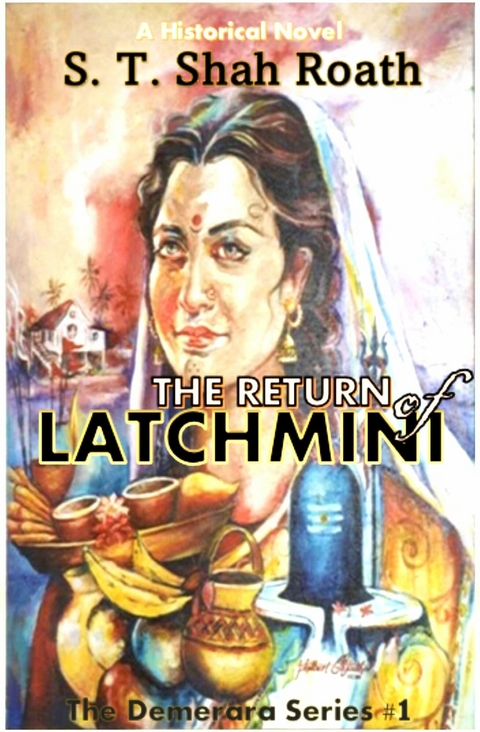
Return of Latchmini (eBook)
330 Seiten
Bookbaby (Verlag)
979-8-9871366-3-8 (ISBN)
This is the first novel in The Demerara Series - The Return of Latchmini. A journey that started in British India in the 1880s. A journey retraced by Bhanmattee who sought to establish the truth in the oral history and make lasting connections, past to present. A journey, the author followed as a researcher and an academic, finding commonalities between her maternal oral history with the archival records that Bhanmattee located in Guyana, Suriname, the United Kingdom, the Netherlands, and India with over 10 world tours and years of dogged fieldwork. Further, the author was able to triangulate the data uncovered with the many scholarly works done by so many Indo-Guyanese researchers and writers over the last seven or more decades.
CHAPTER 1
1894
Suriname
The horses’ gallop changed to a canter as the cart approached the brick road of the Waterkant. Latchmini got a whiff of fish. The fishing boats were preparing for their evening departure. The tide was high, the coolie ship was also preparing to leave. The ship’s horn that rang through the street, as they were approaching the dock, confirmed Latchmini’s thoughts. She and her family descended the cart.
Latchmini noticed Mohabir impishly bend under the horse cart, stick his index finger in the molasses bucket, and put it straight into his mouth with a satisfied sigh. Latchmini ignored him. This may be his last ever taste of molasses out of a horse’s feed bucket!
Hugging her older son, Latchmini felt a familiar tightening chest and stinging nose. She snuggled her face into Ram’s curly hair. Wiping a wayward teardrop with the back of her hand, she raised her head looking straight into the eyes of Madari. Her husband reached out and touched her left cheek. Latchmini turned her lips into his hands and felt a shiver of acute pain join the tightened chest.
Madari rubbed her cheeks, shook his head, and slid his hand down the front of her dress with a satisfied nod. His wife knew he was checking for the tabibige talisman she always kept around her neck. He had placed the cylindrical capsule on a gold chain around her neck since their wedding night, twelve years ago.
Latchmini took a last hug of Ram, kissed him on his forehead, and gently wiped his tears with the pallu of her dark green cotton sari. She turned to Madari and squeezed his hands, moving his ever-present cowlick hair from his eyes. Staring deeply into dark brown eyes, Latchmini sighed as she transferred Radhia from his arms over to her hip.
“Madari, take good care of Ram. Make sure our son doesn’t get into trouble with Massa. Check his toes for chigger bites every night and make sure he drinks a whole cup of milk every night before sleeping! You know he likes to throw it in the Tulsie tree and bring big red ants!” Ram laughed and wiped his eyes with the front of his white kurta, revealing a budding muscular torso. He was only ten years old but looked over twelve years. He was so muscular with the backyard greens gardening, cane field weeding gang work, and an endless appetite for yard chicken.
“Ram, you take care of your father. Make sure he cooks the bhagee and roti every morning. Don’t let him give you salt bread that the creole sells at the market. Pick the rice for him to cook for lunch that you all eat under the mango tree by the cane field. And remember to take out all the rocks from the dhal! You eat good. When I see you again, you will be taller than me.” Latchmini hugged her son again. Radhia tugged at her until she moved to allow her to put her chubby hands around Ram’s neck. The ship’s horn sounded a warning call. Time was running out.
“Madari,” Latchmini looked at Mohabir holding on to his father’s arm, “We have to go now.” Madari opened his arms and enveloped his wife and three children. Radhia started to cry loudly. There was heartbreaking crying along the fish-smelling dock. Other families were also leaving loved ones.
But laughter also rang out, as whole families were returning to their homeland after being away for five years and more. Latchmini placed the red handmade straw bag containing her belongings under her arm, settled Radhia on her hips in the other, and clasped Mohabir’s hands in her own. She bravely stepped onto the plank that led into the tugboat that would take them out to the ship. She had to adjust after just a few seconds on the planks to balance herself. Mohabir disengaged his left hand from hers and held on to the railing. He used his right hand to hold onto to the back of his mother’s sari.
The fishing boats lulled nearby in preparation for another bountiful catch. The scent of rotting fish wafted up at the hundreds of returning indentured laborers. Cries of women and children drowned out any sounds of the black birds circling overhead.
Latchmini was returning to her homeland after ten years, three children, and the hard life in the sugar cane fields of Suriname. Her husband and eldest son, Madari and Ram, stood at the docks staring at the ship that was returning to India. Latchmini’s two children, Radhia and Mohabir, were looking sadly at their father and brother standing among the crowd of sugar and coffee workers. These workers were waving goodbye to friends and family who were leaving at the end of their indentureship contracts.
Almost six feet tall, Madari held Ram in front of him. Latchmini looked at her handsome husband and knew that he was trying to be brave. He was now on his own. Since their marriage, this will be the first time they will be apart for more than a few hours. Latchmini knew how hard it will be for Madari to do what she did every morning for the last 10 years. Wake up before three O’clock in the mornings, cook the roti and bhagee to eat with green tea for breakfast. He also had to cook dhal and rice – and pack the saucepans to carry to the fields for their lunch.
Usually, after waking before dawn, he milked their cow and sent her out to pasture, then bathe by the pond, and dress for work. He never cooked, although she knew he could. He usually collects the saucepan with his lunch on his way out.
It was hard leaving Madari and her eldest son, but the child in her belly demands better. This child could be born in Jamkhuri, close to the place where the three rivers meet in Allahabad. Madari’s mother could help with the birthing and his sisters can take care of Mohabir and Radhia while Latchmini was still weak. Not like in Suriname when she had to go back to the fields with her baby in a baby bag around her neck and her belly banded just the day after she gave birth!
The cries of the seagulls filled the air. They echoed Latchmini’s aching heart as she kept Madari in her sight. His image diminished to a speck. The docks grew smaller and smaller. Latchmini’s chest tightened, nose stung, eyes watered. No. She did not cry.
Latchmini looked at Mohabir’s face – sadness being replaced by scarcely concealed excitement. He looked at the black water beyond the ship. The water reflected the ship’s outline, the silhouette showed the outline of passengers standing at the rails waving to those waving from the docks long after they were no longer visible. The ship’s horn pierced the stillness of sorrow, causing passengers to look up at the mast.
As the ship moved out to sea and the water began to get rougher and rougher, Latchmini’s stomach tightened in anticipation. She licked her lips and tasted the salty air. She was on her way. She was returning to the place of pleasure and color, happiness and culture, music and dance, sweet and sour – delights of the tongue, mind, and body. She was returning to India.
Radhia peered up as the white sails unfurled like angels, white puffy clouds sailing above and white seagulls traversing between sails and clouds against that blue, blue sky. The bow dipped and soared, sipped the salty water, and spit it out only to drink again. Swish, swish, swish, swash, swish, swash, swish, swash – sounds in unison with the movement of the ship. The swish, swish of the ship, cutting through the water, sailed on the wind and echoed back to the passengers descending to their quarters. They had to go below before the waters became too rough to find solid footing.
The ship’s crew ushered stragglers none too gently. Latchmini urged her children below, grabbed a bottom bunk and hugged them to her breast, glad that they had a whole bed to themselves this time. She and Madari had to share a similar bed with three men on the ship that brought them to Suriname. Madari had always tried to be the last man in then hugged her to him so none of the other men could touch her.
Darkness crept like a thief into the large cabin. Mohabir was too excited to sleep and listened to the sounds as it became darker and darker. The swishing water coming from the porthole almost lulled him to sleep. He seemed to be willing himself to stay awake. Latchmini wished he would relax and try to sleep.
She reached over and tapped softly on Mohabir’s back hoping to make him sleep as she had when he as a baby. Loud snoring emitted from the bunk beds all around the large cabin, more like the barracks room she had seen at the Calcutta Depot. Narrower but same kind of bunks and spacing. Beds stacked upon beds, upon beds, which were packed against each other as one long range of sleeping holes sized for two persons but fitting five and six persons.
Soon the ship started swinging like a hammock strung on the porch of her home in Jamkhuri. Home. India. Sleep eluded her. She savored memories of village life with her parents. Bathing with the family’s white cows and her girlfriends. Enjoying the freedom to roam the pastures, climb fruit trees, and watch wedding rituals from the fringes of glittering colorful gatherings.
This was before her marriage to Madari and her new life as a daughter-in-law. Then she had to stay home and do all the housework and wait and watch and hope for a job that would take her and Madari away from the constant watchful, judgmental eyes of his parents. She had had her wish. Ten long years away from that place.
She was bringing home their two grandchildren. They would love Mohabir who looks like a little version of Madari. But Radhia, at a little over one year old, looks a little like Latchmini’s Mai with her long wavy dark brown hair and light brown eyes. She was also quiet and seemed contemplative, never angry, and generally kept her own counsel.
Madari likes to say...
| Erscheint lt. Verlag | 30.12.2022 |
|---|---|
| Sprache | englisch |
| Themenwelt | Literatur ► Historische Romane |
| ISBN-13 | 979-8-9871366-3-8 / 9798987136638 |
| Informationen gemäß Produktsicherheitsverordnung (GPSR) | |
| Haben Sie eine Frage zum Produkt? |
 EPUB (Ohne DRM)
Größe: 10,7 MB
Digital Rights Management: ohne DRM
Dieses eBook enthält kein DRM oder Kopierschutz. Eine Weitergabe an Dritte ist jedoch rechtlich nicht zulässig, weil Sie beim Kauf nur die Rechte an der persönlichen Nutzung erwerben.
Dateiformat: EPUB (Electronic Publication)
EPUB ist ein offener Standard für eBooks und eignet sich besonders zur Darstellung von Belletristik und Sachbüchern. Der Fließtext wird dynamisch an die Display- und Schriftgröße angepasst. Auch für mobile Lesegeräte ist EPUB daher gut geeignet.
Systemvoraussetzungen:
PC/Mac: Mit einem PC oder Mac können Sie dieses eBook lesen. Sie benötigen dafür die kostenlose Software Adobe Digital Editions.
eReader: Dieses eBook kann mit (fast) allen eBook-Readern gelesen werden. Mit dem amazon-Kindle ist es aber nicht kompatibel.
Smartphone/Tablet: Egal ob Apple oder Android, dieses eBook können Sie lesen. Sie benötigen dafür eine kostenlose App.
Geräteliste und zusätzliche Hinweise
Buying eBooks from abroad
For tax law reasons we can sell eBooks just within Germany and Switzerland. Regrettably we cannot fulfill eBook-orders from other countries.
aus dem Bereich