


God of Hope (eBook)
238 Seiten
Bookbaby (Verlag)
978-1-6678-8575-9 (ISBN)
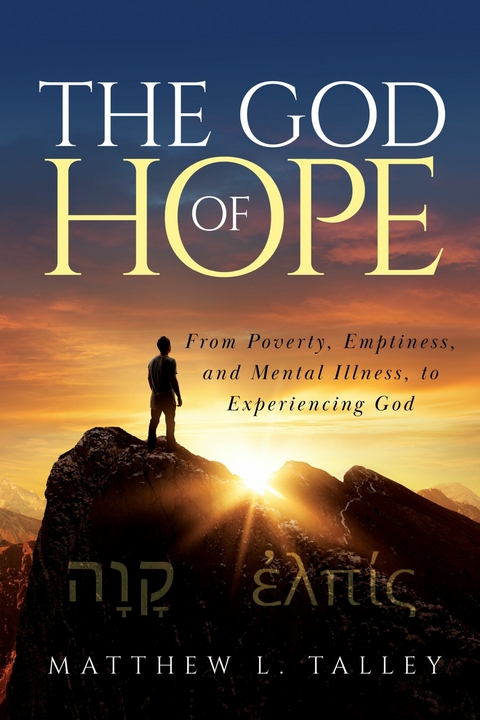
The GOD of HOPE: From Poverty, Emptiness, and Mental Illness to Experiencing God is a shocking and inspirational memoir of a survivor who miraculously overcomes trauma by finding his own identity, faith, and hope despite growing up with deeply religious, yet schizophrenic parents. Circumstances shape his worldview, resulting in shame, anger, and agnosticism, culminating in nihilism. After a series of extraordinary events, his dark skepticism becomes no longer viable. The author takes the reader through a series of extraordinary experiences where the seemingly meaninglessness of life crosses paths with God and the need for hope.
MARKED BY SCARS FROM AMERICAN slavery and racial discrimination, African American families have learned to survive and triumph in the face of adversity and outright hatred. Southern slaveholders took extreme measures to strip away the languages and spiritual customs that Africans practiced in their native lands. Efforts to “break” them through dehumanization, forced submission, and fear were commonplace. Families and marriages of the captured were ripped apart. To keep them powerless and dependent, they were forbidden from learning to read. They lived as their enslavers’ physical property and were considered soulless and mindless.
Financial dependence on slave labor, as well as the belief in white supremacy drove many slaveholders to use the religion, Christianity, in particular, as justification for slavery and obedience to their masters. This contributed to the growth and preservation of American slavery for over two centuries. However, many White people began to challenge the morality of slavery and, with many freedom-fighting slaves. And so, an antislavery movement ensued.
Evangelicalism also began to spread across the North and South, and many enslaved Africans found hope and inspiration in the story and character of Jesus Christ. They saw Him as an overcomer. Like them, He had suffered unjustly, but in humble obedience to God, Jesus fulfilled His purpose. He overcame the evil systems of the world to which He was sent. Though most could not read English, stories were told, many times in secret by elders and spread through songs (spirituals), about the God of the Christian Bible who promised rest, restoration, provision, reward, and victory in eternity for those who follow and imitate the character and life of Jesus Christ. Some slaves did not relate to the Christian teachings, but the stories did appeal to many others. In identifying with the biblical stories of Jesus Christ and others who suffered, many found a sense of empowerment over their capturers. Faith in Christ and beliefs in redemption and restoration became spiritual coping mechanisms for the brutalities that they faced daily. By divine providence, Africans Americans found a Redeemer out of slave owners’ barbarous perversion of the gospel.
The African American family or Black community as we know it today still reflects many of the traditions, beliefs, and religious values that developed amid enslavement and our eventual freedom. Many African Methodist and Baptist churches were founded during those racially turbulent times and became cornerstones of the Black community. These churches eventually provided a physical sanctuary for worship and spiritual teaching, but also became central institutions for support, education, and civic organization. They grew many of the cultural and social practices that comprise the fabric of African American tradition. A significant element of our American experience, faith continues to sustain the African American spirit. It was religious faith and hope that got many families through exceedingly difficult times, and those beliefs are ingrained deep within our culture.
The Talley family was no exception. In fact, through the years, a family motto developed: “Faith, Love, and Compassion.” A fitting phrase for an African American family that lived out those very words from generation to generation. One of those persons was my grandfather, Elder Elmus Talley, who passing preceded by birth. Born in Cobb County Georgia in 1897, Elmus was the eleventh son of Milton and Matilda Talley. From an early age, Elmus had a hunger to know God and build his faith like that of his mother and father. When Elmus reached maturity, he married my grandmother, known as Mother Lottie Blanche Townes, in 1914. Both Elmus’ and Lottie’s family backgrounds held strong roots in the local Baptist church. But it was not until Elmus’ involvement in the Holiness Movement that his ministry increased. Elmus began teaching God’s Word at an early age and made his rounds in various churches as a neighborhood preacher.
Eventually, he built a small church on a piece of land close to his home. Playing a critical role in the early days of the Georgia’s Church of God in Christ denomination, Elmus’ preaching and passion for God permeated the pews. Eventually, his small church became a beacon for other pastors, including several renowned bishops who began their teaching ministries at that very location. Serving alongside Elder Elmus in the ministry was his partner and beloved wife, Mother Lottie. In her demonstrated love for God and others, Lottie became the official church mother in Cobb County’s Tabernacle Church of God for many years. Her service to others earned her the respect and adoration of many elders and bishops alike. The contributions of Elder Elmus and Mother Lottie Blanche Talley, and the early history of the Church of God in Christ in the state of Georgia remain inseparable.
Over the course of their union, Elmus and Lottie had eight girls, LottieMae, Pauline, Miriam, Lizzie, Evelyn, Virginia, Rochelle, and Marthene. Along with seven boys, Elmus Junior, James, Timothy, John Henry, Benjamin, Felton, and Fletcher. Their spiritual heritage imparted on their children a keen sense of faith, equally matching the zeal of those before them. Sequentially, most of the children continued in the faith by becoming pastors, elders, and deacons. Joining the spiritual ranks of his father and older siblings was that of Fred Lee Talley, the sixteenth child of Elmus and Lottie. Fred was born on April 20, 1938. In Fred’s early years, he gravitated toward his nurturing mother. The young boy observed his mother’s compassion, her high sense of character, and warmth toward him and his siblings. Lottie shared the goodness of God with young Fred daily, leaving a positive impression, and displaying the loving kindness of a tender mother. Yet, even as Fred enjoyed those day-to-day moments with his adoring mom, it was the towering spirit of his father that influenced the course of his life.
Fred watched intensely as his father worked his hands raw as both a diligent farmhand, and a spiritual leader in his community. At the age of six, Fred sat and observed his father with great fondness as he taught the Word of God to every willing ear. Sitting in his father’s pews, Fred was often moved to tears over his dad’s spiritual messages. Witnessing how the power of God’s Word changed lives drove Fred to want to follow in his father’s footsteps and become a teacher.
By the time Fred was sixteen years old, he was faithfully serving in ministry. Fred taught and shared the gospel throughout town. From the pulpit, Fred often spoke of his mother’s gentleness and love. Mother Lottie and her older children took notice of Fred’s active involvement in ministry. Both mother and older siblings were moved with joy and impartial love for the young man.
When the Talley patriarch, Elder Elmus, passed away unexpectedly at a relatively young age, Fred became utterly distraught. He coped with the sudden loss of his father with seclusion, even refusing to attend the funeral. For Fred, it was simply too overwhelming to witness his father’s remains being laid into the ground. Fred’s withdrawal from his family’s collective mourning brought about hurt feelings from his mother and siblings who wanted to aid him in his grief. But the memories of a lost father were too much to bear. Ultimately, Fred chose to leave Cobb County and his pain behind. To find his own sense of peace, Fred opted to say goodbye to his family and move to the city of Atlanta. For Fred, the path forward was found in the footsteps of his father, Elmus. Fred was determined to leave the shadow of Cobb County, venturing out as a full-time servant of God.
Fred’s bus ride to Atlanta held its share of contemplation, yet his mind was filled with resolve. He wiped away tears as he looked out the bus window and watched his destination come into view. As he finally stepped off the bus, Fred surveyed a city full of promise and opportunity. Wasting little time, he immediately connected with a fellow pastor and friend of his father and took temporary shelter at his residence. Rest was elusive in those initial weeks as Fred battled night sweats, dreams of his father, and the realization of a family left behind. The stress was so great that Fred fell severely ill several times during his stay. Nonetheless, he pushed on as he began his ministry, teaching at various churches throughout the city. It was here that Fred found refuge in sharing the gospel, the only thing that brought him peace. Yet, there was one church visit where Fred discovered the untamed world of romance.
Routinely, Fred preached in every available pulpit. During one service, Fred’s eyes strayed from the masses in the seats and locked onto a nineteen-year-old woman as he was teaching. Fred tried hard to concentrate on his sermon even as the woman began to smiled back in his direction. At the conclusion of the service, the parishioners gathered in the parking lot to have a moment with the minister. Quietly waiting at the back of the line for her moment, the petite young woman eventually greeted Fred with an extended handshake and a long, warm stare. The charismatic minister and the woman were both intrigued by one another. With a lingering look and continuously held hands that went far beyond cordial greetings, the young woman softly shared her name with the young preacher, “Estelle Tuggle.”
After an engaging conversation, eighteen-year-old...
| Erscheint lt. Verlag | 1.5.2023 |
|---|---|
| Sprache | englisch |
| Themenwelt | Literatur ► Biografien / Erfahrungsberichte |
| ISBN-10 | 1-6678-8575-8 / 1667885758 |
| ISBN-13 | 978-1-6678-8575-9 / 9781667885759 |
| Informationen gemäß Produktsicherheitsverordnung (GPSR) | |
| Haben Sie eine Frage zum Produkt? |
 EPUB (Ohne DRM)
Größe: 3,4 MB
Digital Rights Management: ohne DRM
Dieses eBook enthält kein DRM oder Kopierschutz. Eine Weitergabe an Dritte ist jedoch rechtlich nicht zulässig, weil Sie beim Kauf nur die Rechte an der persönlichen Nutzung erwerben.
Dateiformat: EPUB (Electronic Publication)
EPUB ist ein offener Standard für eBooks und eignet sich besonders zur Darstellung von Belletristik und Sachbüchern. Der Fließtext wird dynamisch an die Display- und Schriftgröße angepasst. Auch für mobile Lesegeräte ist EPUB daher gut geeignet.
Systemvoraussetzungen:
PC/Mac: Mit einem PC oder Mac können Sie dieses eBook lesen. Sie benötigen dafür die kostenlose Software Adobe Digital Editions.
eReader: Dieses eBook kann mit (fast) allen eBook-Readern gelesen werden. Mit dem amazon-Kindle ist es aber nicht kompatibel.
Smartphone/Tablet: Egal ob Apple oder Android, dieses eBook können Sie lesen. Sie benötigen dafür eine kostenlose App.
Geräteliste und zusätzliche Hinweise
Buying eBooks from abroad
For tax law reasons we can sell eBooks just within Germany and Switzerland. Regrettably we cannot fulfill eBook-orders from other countries.
aus dem Bereich


