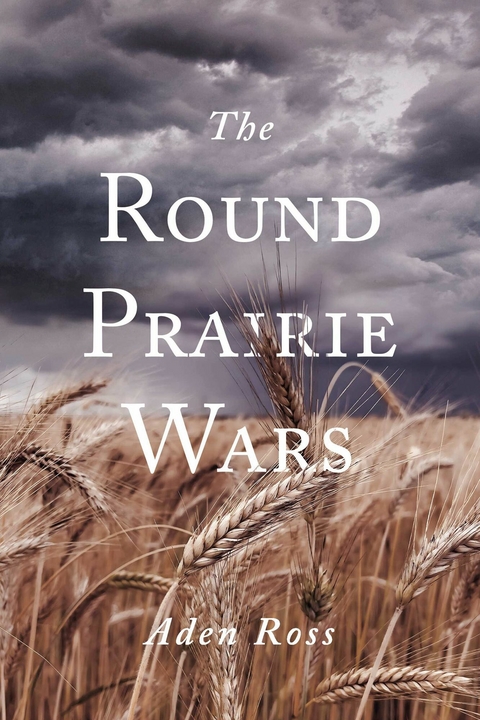
The Round Prairie Wars (eBook)
612 Seiten
Bookbaby (Verlag)
978-1-6678-6169-2 (ISBN)
Award-winning writer Aden Ross received her Ph.D. from the University of Utah. She taught literature, creative writing, theater, and interdisciplinary courses in art, music, and philosophy for over two decades. Her plays and poetry have been anthologized in numerous publications. Her libretto for 'Dreamkeepers,' written for the Utah Centennial opera, was nominated for a Pulitzer Prize. Outside academia, she has survived the production of 25 of her plays, a serious Harley accident, teaching piano lessons, moving 55 times, selling Ferraris, and being locked down while teaching inside Utah State Prison.
CHAPTER 2
THE DAY THE EARTH STOOD STILL
Everybody called it the Inavale drive-in movie, although it was actually the two-story wall of the Inavale Hotel facing a vacant lot. Built of Nebraska limestone, the hotel glistened creamy white, the perfect outdoor movie screen except for the windows breaking the surface. Every Friday night, people from neighboring farms and towns gathered there and spread blankets on the ground or built makeshift benches from cinder blocks and planks to watch the free movie sponsored by the hotel owners. They brought potatoes, corn, or garden vegetables to share with anyone nearby. Always hopeful for store-bought cookies, which almost never appeared, Sam and I at least maneuvered to sit near the cold storage apples rather than the carrots or leaf lettuce.
I didn’t know where the projector was, but suddenly the roaring lion or the lady with the torch would magically spread across the hotel wall and, from somewhere behind us, the soundtrack would scratch and crackle, turned up too high for the speakers to handle.
Sam, halfway through his Electricity merit badge, explained, “It sounds like mismatched impedance to me.”
I responded, “It sounds like a loose nut to me.”
“That’s why I’m the Boy Scout and you’re not.”
Sam always wanted to find out how things actually worked, unlike me, who was happier inventing explanations. My method took less time but required more imagination.
The owners asked the people staying in the hotel to close their shades to create as smooth a screen as possible, but someone would always open their window and look out—right in the middle of Claudette Colbert’s eye or the starched bib Ingrid Bergman wore as a nun. Sometimes the hotel residents would close their shades but walk back and forth behind them, creating a silhouette show appearing in the canvas of the covered wagon stranded on the prairie or in the middle of bombs dropping from a Flying Fortress like fish eggs.
If the movie were thrilling enough, I could momentarily ignore the tiny, shadowy strangers appearing in the folds of Ginger Rogers’ swirling skirt, but life in the hotel windows usually intruded on moments of greatest crisis or intimacy, predictably during the ever so hesitant and whispery kisses for which I waited through many a stupid grown-up movie. At any kiss on screen, Sam would groan the way boys were required to do, complete with bared teeth, but never so disgusted as when a previously dependable cowboy like John Wayne, back at the fort after a day killing Indians, suddenly grabbed and kissed Maureen O’Hara.
I relived any kisses for days afterward, replete with the billowy gowns and shiny ringlets, while Sam groused about the unrealistic blood which wouldn’t fool a fly. Since everything was black and white, I told him to color the blood himself. Mama told me in secret that she always saw movies in color and encouraged me to do the same, to envision not just the ladies’ gowns in turquoise or crimson but also to see Barbara Stanwyck with purple hair and Loretta Young with green cheeks, in other words, how she saw them. I finally got the courage to ask if she saw real people that way, or only fake ones in the movies.
“I see everybody’s true colors,” she answered.
This was not very helpful.
“Just because nobody else can see what you see doesn’t mean it isn’t true,” she insisted.
Did her actual eyes see these things, or her overactive imagination? If I couldn’t see what she saw, was something wrong with me? Could she be lying, my own mother? Sometimes you have to stop asking questions because there aren’t enough answers to go around. Papa often said that, but possibly just to make me quiet.
Better than the kisses were the reunions on screen, reunions between long separated lovers, the slow, loping, striding, leaping across fields of flowers, the camera flicking from the lady hopping like a deer in from the left to the man loping in from the right, closer and closer until WHAM they met and he twirled her in his arms. I daydreamed that Sam and I were separated from Mama and Papa by war, wind and flood; after endless agony and heartache, we saw them from afar and began running in slow motion, leaping across vacant lots full of weeds until we all collided in a happy little tornado, spinning in each other’s arms.
By the end of the Inavale movie, the people inside the hotel windows had created miniature, alternate movies embedded in the bigger one. In effect, we watched four or five movies of different sizes in different dimensions, simultaneously. Mama said a double feature couldn’t hold a candle to it. I liked to make up lives for the people staying in the hotel: traveling salesmen became mad scientists developing secret weapons, construction workers were actually FBI agents investigating enemy spy rings on surrounding farms. Deep down, I knew that the real lives of the hotel people never ended with kisses or reunions, never ended half as happy as the gigantic, flat fiction surrounding them. But it could happen. Meanwhile, I would be happy if just once I could see June Allyson’s perfect cheek unpocked by some tired trucker smoking a cigarette out his window.
We heard that tonight’s movie was called “The Day the Earth Stood Still.” On the drive to Inavale, Sam pointed out that the earth was spinning on its axis, orbiting the sun, and racing through the Milky Way for a total of half a million miles an hour, day and night, forever.
“If the earth ever stood still,” Sam continued solemnly, “people on the sun side would immediately incinerate and people in the shade would freeze solid.”
“It’s a metaphor,” Mama explained.
“Meta-what?” Sam asked.
“It says one thing, but means something else.”
“Like a lie?” I was thrilled at the prospect of using a new word much more sophisticated than fib.
“No, like a poem,” she answered. “A skull can be a metaphor for death.”
When Mama wasn’t cleaning the trailer, she spent all of her time reading poetry or the encyclopedia. She had already started Volume 2 of the Funk and Wagnall’s we bought at the grocery store, one volume every month.
“How do you–“I began.
Before I could finish, Mama spelled, “M-e-t-a-p-h-o-r.”
Oh boy. I loved words which had a ‘ph’ for an ‘f,’ like philosophy, which did it twice.
The audience never cared what movie was showing, given any break from hard work and sweltering heat. This late June night, sticky as warm honey on my bare legs, word went around the crowd that tonight’s show was almost new, unlike the ancient episodes of the Three Stooges or Buster Keaton we usually saw. Most of the hotel windows stood open to catch any moving air even after the title flashed on the screen, accompanied by a high-pitched, quivering moan preparing us to be scared witless.
Right away, a flying saucer landed in Washington, D. C., but when the spaceman, Klaatu, stepped out to give Earthlings a present, he was gunned down by the surrounding Army. Typical. Immediately, a huge robot named Gort melted all of their weapons just by staring at them, his eyes a terrifying beam of light focused through a slit in his metal head.
Except for Earth, the whole universe had evolved beyond using violence to solve problems, but space-traveling civilizations realized that humans had atomic bombs and could not only destroy ourselves but also harm other planets. When the Earthlings couldn’t agree even to meet at the United Nations to hear the warning from outer space, Klaatu demonstrated his power by cutting off all electricity in the world except for hospitals and planes in flight. He was pretty considerate for an alien.
At the exact moment when the Earth was standing still, someone opened their hotel window smack in the middle of Gort’s smooth metal chest and shook out a long rug. All the grown-ups laughed, but not us kids.
In the end, Klaatu warned that, if Earthlings continued to use violence, especially nuclear war, Gort’s race–the universe’s designated executioners—would annihilate our planet and everything on it. The spaceship blasted off to woozy strings and Frankenstein organ music.
Wow. We all clapped, then people began gathering their seats, blankets and children.
Sam complained, “The Earth didn’t exactly ‘stand still.’ It was just a massive power outage.”
“Yeah.” Whenever it didn’t cost me anything, I agreed with him. “But that would be a pretty dumb title: ‘The Day the Earth Had a Power Outage’.”
“It would’ve been better if the aliens used mind control, too,” he continued. “If Gort’s race had evolved that far, they could certainly control the minds of us puny Earthlings.”
“If they could control our minds, they could’ve stayed home and done it from there,” I argued. “Of course, then there wouldn’t have been any movie.”
“That is so stupid,” Sam picked up a pop bottle to see if anything was left in it, then tossed it back on the ground.
“It’s just logic.”
As the expert in logic, Sam looked momentarily crestfallen. To cheer him up, I pointed out, “There were some pretty good explosions, though.” Explosives of any kind always made Sam feel better.
We walked slowly toward the highway with the crowd, the grown-ups all shaking hands and cracking jokes, while the kids jumped back and forth across the temporary plank benches. Mama and Papa...
| Erscheint lt. Verlag | 8.11.2022 |
|---|---|
| Sprache | englisch |
| Themenwelt | Literatur ► Romane / Erzählungen |
| ISBN-10 | 1-6678-6169-7 / 1667861697 |
| ISBN-13 | 978-1-6678-6169-2 / 9781667861692 |
| Informationen gemäß Produktsicherheitsverordnung (GPSR) | |
| Haben Sie eine Frage zum Produkt? |
 EPUB (Ohne DRM)
Größe: 2,5 MB
Digital Rights Management: ohne DRM
Dieses eBook enthält kein DRM oder Kopierschutz. Eine Weitergabe an Dritte ist jedoch rechtlich nicht zulässig, weil Sie beim Kauf nur die Rechte an der persönlichen Nutzung erwerben.
Dateiformat: EPUB (Electronic Publication)
EPUB ist ein offener Standard für eBooks und eignet sich besonders zur Darstellung von Belletristik und Sachbüchern. Der Fließtext wird dynamisch an die Display- und Schriftgröße angepasst. Auch für mobile Lesegeräte ist EPUB daher gut geeignet.
Systemvoraussetzungen:
PC/Mac: Mit einem PC oder Mac können Sie dieses eBook lesen. Sie benötigen dafür die kostenlose Software Adobe Digital Editions.
eReader: Dieses eBook kann mit (fast) allen eBook-Readern gelesen werden. Mit dem amazon-Kindle ist es aber nicht kompatibel.
Smartphone/Tablet: Egal ob Apple oder Android, dieses eBook können Sie lesen. Sie benötigen dafür eine kostenlose App.
Geräteliste und zusätzliche Hinweise
Buying eBooks from abroad
For tax law reasons we can sell eBooks just within Germany and Switzerland. Regrettably we cannot fulfill eBook-orders from other countries.
aus dem Bereich