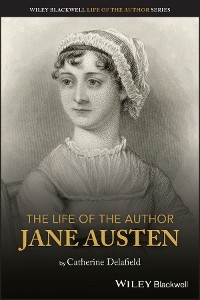
The Life of the Author: Jane Austen (eBook)
John Wiley & Sons (Verlag)
978-1-119-77936-0 (ISBN)
A fresh approach to building the life of Jane Austen through her letters, demonstrating that a well-known life can be reframed by being grounded in evidence of that life
The Life of the Author: Jane Austen takes readers on a literary-biographical journey through Austen's life in letters. Using a unique non-linear approach, author Catherine Delafield explores three frames for Austen's literary life—family, correspondents, and fiction—to suggest new pathways for the interpretation of life writing about one of the most popular and influential English novelists of all time. Delafield addresses multiple aspects of Austen's epistolary practice and the ways in which her letters, juvenile writings, and unpublished novels have been overlaid on both biography and fiction.
Throughout the text, special attention is paid to the changing view of women’s correspondence as personal record and to Cassandra Austen's role as editor of her sister’s surviving letters. The book opens with selected readings from Austen's letters and a review of the family treatment of the life. Subsequent chapters discuss the female circle of correspondents in both extant and missing letters, the letter content and structure of Austen's novels, the use of letters as representations of places and spaces based on Austen's own lived experience of epistolary communication, and more.
- Discusses how the letters, correspondents, and novels supplement Jane Austen’s fiction and substantiate her life
- Highlights Austen's use of the letter as a conversation on paper, rather than as an autobiographical tool
- Explores the letters within Austen's fictional writing as well as recipes, accounts, and needlework with links to the letters
- Features a select chronology using letters as landmarks, tables representing surviving letters by correspondent, and family trees tracing names and relationships
The Life of the Author: Jane Austen is an excellent text for undergraduate and graduate courses on the novel, women's writing, British writing, and life writing, as well as for general readers with interest in gaining new perspectives on Austen's chronological life and literary output.
Catherine Delafield is an independent scholar based in Devon, UK. She has previously taught at the University of Leicester and has published on women's life writing, diaries, and the serialization of popular fiction. She is the author of Women's Diaries as Narrative in the Nineteenth-Century Novel, Serialization and the Novel in Mid-Victorian Magazines, and Women's Letters as Life Writing 1840-1885.
Catherine Delafield is an independent scholar based in Devon, UK. She has previously taught at the University of Leicester and has published on women's life writing, diaries, and the serialization of popular fiction. She is the author of Women's Diaries as Narrative in the Nineteenth-Century Novel, Serialization and the Novel in Mid-Victorian Magazines, and Women's Letters as Life Writing 1840-1885.
List of Figures vi
A Note on Texts and Abbreviations vii
Acknowledgements viii
Select Chronology of Letters ix
Introduction: A Life in Letters 1
1 Austen's Life in Letters 11
2 Austen's Letters in Family 'Lives' 40
3 Cassandra and Correspondence 62
4 The Sisterhood of the Letters 86
5 Novels in Letters: Letters into Novels 112
6 Letters and Novels: Places and Spaces 138
7 Letters and Patchwork: Scraps in the Life 163
Conclusion: Letters and Biography: Prisms, Kaleidoscopes, 'Elephants & Kangaroons' 182
Bibliography 186
Index 202
1
Austen's Life in Letters
This chapter traces the life recoverable from Austen's letters and discusses the role of letters in the life‐writing cycle. It follows a number of themes within Austen's life readable in the letters and then tracks the publication of the novels. The shape of this correspondence as a whole has been altered by the events of the life and by preservation and publication. The first section therefore considers how the distribution and weighting of the surviving letters shape an understanding of Austen's life. The chapter goes on to situate the novels in the life using the letters. Austen is sister, aunt, author, and letter writer adopting and acting out both conventional and unconventional roles.
The letters inform the outline of Austen's life in progress. She lived in Steventon Rectory from 1775 to 1801 having spent brief periods at school in Oxford and Southampton (1783) and in Reading (1785–1786). She also visited family in Kent and friends in Ibthorpe, and stayed in Bath (1797 and 1799). In May 1801, the family relocated permanently to Bath taking up the lease on a house for a few years but visiting the seaside in the summer including Lyme Regis (1804) but also Dawlish (1802). After the death of the Reverend George Austen in January 1805, the Austen women – or as Henry called them ‘our dear trio’ – were reliant on financial support from Austen's brothers and lived in Bath lodgings in between trips to see family in Kent and in Warwickshire. Having been joined by their friend and sister‐in‐law Martha Lloyd, in 1806 they united their domestic arrangements with brother Frank Austen and his wife Mary and lived in Southampton. In 1809 the four women were provided with a cottage by Edward Austen Knight in Chawton near Alton where Austen lived until her removal to Winchester for medical treatment in May 1817. There were trips to London to oversee the publication of the four novels that appeared in Austen's lifetime as well as to nurse both Henry and his first wife Eliza.
The reordered modern edition of the letters (Le Faye 2011 ) has a well‐established pattern of its own. As demonstrated chronologically in Figure 1.1, there are 92 letters to Cassandra, 16 to Anna Lefroy, 10 to Caroline Austen, eight to Frank Austen, six to Fanny Knight, five to John Murray, four to Martha Lloyd, three to James Edward Austen‐Leigh, and three to librarian James Stanier Clarke. There is one letter each to Alethea Bigg, Anne Sharp, Cassy Esten Austen, Frances Tilson, and Charles Austen all dating from 1817, and three letters to individuals (Catherine Prowting, Charles Haden, and the Countess of Morley) relating to the publication of Emma. There is evidence of letters being written to James, Edward, and Henry but none to them from Austen survive. James and Henry were themselves survived by their wives who may have made any final decision about preservation and Henry had a wandering life even after his ordination in 1816. No letters survive to any of the sisters‐in‐law other than Martha and none to Austen's parents. There is the possibility that the letters to and from Cassandra were shared with them, of course, and that Cassandra had the final say over survival when putting her affairs in order as she reported she was doing to Charles in 1843 (Modert 1990, p. xxi). Austen also names in the surviving letters a number of other correspondents including the other Bigg sisters, her mother's friend Mary Newell Birch, the Cookes in Great Bookham, and the Bullers in Devon.
The modern edition contains 161 letters of which two are poems, one is Austen's will, and one is in backward writing for an eight‐year‐old niece. Four are scraps with limited or no content probably redistributed for autographs, and one (29–30 November 1812) is a spoof fan letter whose original was rediscovered and sold for £162,000 in Austen's bicentenary year (Le Faye 2017, pp. 26–27). One is in Austen's hand dictated by Henry (20–21 October 1815) and another merely protests at the gift of a turkey (December 1816). Of the other 150 letters there are briefer communications with the 12‐year‐old Caroline, as well as negotiated epistolary spaces on paper shared with others. Some letters were intentionally shorter and others have been preserved with leaves missing. The greatest concentration by number of letters on one subject and with various correspondents concerns the publication and distribution of Emma in late 1815. The physical appearance and layout of the letters has biographical import as does the coding of internal references. The letters reveal factual details but at the same time the medium of the letter with its detailed language and narrative economies supplements our knowledge of Austen's life and methods as an author.
Figure 1.1 charts the distribution of available letters without weighting their length or biographical significance. There are not just four‐page bulletins to Cassandra but also the shadows of letters in scraps, and notes with a single purpose. Of the total, 34 were written during Austen's residence at Steventon and 86 during her time at Chawton. It is notable that there are no surviving letters until 1796 and none for 1797. There is only one letter (from Lyme) between May 1801 and January 1805, and of the eight letters in 1805 three are to Frank about George Austen's death. The 1807–1809 letters from Southampton shared domestic and family news as Austen and Cassandra alternated at Godmersham particularly after the death of Elizabeth Austen, wife of Edward. In April 1809 Austen wrote to the publisher Crosby requesting the return of her manuscript of ‘Susan’ and there is then a further gap until April 1811 when Austen was in London to proofread Sense and Sensibility. The two surviving 1812 letters are to Anna Lefroy and Martha Lloyd, suggesting that Cassandra stayed at Chawton keeping house while Austen redrafted Pride and Prejudice and began Mansfield Park. The volume of surviving letters between 1813 and 1817 reflects the adoption of nieces and nephew as correspondents; about one third, 33 of the letters, are to James's children Anna, (James) Edward, and Caroline, and to Edward's eldest daughter Fanny. Eleven letters concerning the publication and dedication of Emma constitute more than half of the 20 dated 1815. Austen had gone with Cassandra in May 1816 to take the waters in Cheltenham. The last two letters to Cassandra were written in September that year to Cheltenham when Cassandra was accompanying Mary Lloyd Austen. The more numerous letters of 1817 suggest memorial preservation since these include Austen's last letters to James Edward, Fanny, and Caroline. Anna lived within walking distance. The 1817 letter borrowed by Henry for his ‘Biographical Notice’ is the only letter to Frances Tilson, a friend from London. Alethea Bigg, Anne Sharp, and even Charles Austen are noted as regular correspondents and yet have preserved only their last letters from Austen written in 1817.
Figure 1.1 Letter chronology by recipient.
The letters as they now appear have a deducible pattern based on travel and visits; their survival and preservation emerge from other imperatives. Figure 1.2 presents the sequences of letters initially preserved by Cassandra herself as records of her separation from Austen. It is notable that 57 of these letters were received by Cassandra when she herself was away from home. These letters would have had to be transported after the completion of Cassandra's visit even before being considered for preservation between residences in Hampshire and Bath. These letters and other single missives were evidently doubly removed and valued. On 23 August 1796 Austen writes from Cork Street en route to Kent when Cassandra is presumed to be at home since there are four subsequent letters to her from Austen (1–18 September 1796) from their brother Edward's first marital home at Rowling. Cassandra was away from home on 8 April 1798 but unusually there are no letters written during this visit during which Austen wrote, from Steventon, her only surviving letter to their half‐cousin Philadelphia Walter. From 27 October 1798 to 23 January 1799 Austen was at Steventon having returned from Godmersham where Cassandra remained after the birth of their nephew, Edward's fourth son William. Austen, along with her parents, had travelled back via Dartford, as evidenced by another letter written on the road (24 October 1798). The letters of 17 May to 19 June 1799 were written as a tourist from Bath on a visit for Edward to take the waters.
Figure 1.2 Letter sequences.
Between late October 1800 and late January 1801 Cassandra was at Godmersham and Austen at Steventon until the end of November when she was at Ibthorpe but back at Steventon on 3 January. It was on this return that Austen was informed of her parents' decision to move to Bath. A gap in correspondence between 1 December 1800 and 3 January 1801 is assumed to be the result of destroyed letters criticising the move to which Austen had apparently become more resigned in five letters between 3 and 25 January in which preparations were in an advanced state. In February 1801 Austen was visiting their friends the Bigg sisters at Manydown while Cassandra was in London returning from Godmersham. The four May 1801 letters from Bath are Austen's first as a resident. Cassandra...
| Erscheint lt. Verlag | 11.10.2022 |
|---|---|
| Reihe/Serie | The Life of the Author | The Life of the Author |
| Sprache | englisch |
| Themenwelt | Literatur ► Biografien / Erfahrungsberichte |
| Literatur ► Romane / Erzählungen | |
| Geisteswissenschaften ► Sprach- / Literaturwissenschaft | |
| Schlagworte | 19th Century English Literature • Austen, Jane • Austen, Jane /Biographie • Cassandra Austen • Englische Literatur • Englische Literatur / 19. Jhd. • English literature • jane austen biography • Jane Austen chronology • Jane Austen correspondence • Jane Austen epistolary writing • jane austen letters • Jane Austen life writing • Jane Austen's letters • letters in Austen fiction • letters in Austen novels • Literarische Biographien • Literary Biography • Literature • Literaturwissenschaft |
| ISBN-10 | 1-119-77936-7 / 1119779367 |
| ISBN-13 | 978-1-119-77936-0 / 9781119779360 |
| Informationen gemäß Produktsicherheitsverordnung (GPSR) | |
| Haben Sie eine Frage zum Produkt? |
 EPUB (Adobe DRM)
Kopierschutz: Adobe-DRM
Adobe-DRM ist ein Kopierschutz, der das eBook vor Mißbrauch schützen soll. Dabei wird das eBook bereits beim Download auf Ihre persönliche Adobe-ID autorisiert. Lesen können Sie das eBook dann nur auf den Geräten, welche ebenfalls auf Ihre Adobe-ID registriert sind.
Details zum Adobe-DRM
Dateiformat: EPUB (Electronic Publication)
EPUB ist ein offener Standard für eBooks und eignet sich besonders zur Darstellung von Belletristik und Sachbüchern. Der Fließtext wird dynamisch an die Display- und Schriftgröße angepasst. Auch für mobile Lesegeräte ist EPUB daher gut geeignet.
Systemvoraussetzungen:
PC/Mac: Mit einem PC oder Mac können Sie dieses eBook lesen. Sie benötigen eine
eReader: Dieses eBook kann mit (fast) allen eBook-Readern gelesen werden. Mit dem amazon-Kindle ist es aber nicht kompatibel.
Smartphone/Tablet: Egal ob Apple oder Android, dieses eBook können Sie lesen. Sie benötigen eine
Geräteliste und zusätzliche Hinweise
Buying eBooks from abroad
For tax law reasons we can sell eBooks just within Germany and Switzerland. Regrettably we cannot fulfill eBook-orders from other countries.
aus dem Bereich