Supply of Heroes (eBook)
100 Seiten
Blackstone Publishing (Verlag)
979-8-200-89401-7 (ISBN)
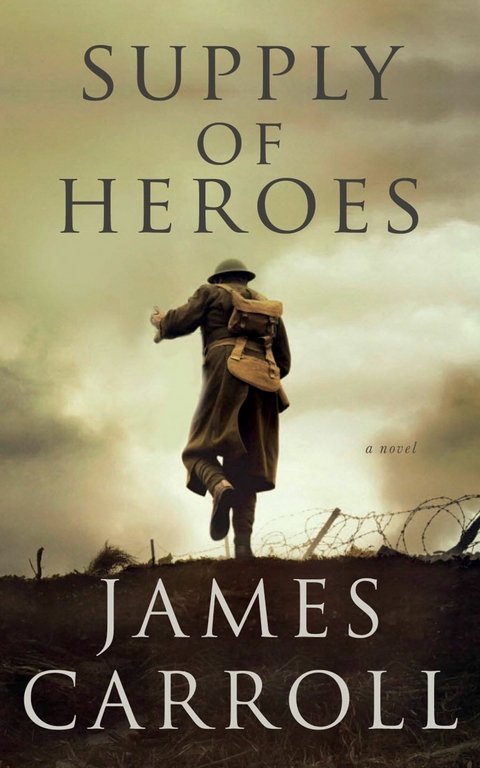
At the height of World War I, Douglas Tyrrell leaves Ireland and his wife to fight in the English Army, and his sister meets a revolutionary who is determined to fight for Irish independence even if it means siding with the Germans.
James Carroll is the author of twelve novels, most recently The Cloister, which the New York Times called 'incandescent,' and eight works of nonfiction. Other books include the National Book Award-winning An American Requiem; the New York Times bestselling Constantine's Sword, now an acclaimed documentary; House of War, which won the first PEN/John Kenneth Galbraith Award; and Jerusalem, Jerusalem, which was named a 2011 Best Book by Publishers Weekly. Carroll is a fellow of the American Academy of Arts & Sciences and an Associate of the Mahindras Humanities Center at Harvard University. For twenty-three years he wrote a weekly column for the Boston Globe and he contributes occasional essays to NewYorker.com. He lives in Boston with his wife, the writer Alexandra Marshall.
A passionate historical epic of love and war from the author of the National Book Award-winning An American Requiem and the classic bestseller Constantine's SwordAt the height of World War I, Douglas Terrell, an Anglo-Irish aristocrat, leaves Ireland and his family to fight in the English Army against the Germans. Pamela, his beautiful English wife, driven by her own fierce loyalty, defies her people as well as the Crown itself while Jane, his sister, meets a revolutionary who is determined to fight for Irish independence-even if it means siding with the Germans against the English.The knotted alliances and conflicting loyalties of this Anglo-Irish family meet their ultimate test during the Easter Rebellion of 1916 and demonstrate how trying to act honorably can be fraught with heartbreak and disappointment-yet offers the only way to live.
1
Even before their last kiss something, not time or place or that vicious circumstance, divided them. Each had firmly in mind an idea of how such farewells as this were to be enacted. Their ideas of the scene were similar; by the late spring of the war’s first year everyone in London knew how young wives saw husbands to the War Train at Victoria, with what stoic cheer, but also what lapses of heavy, pointed silence. Despite its horrors up to then, the war had yet to really show itself, and so it was still a chivalric moment, full of association. The unselfish sacrifice of an entire nation was implicit in the welling eyes of those women, and its disciplined restraint in the fact that tears never overspilled those ruby cheeks in the public setting of a crowded, bustling, noisy train platform. This was courage and resolve; even nobility. These were people for whom such notions still carried resonance. Farewell was the first and sweetest act of war, the only one the women were admitted to until the soldier’s eventual return, when they nursed him or buried him. But even that prospect, now, while terrible, had its loveliness. In prospect, death lacks loveliness utterly except in war.
An observer would have seen the young woman and man as types of a species—British bluebloods, him in his mustache, Sam Browne, jodhpurs, and polished boots, fresh-stitched captains’ diamonds on his sleeves, her in the flat-hipped practical dress, plumpness nowhere, not of Victoria but of Victoria’s granddaughters—but an observer could not possibly have read their silence. For an unbearably short time he had been with her and their two young children at her parents’ house in Chelsea. It was the leave to which he was entitled, having, with his men, just completed training, having been promoted unexpectedly from first lieutenant to captain, and his regiment having been ordered at last to France. And at the end of those precious, fleeting four days, he and this woman, whom he loved more than he loved, even, his children or his father or the memory of his mother or his native land or God, had quarreled bitterly.
She looked up at him. “I’m sorry, Douglas.”
He shook his head. “It was my fault, darling. It was my fault.” And he meant it. True, one would think a man going off to war had the right to know that his wife and children were where they belonged, where he wanted them, where she’d always promised they would be. But he saw grief in her eyes and he knew it had nothing to do with him. Her father was dead exactly a month now, having gone down on the Lusitania, sunk May 7. Douglas knew that the bottom of her world had fallen out from under her, and he knew how afraid she was for her mother. But when she told him that she and the children were going to stay permanently in London instead of going home, he reacted with a fierce, disapproving imperiousness that was not uncommon among men like him but which, between them, was unprecedented and therefore frightening to both. His anger had made him crudely insensitive and he had accused her of using her father’s death as a pretext for leaving Cragside. Only after he’d seen the fury of her denial had he known it was true.
He took her into his arms and felt her settle against him. At last the rigid tension that had so threatened their parting melted, drained away. He touched her hair with his lips, inhaling the fragrance that was at once familiar and always new. The fragrance of his wife’s hair never failed to stir Douglas, to draw him to her, to surface his longing. She possessed him totally, not as a mere owner possesses, but as a demon does. And this feeling of having been willingly bewitched, of having had the field of all his senses occupied by this woman as woman, brought with it, as always, the wonder that she should be his. He had been braced to say a steely good-bye in which neither would admit to feeling much of anything. Instead emotion swelled his chest. If he’d tried to speak, it would have choked him. He closed his arms around her and pressed her until he could feel, even through that clothing, her breasts against him. The old fear of losing her stalked across his mind; now he saw it was that that made him hate the thought of her in London. He closed his eyes to see her again as he had in the beginning and, remarkably, even in that chaos of setting and feeling, the door on his cherished memory opened.
The scent of lime combined with the sound of countless bees humming as they worked the flowers of the arching fruit trees that lined the pathway from the great house down to Coole Lake. He had slipped out of the crowded drawing room, throwing off the stifling pall of his seniors’ arcane chatter. The midsummer eve had cast its spell over the lush estate—Coole Park was a softer place than Cragside, though as beautiful—but there was a spell too in the high-toned melancholy to which Douglas had surrendered. He was twenty-one years old, only recently come down from Balliol, and he was quite naturally afraid that the self-anointed seers of Oxford would prove right about his life in Ireland. He hadn’t struck an attitude of his own as yet and hung suspended between his mates’ contempt for the island, born palpably of ignorance and English bias, and his father’s worship of it, born partly of wounds suffered years before and partly of a fierce commitment to the work of his land, work he expected his son to join him in. It had never occurred to Douglas not to come home; that was because his father’s will in this, as in all things still, was the only will. Not that his father didn’t know that Douglas would have to be wooed back from the last enchantments of Eton and Balliol, but that in his opinion, between the appeal of the English mode of Britishness and the Irish mode of Britishness there was simply no contest, hadn’t been since the Normans made Celts of themselves. His bright young son would see that clearly quite soon enough. Nevertheless, Douglas’s father was making sure to remind Douglas of all that Ireland still offered their kind, and not the least of that was the swirling life of intellect and art that had for its center, in the summer at least, Coole Park. It was an estate only fifteen miles east of the coast and Cragside. But Douglas’s hesitance revealed, and even his father knew it, that by the beginning of the twentieth century what had been true for the poor for generations was becoming true as well for the rich; the reasons to leave Ireland were obvious. What one wanted was reason to stay. Hence the invitation to accompany his parents on this social weekend, the first time he’d been so invited as an adult.
The British aristocracy did nothing so well as their holidays in the country and the Irish Ascendancy had its cherished version. Mostly the gentlefolks of both islands spent their weekends shooting, hunting, and drinking, but in this green corner of their class the bluebloods took their cues from one of history’s great bluestockings. Lady Augusta Gregory reinvented the meaning of such gatherings.
Douglas’s parents knew he was far from bookish, but they nevertheless expected to impress him with Lady Gregory’s menagerie. Even at Oxford they had spoken of that confluence of talent. Shaw had made a large mark already. Yeats was noticed and Synge commented upon. Eventually it would be said that Ireland was producing genius as no place had since fourteenth-century Florence, and indeed, just then in 1906, Lady Gregory’s circle was as illustrious as it would ever be again. On that weekend several of the famous artistes were there, together with various Sligo and Galway gentry and a friend or two from London. But the verve of all that splendid conversation—the plethora of mots!—only made Douglas feel plodding and young and quite as provincial as his Oxford friends assured him he was. And so he’d slipped away as chairs were being rearranged for the reading of Lady Gregory’s new play about Irish traitors in the time of Queen Elizabeth. Instead of to literary revival, he’d given himself to the scent of lime, the humming of bees, and the simple pleasure of walking alone from the great house to the lake.
And then he saw her. She was sitting by the lake alone, watching the sun begin to fall in the western sky toward the blue Connemara hills. He thought at once, Here is an Irish beauty, here is where their legend comes from. She seemed part of the scene, curled over her knee, head resting on her arm just the way the curling hills beyond rested on the valley. For the first time since his return Douglas laid aside his impulse to compare with England. What were the languid girls in punts to this? It wouldn’t last, he knew, but this first sight of her—the essence of its power that she had not seen him—was incomparable. As with the scent of lime and the sound of the nectaring bees, he saw her simple elegance with an unprecedented acuteness.
He startled her when he approached, and when she stood he forgot to speak. She was tall and dark. She had perfectly cut features, strong brown eyes, black hair that she began at once to collect and tie behind her head, all the while staring back at him. She wore a pale yellow dress that covered her to her ankles, but her feet were bare, and the sleeves of the dress were pushed up past her elbows. He was aware at once of her sexuality, not for any reason she gave him, save her refusal to lower her eyes. Douglas looked again at her feet, and the nakedness of her ankles was fatal to him. He looked once more into her face and saw that, despite her womanliness, she was younger than he was.
When her ribbon was tied,...
| Erscheint lt. Verlag | 25.10.2022 |
|---|---|
| Sprache | englisch |
| Themenwelt | Literatur ► Romane / Erzählungen |
| ISBN-13 | 979-8-200-89401-7 / 9798200894017 |
| Informationen gemäß Produktsicherheitsverordnung (GPSR) | |
| Haben Sie eine Frage zum Produkt? |
 EPUB (Wasserzeichen)
Größe: 969 KB
DRM: Digitales Wasserzeichen
Dieses eBook enthält ein digitales Wasserzeichen und ist damit für Sie personalisiert. Bei einer missbräuchlichen Weitergabe des eBooks an Dritte ist eine Rückverfolgung an die Quelle möglich.
Dateiformat: EPUB (Electronic Publication)
EPUB ist ein offener Standard für eBooks und eignet sich besonders zur Darstellung von Belletristik und Sachbüchern. Der Fließtext wird dynamisch an die Display- und Schriftgröße angepasst. Auch für mobile Lesegeräte ist EPUB daher gut geeignet.
Systemvoraussetzungen:
PC/Mac: Mit einem PC oder Mac können Sie dieses eBook lesen. Sie benötigen dafür die kostenlose Software Adobe Digital Editions.
eReader: Dieses eBook kann mit (fast) allen eBook-Readern gelesen werden. Mit dem amazon-Kindle ist es aber nicht kompatibel.
Smartphone/Tablet: Egal ob Apple oder Android, dieses eBook können Sie lesen. Sie benötigen dafür eine kostenlose App.
Geräteliste und zusätzliche Hinweise
Buying eBooks from abroad
For tax law reasons we can sell eBooks just within Germany and Switzerland. Regrettably we cannot fulfill eBook-orders from other countries.
aus dem Bereich