


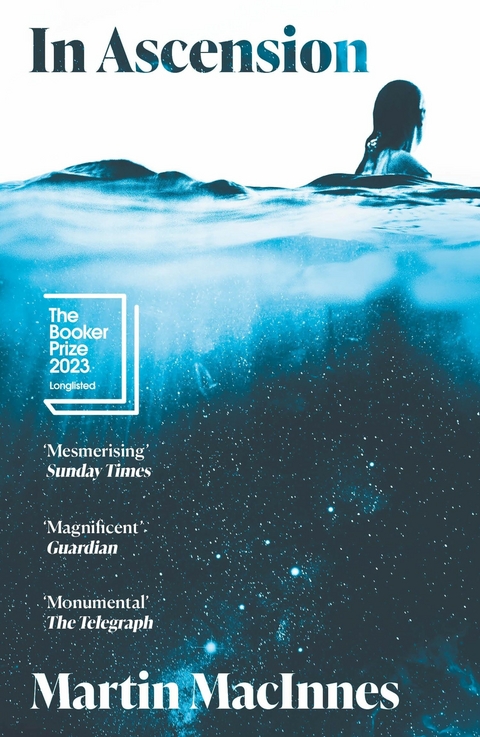
In Ascension (eBook)
512 Seiten
Atlantic Books (Verlag)
978-1-83895-626-4 (ISBN)
Martin MacInnes is the best-selling and multi-award-winning author of three novels, most recently In Ascension (2023), which was long-listed for the Booker Prize and has been optioned for film. He has been published in 11 languages, and lives in Edinburgh, Scotland.
LISTED FOR THE BOOKER PRIZEBLACKWELL'S BOOK OF THE YEAR'Mesmerising' Sunday Times'Magnificent' Guardian'Monumental' The TelegraphLeigh grew up in Rotterdam, drawn to the waterfront as an escape from her unhappy home life and volatile father. Enchanted by the undersea world of her childhood, she excels in marine biology, travelling the globe to study ancient organisms. When a trench is discovered in the Atlantic ocean, Leigh joins the exploration team, hoping to find evidence of the earth's first life forms - what she instead finds calls into question everything we know about our own beginnings. Her discovery leads Leigh to the Mojave desert and an ambitious new space agency. Drawn deeper into the agency's work, she learns that the Atlantic trench is only one of several related phenomena from across the world, each piece linking up to suggest a pattern beyond human understanding. Leigh knows that to continue working with the agency will mean leaving behind her declining mother and her younger sister, and faces an impossible choice: to remain with her family, or to embark on a journey across the breadth of the cosmos. 'Utterly compelling' The Times, Books of the Year'Profound and thrilling' New Statesman, Books of the Year'A far-reaching epic' Financial Times, Books of the Year
Martin MacInnes is the best-selling and multi-award-winning author of three novels, most recently In Ascension (2023), which was long-listed for The Booker Prize and has been optioned for film. He has been published in eleven languages, and lives in Edinburgh, Scotland.
PART TWO
Datura
ONE
I arrived with my bags and found the room already cleared. Fenna had bought new linen and put a small lamp on the cabinet by the bed. The room was narrow, difficult to reconcile with the memory. Neat, welcoming in a formal, impersonal kind of way. I detected a slight air of awkwardness and Fenna, behind me in the doorway, said she would put on some tea. I looked at the space, its hotel emptiness, heard the water running in the kitchen, and wondered if her offhand manner, her irritation at my and my sister’s concern, her lack of interest in our visits since our father had died, was a way of maintaining dignity, avoiding scenes, and protecting her two daughters from the burden of any guilt. The room couldn’t help declare an absence – muted colours expressing the light – and as I lowered my bags onto the bed I thought this might have been a mistake. In three short weeks Fenna would have to strip the bedding and take away the lamp, keep the window open late to air the furniture, and work especially hard to recover the equanimity she’d earlier achieved. I could now see that the list of conditions for my staying these three weeks, which had made Helena laugh, were a delaying tactic, a way of asking me to really think about what I was doing and decide whether I wanted to commit to this. She’d anticipated my leaving, when I first asked if I could stay. Barely through the door, already I regretted the upheaval. However separate our routines, however determined we both were not to upset the balance, the damage was done.
Late on the third night I woke up hearing a splashing sound coming from the far end of the house. At first I thought it was spillover from a dream, another half-memory of the ship, not of the dive but of preparing to go in, leaning over the railings and listening to the swell, but as I waited, sitting up in the dark, I realised my mother was in the kitchen. It was 03:38. The noise of plates slipping in the sink and in the drying rack. After every sound there was a pause, as if she were waiting out the time in which I might have woken up. Finally I got up, opened the bedroom door. The hall was dark, but an edge of light filtered out from the kitchen. I crept forward and peered through the gap.
She was in her powder blue nightgown at the sink, colander and sponge in her hands. She rinsed, soaked, then rinsed again, carefully studying each item before laying it down to dry. Was she secretly eating lavish meals in the middle of the night? Had someone been over, even? But then I noticed that the spread of dishes on the drying rack exactly matched those we’d used ourselves. I’d already washed and put them away. The same two glasses and plates. The same colander and lemon squeezer.
I crept away, wishing I hadn’t seen this. She looked small and frail in her pale blue nightgown. The slow, careful way she cleaned implied infinite patience, endless reserves of time. I felt I’d intruded, glimpsed an insight she’d never willingly have allowed, and which I couldn’t even begin to understand.
The longer I stayed at Fenna’s – strange, now, to call it that, and not simply think of it as ‘home’ – the clearer it was how carefully and deliberately she’d built up her new life there. She was wary of me as a relative stranger in the house, and waited up in her room each night until I had gone to bed, but after the first week, having spent more time together in the evenings, something seemed to shift, and we became a little freer. She’d measured me, and was learning to see me as only a minimal threat to the order she’d established. Perhaps one of her greatest worries, on learning I was to live with her these three weeks before starting my new job, was that I would bring up something uncomfortable or inconvenient from the past. The fact I hadn’t done appeared to have calmed her.
On occasions, she started to smile or laugh. I was worried, once, she might even try to hug me. She looked at me – and I only thought about this after – with curious amazement, as if struck by the fact that I had emerged from her. This was too broad and shapeless a thought to do anything with – certainly we couldn’t speak about it. But she eyed me fondly, maybe with a kind of pride, realising she had never given herself enough credit for making this person. I enjoyed these little spells, odd grace periods in which I had total immunity. I could do no wrong at all, my mother purely happy that I was there, that I existed. She appeared youthful, as if the perspective had returned her to the person she had been almost thirty years before. This could be a little unsettling, a graphic shift in her identity, the person I had been talking to moments earlier now in the process of falling away. Recovering herself involved, at the same time, losing herself, or at least as these two distinct identities appeared to me. On one occasion, in the kitchen by the sink, I had an insight into a more dramatic and alarming shift, as Fenna appeared to lose sight of where and who she was, a wet uncertainty filling her eyes. It only lasted a moment, but it was awful, and I desperately wanted my acknowledged mother back, the distant, aloof, independent and generally pleasant older woman I was briefly living with.
Though over two years had passed, I still dreamed frequently of Endeavour, waking on my descent into the water. Everything was vivid: the briny smell of the corridors, impervious to our attempts at sterilising them; the sound of air tunnels whipping across locked gates; the sudden loss of stability as my centre of gravity shifted. I pictured our ship from above, a single vessel swept in blue wastes. Despite what had ultimately happened, my abiding memory was of excitement, determination, and the promise of something extraordinary soon to be revealed.
I didn’t share any of this with Fenna, despite her asking me about this and the new position I was taking up in California. I refrained from speaking about it, fearing that this other, bigger world might undermine the more intimate one we were developing. With several days until I flew, I tried not to be distracted by where I was going, and to enjoy this unusually prolonged spell with my mother.
When she came in in the evening, her cheeks flushed from the 6-kilometre cycle from the university, and I asked her how her day had been, what she had been working on, I recognised the reluctance in her weak smile and dismissal. This was her world, and it wasn’t something that could be communicated in the exchange of a few words before our evening meal. It required investment, and we didn’t have time for that. So I didn’t press for details, and we kept up this light and airy communication, on the weather, the spiciness of the food, the way I’d tied up my hair that morning. This was the language, the register, that Fenna requested when she prepared the guest room and left a wrapped bar of soap and a toothbrush in the bathroom. Expecting so little from language, we could relax, enjoy the silence while we read, take pleasure in food, sit close to one another on the sofa for our nightly appointment with the detective show. I will never forget her pleasure at the inevitable twist in each episode. The fact that this person could still be surprised by little things like this, someone considered to be old, seemed incongruous and unlikely, even absurd. She was still a child. We all were. This never changes, it never leaves us, this sense of beginning, of always beginning, of always being young.
It came as a shock to realise there were fewer than forty-eight hours until I flew. Without stating it – while saying the opposite, in fact, and telling each other that we would do this again soon, the next time I was in the country – we both understood this was likely to be a one-off, something that partly explained our determination to get along and the real enjoyment we were able to take, in the end. In the final two days a slight change came over Fenna, as she stiffened and retreated, closing herself off to better arm herself against my coming absence. This was for both of us. She didn’t want to be hurt, and didn’t want me to see her hurt. So it actually made sense, and in this way I was glad, that on my final night Fenna came back from the university later than expected. We ate apart. The strange shift in our priorities over the past three weeks had ebbed away. We were closer, once again, to two neighbours in a guest-house, two people making pleasantries over breakfast and nodding as they each disappeared into unimaginable days.
TWO
It was the tiredness, the dawn sky, the airport effect that left me close to tears at any moment, at the slightest provocation – a glimpse of a distressed child’s face, clichéd advertising copy – and made the first part of the journey so difficult. Fenna wasn’t supposed to get up; we agreed on that. It was too early. A car was booked to take me to the station at 05:20. We said goodbye the evening before, I thanked her for the previous three weeks, we embraced quickly and she pulled back, hummingbird body stiff and small and thrumming with energy, that soapy smell on her skin, buttery scent on her grey-white hair. I went to say something else, something more, but she nodded impatiently, and so I stopped. We looked at each other one last time, then she turned back to her room.
In the airport train Rotterdam rushed away, and I remembered details from the past three weeks, the half-eaten meals clingfilmed in the fridge, the damp bath mat we shared in the morning stamped by...
| Erscheint lt. Verlag | 2.2.2023 |
|---|---|
| Verlagsort | London |
| Sprache | englisch |
| Themenwelt | Literatur ► Fantasy / Science Fiction ► Fantasy |
| Literatur ► Fantasy / Science Fiction ► Science Fiction | |
| Literatur ► Romane / Erzählungen | |
| Schlagworte | arrival • Ascencion • atwood new book • best books 2023 • best books literary 2023 • best literary 2023 • Bewilderment • book bestsellers 2023 • booker prize longlist 2023 • booker shortlist 2023 • Clifi • climate change • female character • guardian book of the day • Humanity • Ian McEwan • ishiguro • kazuo ishiguro latest book • Kim Stanley Robinson • Kubric • lem • lethem • literary fiction • margaret attwood latest book • Margaret Atwood • martin mcinnes • nature fiction • Nature writing • Origins • origins of mankind • overstory • Richard Powers • Science • Sci-fi • sea exploration • Solaris • space • space exploration • Space Odyssey • Space Travel • ted chiang • Three Body Problem • wives under the sea |
| ISBN-10 | 1-83895-626-3 / 1838956263 |
| ISBN-13 | 978-1-83895-626-4 / 9781838956264 |
| Informationen gemäß Produktsicherheitsverordnung (GPSR) | |
| Haben Sie eine Frage zum Produkt? |
 EPUB (Wasserzeichen)
DRM: Digitales Wasserzeichen
Dieses eBook enthält ein digitales Wasserzeichen und ist damit für Sie personalisiert. Bei einer missbräuchlichen Weitergabe des eBooks an Dritte ist eine Rückverfolgung an die Quelle möglich.
Dateiformat: EPUB (Electronic Publication)
EPUB ist ein offener Standard für eBooks und eignet sich besonders zur Darstellung von Belletristik und Sachbüchern. Der Fließtext wird dynamisch an die Display- und Schriftgröße angepasst. Auch für mobile Lesegeräte ist EPUB daher gut geeignet.
Systemvoraussetzungen:
PC/Mac: Mit einem PC oder Mac können Sie dieses eBook lesen. Sie benötigen dafür die kostenlose Software Adobe Digital Editions.
eReader: Dieses eBook kann mit (fast) allen eBook-Readern gelesen werden. Mit dem amazon-Kindle ist es aber nicht kompatibel.
Smartphone/Tablet: Egal ob Apple oder Android, dieses eBook können Sie lesen. Sie benötigen dafür eine kostenlose App.
Geräteliste und zusätzliche Hinweise
Buying eBooks from abroad
For tax law reasons we can sell eBooks just within Germany and Switzerland. Regrettably we cannot fulfill eBook-orders from other countries.
aus dem Bereich


