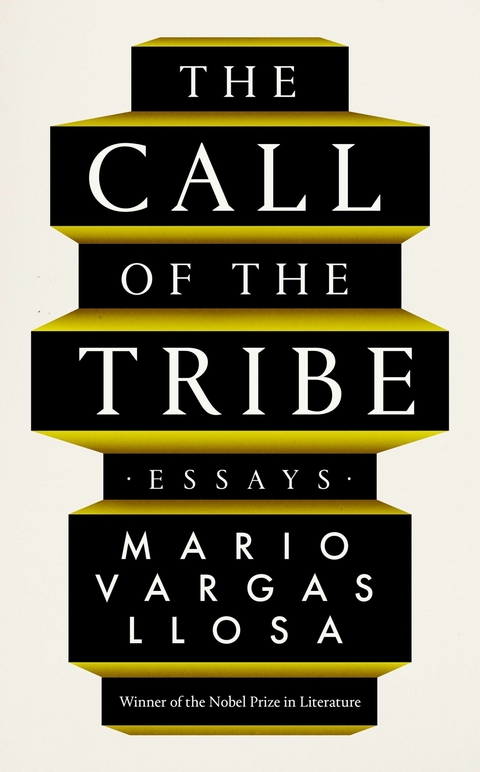
Call of the Tribe (eBook)
320 Seiten
Faber & Faber (Verlag)
978-0-571-35219-7 (ISBN)
Mario Vargas Llosa was awarded the Nobel Prize in Literature in 2010. He also won the Cervantes Prize, the most distinguished literary honour in the Spanish-speaking world. His many works include The Feast of the Goat, The Bad Girl and Aunt Julia and the Scriptwriter as well as several collections of essays, journalism and plays. He died in April 2025.
In The Call of the Tribe, Mario Vargas Llosa surveys the readings that have shaped the way he thinks and has viewed the world over the past fifty years. The Nobel Laureate maps out the liberal thinkers who helped him develop a new body of ideas after the great ideological traumas of his disenchantment with the Cuban Revolution and departure from the ideas of Jean-Paul Sartre, the author who most inspired Vargas Llosa in his youth. Writers like Adam Smith, Friedrich A. Hayek, Karl Popper and Isaiah Berlin helped the author navigate through these uneasy years of intellectual formation. They showed him another school of thought that placed the individual before the tribe, nation, class or party, and defended freedom of expression as a fundamental value for the exercise of democracy. The Call of the Tribe documents Vargas Llosa's engagement with their work and charts the evolution of his personal and philosophical ideology. Mario Vargas Llosa is one of the world's greatest living novelists, but, as Clive James wrote in Cultural Amnesia, his 'true strength' is 'undoubtedly in the essay'.
I would never have written this book had I not read Edmund Wilson’s To the Finland Station more than twenty years ago. This fascinating study traces the evolution of the idea of socialism from the moment when the French historian Jules Michelet, intrigued by a quotation, started to learn Italian to read Giambattista Vico, up to the arrival of Lenin at the Finland Station in Saint Petersburg, on April 16, 1917, to lead the Russian Revolution. I then had the idea for a book that would do for liberalism what the American critic had done for socialism: an essay that, starting in the small Scottish town of Kirkcaldy with the birth of Adam Smith in 1723, would trace the evolution of liberal ideas through their main exponents and the historical and social events that caused them to spread throughout the world. Although it is quite different from Edmund Wilson’s book, this was the early inspiration for The Call of the Tribe.
It might not seem so, but this is an autobiographical work. It describes my own intellectual and political history, the journey from the Marxism and Sartrean existentialism of my youth to the liberalism of my mature years, a route that took me through a reappraisal of democracy helped by my readings of writers such as Albert Camus, George Orwell, and Arthur Koestler. I was being drawn to liberalism by certain political events and, above all, by the ideas of the seven authors to whom I dedicate these pages: Adam Smith, José Ortega y Gasset, Friedrich August von Hayek, Karl Popper, Raymond Aron, Isaiah Berlin, and Jean-François Revel.
I discovered politics when I was twelve, in October 1948, when a military coup in Peru led by General Manuel Apolinario Odría overthrew president José Luis Bustamante y Rivero, a relative of my mother’s family. I think that it was during Odría’s eight-year reign that I developed a hatred for dictators of any stripe, one of the few invariable constants in my political outlook. But I only became aware of the social dimension, that Peru was a country weighed down by injustice, where a minority of privileged people exploited the vast majority in abusive fashion, when, in 1952, I read Out of the Night by Jan Valtin in my final year of school. This book led me to go against the wishes of my family, who wanted me to attend the Catholic University—then the place where wealthy young Peruvians studied—as I applied to San Marcos University, a public, popular university, not cowed by the military dictatorship, where, I was sure, I would be able to join the Communist Party. The party had almost been eradicated by Odría’s repressive measures when I entered San Marcos in 1953 to study literature and law, its leaders imprisoned, killed, or forced into exile; and it was trying to reconstitute itself as the Cahuide Group that I belonged to for a year.
It was there that I received my first lessons in Marxism, in clandestine study groups, where we read José Carlos Mariátegui, Georges Politzer, Marx, Engels, and Lenin, and we had intense discussions about socialist realism and “left-wing” communism, branded by Lenin as “an infantile disorder.” The great admiration I felt for Sartre, who I read devotedly, inured me against dogma—we Peruvian communists at that time were, in the words of Salvador Garmendia, “few but very sectarian”—and in my reading group I adhered to Sartre’s theory that upheld historical materialism and class struggle but not dialectical materialism, which caused my comrade Félix Arias Schreiber to label me in one of our discussions as “subhuman.”
I left the Cahuide Group at the end of 1954 but I remained, I believe, a socialist, at least in my readings, an interest that took on fresh impetus with the struggle of Fidel Castro and his barbudos in the Sierra Maestra and the triumph of the Cuban Revolution in the final days of 1958. For my generation, and not just in Latin America, what happened in Cuba was decisive, an ideological watershed. Many people, as I did, saw Fidel’s epic achievement as a heroic and generous adventure, of idealistic fighters who wanted to end the corrupt dictatorship of the Batista regime, and also as a means of establishing a nonsectarian socialism that would allow for criticism, diversity, and even dissidence. Many of us believed this, which explains why, in its early years, the Cuban Revolution had such great support the world over.
In November 1962 I was in Mexico, sent by Radiodiffusion-Télévision Française, where I worked as a journalist, to cover an exhibition that France had organized in Chapultepec Park, when the Cuban missile crisis erupted. I was sent to cover this event and was on the last flight by Cubana Airlines to leave Mexico before the blockade. Cuba was in a state of general mobilization, fearing an imminent invasion by U.S. marines. It was an impressive sight. Along the Malecón, small antiaircraft guns called bocachicas were operated by young men, almost boys, who put up with the low-level flights of U.S. Sabre jets without firing at them, and radio and television gave instructions to the people as to what to do when the bombing started. What they were living through brought to mind the emotion and enthusiasm of a free and hopeful people described in Orwell’s Homage to Catalonia, when he reached Barcelona as a volunteer at the beginning of the Spanish Civil War. Profoundly moved by what seemed to me to be the personification of socialism in freedom, I joined a long queue to donate blood. Thanks to my old companion at the University of Madrid, Ambrosio Fornet, and the Peruvian Hilda Gadea, who had met Che Guevara in Guatemala during the Jacobo Arbenz regime and had married and had a daughter with him in Mexico, I spent time with a number of writers connected to Casa de las Américas and its president, Haydée Santamaría, whom I met briefly. When I left, some weeks later, young people were singing in the streets of Havana, “Nikita/mariquita/lo que se da/no se quita” (“Nikita, you little poof, what’s given can’t be taken back”) because the Soviet leader had accepted Kennedy’s ultimatum and withdrawn the missiles from the island. Only afterward did it become known that in this secret agreement John F. Kennedy had promised Khrushchev that in return for the removal of the weapons, the United States would refrain from invading Cuba and would withdraw its Jupiter missiles based in Turkey.
My support for the Cuban Revolution lasted for most of the sixties. I traveled five times to Cuba as a member of the International Council of Writers affiliated with Casa de Las Américas and I defended the revolution in manifestos, articles, and public acts, both in France, where I was living, and in Latin America, where I traveled quite regularly. In those years I took up my Marxist readings again, not only the classics but also work by writers identified with the Communist Party, or close to it, like György Lukács, Antonio Gramsci, Lucien Goldmann, Frantz Fanon, Régis Debray, Che Guevara, and even the ultraorthodox Louis Althusser, professor at the École Normale, who later became insane and killed his wife. However, I remember that, during my years in Paris, once a week I would stealthily buy a copy of the paper deplored by the left, Le Figaro, to read the column by Raymond Aron, whose penetrating analyses of current events made me uneasy but also captivated me.
Several events at the end of the sixties began to distance me from Marxism. There was the creation of the UMAP camps in Cuba, where, behind the euphemistic term, Military Units to Aid Production, there lay the reality of concentration camps where counterrevolutionaries were kept with homosexuals and common criminals. My visit to the U.S.S.R. in 1968, when I was invited to a commemoration related to Pushkin, left me with a bad taste in my mouth. I discovered there that, had I been a Russian, I would have been a dissident in that country (that is, a pariah) or I would have been rotting in the Gulag. That made me feel somewhat traumatized. Sartre, Simone de Beauvoir, Merleau-Ponty, and the journal Les Temps Modernes had convinced me that, despite everything that was wrong with the U.S.S.R., it represented progress and the future, a country where, as Paul Éluard put it in a poem that I knew by heart, “there are no prostitutes or thieves or priests.” But there was poverty, drunks sprawled in the street, and a widespread apathy; one felt everywhere a collective claustrophobia due to the lack of information about what was happening inside the country and in the rest of the world. One just had to look around to realize that although class divisions based on money might have disappeared, in the U.S.S.R. the inequalities were enormous and were exclusively related to power. I asked a talkative Russian, “Who are the most privileged people here?” He replied, “Submissive writers. They have dachas for their holidays and they can travel abroad. That puts them way above ordinary men and women. You can’t ask for more!” Could I defend this model of society, as I had been doing, knowing now that it would have been unlivable for me? And my disappointment with Sartre was another important factor, the day I read in Le Monde an interview with Madeleine Chapsal where he stated that African writers should give up literature and dedicate themselves first and foremost to revolution...
| Erscheint lt. Verlag | 10.1.2023 |
|---|---|
| Sprache | englisch |
| Themenwelt | Literatur ► Essays / Feuilleton |
| Literatur ► Romane / Erzählungen | |
| Geisteswissenschaften ► Religion / Theologie | |
| Geisteswissenschaften ► Sprach- / Literaturwissenschaft ► Literaturwissenschaft | |
| Sozialwissenschaften ► Politik / Verwaltung ► Politische Theorie | |
| Sozialwissenschaften ► Politik / Verwaltung ► Vergleichende Politikwissenschaften | |
| Schlagworte | A Thousand Small Sanities Adam Gopnik • A World After Liberalism Matthew Rose • Last Best Hope George Packer • Legacy of Violence Caroline Elkins • Liberalism and its Discontents Francis Fukuyama • Matthew • What Was Liberalism? James Traub |
| ISBN-10 | 0-571-35219-7 / 0571352197 |
| ISBN-13 | 978-0-571-35219-7 / 9780571352197 |
| Informationen gemäß Produktsicherheitsverordnung (GPSR) | |
| Haben Sie eine Frage zum Produkt? |
 EPUB (Adobe DRM)
Kopierschutz: Adobe-DRM
Adobe-DRM ist ein Kopierschutz, der das eBook vor Mißbrauch schützen soll. Dabei wird das eBook bereits beim Download auf Ihre persönliche Adobe-ID autorisiert. Lesen können Sie das eBook dann nur auf den Geräten, welche ebenfalls auf Ihre Adobe-ID registriert sind.
Details zum Adobe-DRM
Dateiformat: EPUB (Electronic Publication)
EPUB ist ein offener Standard für eBooks und eignet sich besonders zur Darstellung von Belletristik und Sachbüchern. Der Fließtext wird dynamisch an die Display- und Schriftgröße angepasst. Auch für mobile Lesegeräte ist EPUB daher gut geeignet.
Systemvoraussetzungen:
PC/Mac: Mit einem PC oder Mac können Sie dieses eBook lesen. Sie benötigen eine
eReader: Dieses eBook kann mit (fast) allen eBook-Readern gelesen werden. Mit dem amazon-Kindle ist es aber nicht kompatibel.
Smartphone/Tablet: Egal ob Apple oder Android, dieses eBook können Sie lesen. Sie benötigen eine
Geräteliste und zusätzliche Hinweise
Buying eBooks from abroad
For tax law reasons we can sell eBooks just within Germany and Switzerland. Regrettably we cannot fulfill eBook-orders from other countries.
aus dem Bereich