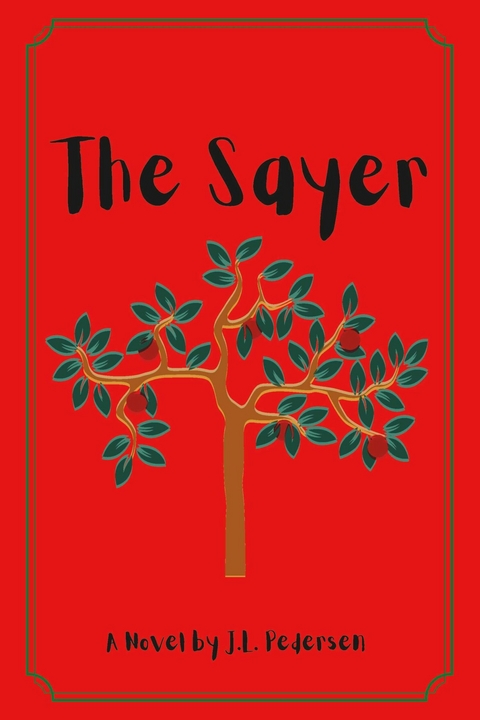
Sayer (eBook)
308 Seiten
Bookbaby (Verlag)
978-1-6678-2500-7 (ISBN)
J.L. Pedersen brings you "e;The Sayer"e;, a captivating novel that blends elements of romance, allegory, and mythology. A masterfully written tale filled with secrets, drama, and tragedy, this is a must-read for all fans of literary fiction. Enter a place where the courage of friendship, and the bonds of love endure. Open your heart to remembrance, poetry, and the treasure of hidden hopes which may survive the greatest of sorrows. Follow here the story of Erein, the girl who discovered that losing your life is, sometimes, the only way to find it.
4
Halla did indeed heal. But only after long days of broth, and tea, and fitful sleeps. I tended to her as best I could. I wet-wooled her feet, and rubbed her knuckles, and placed black, glistening leeches on the fragile, pulsing skin of her neck. This I didn’t much like, but Litha encouraged me. I listened to her breathing in the still afternoons, vigilant for any signs of rattle or cough. When she woke, I sang to her. I pressed flowers to her nose, dusting her with pollen and dropping an occasional stray ant which made her shriek and flail about, and brought Litha running. I would defend my ministrations, saying, “it is good for her to laugh.” And so, I kept coming to her bedside with gifts and trinkets, and odorous salves. And still the leeches, which she endured with her eyes sealed shut, clutching my hand until they were done with their gruesome work.
Friendships are sealed in strange ways.
By the time she was well again, the great rains had come, and gone, and the river Dru was swollen among the bracken. Halla, thin as a beech but fully herself once more, had dragged me to the edge of it, as close as we dared. We watched, wide eyed, as the waters tumbled and writhed before us, bejeweled by sunlight and flecked with ruin. We saw entire trees being pulled along, their tortured limbs cracking as they rushed by. As they scratched the banks, we screamed and backed away, clutching at each other. It was wonderful.
“Look!” Halla pointed upstream.
Something was coming down the river. Swift as the waters were, it moved with a languor that belied them. It tilted and bobbed, heavy in its journey, and I could see that it had a shape to it that was all corners.
“Is that…is that a buka?” I shrieked, more loudly than I intended. One of the small huts used to overwinter seeds. I wondered who it might belong to. They would be vexed.
Halla squinted, shading her eyes against the early sun. “I think it is!” She grasped my wrist, and pulled me towards the river. She was still strong, even after her long infirmity. “Hurry!” she cried, slipping in the mud. She left wedges of dark earth where her heels dug in.
The buka came up fast, crashing and spinning around rocks in a dizzying dance. Halla gripped my hand even tighter, pumping it up and down. Her mouth moving. The river was deafening, and I had to lean close to hear her.
“Cat!” she was crying, “Cat!”
I thought I had misheard, but as the buka came ever closer, I spotted the sorry spectacle of a very dirty cat clinging to its roof. It was crying, and the pink of its mouth kept showing. My heart sunk with the sight. I wanted to look away, but then my arm was nearly yanked from my body as Halla pulled me downstream, where a large tree had been felled across the water.
A deadwood.
Halla wasted no moment and began scaling the exposed roots. I begged her to stay, but she was deaf to my pleas. She began inching her way out over the river on her hands and knees. My heart ker-thunked! when the trunk jolted, and Halla dropped to her belly and clung tightly, never taking her eyes off her prize. The buka had caught up on the tree, but was slowly being dragged under. Halla scrabbled like a beetle, further out. She grasped one of the dead tree branches, and snapped it off. She extended it to the roof, and then lay still. The cat clung to the roof, flattening itself and showing its teeth. I could see Halla tapping the branch, tempting the cat to come. The buka continued to sink below the surface and still Halla stayed, tapping at the roof. I was about to yell for her to stop, to come back, it was too late, when the deadwood shifted in the water, the buka pushing it. Now I did scream, because Halla, the buka, and the cat all dropped out of my sight.
My throat was burning when a shape blocked out the sun above me. I shaded my eyes and saw my friend climbing down out of the tree roots. She was soaking wet, and filthy. Her zapi was wrapped around her chin like a feedbag. She dropped to the ground and began running. She did not stop until she came to the edge of the woods. She dropped to her knees and bowed her head, back heaving. I slid to a kneel next to her, my blood rushing loudly in my ears, and sought her face with my hands. I thought she was crying but when I pushed her zapi away, I saw she was laughing, clutching her belly.
“Are you hurt?” I cried, not understanding. She met my eyes, tears streaming, and then I looked at her lap where her sodden skirts were bunched. She pulled the fabric away, revealing a very small, terrified cat that was clinging pitifully to her clothing.
“Ohhh…” I wheezed, “it’s hardly more than a kitten.”
Halla nodded, “I know. It’s just a babe.”
She gently stroked the cat’s fur, clumps of grass and mud coming away. I took the hem of my own skirt and began wiping the rest of it clean. The cat was either too scared or too exhausted to protest. It lay very still under our ministrations. So still, in fact that I began to suspect that it had perished. Gingerly I put my hand to its belly, feeling for breath, and was rewarded with the faint vibrations of purring. Eventually, we discovered a ginger striped tom under the mess, with eyes the color of hazelnuts. He kept blinking and Halla said, “See, he likes us.”
Suddenly, I felt hot all over, and before I could think better of it, I reached out and slapped Halla across her face. She gasped and covered her cheek with her hand. I began to cry.
Halla simply stared at me, shocked into silence. Then, without a word, she placed the kitten in my lap.
“Here,” she whispered. “His name is Pip.”
I sniffed pitiably, and stroked his gritty ears. “Pip,” I echoed, liking the sound of it. I felt her grab my hand, and to my dismay, I saw tears in her eyes.
“I’m sorry I frightened you,” she said, gripping my fingers. “Look!” she cried, brandishing the branch she had used in rescuing the cat. She held it out before her. “Look,” she continued gently, running her dirty fingers along its length. “We shall make a ka-tun. Did you bring your knife?”
I nodded, a thrill running through me. A ka-tun.
We all had our belief in them; amulets that were made and exchanged between friends, siblings, mothers and fathers. Some were used for protection, with symbols of the sickle engraved inside; but there was all manner of ka-tun. They were worried on with thumbs, gazed upon with wishing thoughts, kissed for luck, and treasured above all things. Even though children were allowed to play at fashioning crude ones of their own, the real thing was a sacred gift. If one became lost, the entire community would search day and night to find it, often sacrificing their work and livelihood until the thing was found. No person, to my knowledge, ever lost one. And if someone gifted you a ka-tun in good faith and with a clear heart, you must accept it and never remove it from your person, for you were now in possession of a part of their ka, or spirit.
And so, on the banks of the Dru river, while Pip found his legs again, we took to fashioning a pair of wooden callers. Two notes, we decided. One for each of us. When we were finished, we made a great ceremony of exchanging them, with the purpose of threading them onto leather, to string around our necks. We somberly presented each other with our ka-tuns saying, in turn, take this of my ka and bowed our heads.
We practiced our technique for whistling through the small instrument, until we had our calls matched. A high note, and a low note. We were very pleased, and we walked home, taking turns running up ahead, and then whistling to be found. This pleased us to no end.
Upon my arrival at home, I was met by an angry Mama who grabbed me by the ear and growled, “Zaldi is ripping up the goose grass in my garden. Have you fed him today?”
My heart dropped, as I realized how long I had tarried at the river. I shook my head, ashamed.
“Your father did not gift you that horse to be neglected, young one. So then—” here she paused, catching a glimpse of the kitten in my blouse. Her mouth formed a small circle and her face softened. “Well, now, what is this?” she cooed, plucking the tiny creature from my bosom with practiced hands. The cat mewled pitifully, and Mama appraised it, turning it over and back, lifting its tail and pronouncing: “This tom needs milk, poor thing.”
“Halla found it,” I offered.
“But of course, she did,” Mama said with a small smile and a shake of her head.
She turned to go, but her eyes fell upon the caller tucked in my bodice. “What is this?” she asked, taking it between her fingers. Mama knew quite well what it was.
“It’s Halla,” I simply said. Which, in essence, was the very truth of it. It was Halla. Or, a part of her.
“So I see,” Mama said, nodding. She placed her hand upon my head, in a rare gesture of tenderness, adding: “It needs to be threaded. See that you do it soon,” before moving me towards the garden.
I ran to the back of the house, where Zaldi was making very free with the goose grass. The sharp, peppery herb we used to flavor our favorite soups and potatoes. I grabbed his nose rope and chided him gently, coaxing him away from the garden bed. This would seem an impossible task, as I was small, and Zaldi was enormous. He was built for labor, with legs as big as birch trunks, and a head that was almost as big as I was. Papa told me he...
| Erscheint lt. Verlag | 24.1.2022 |
|---|---|
| Sprache | englisch |
| Themenwelt | Literatur ► Romane / Erzählungen |
| ISBN-10 | 1-6678-2500-3 / 1667825003 |
| ISBN-13 | 978-1-6678-2500-7 / 9781667825007 |
| Informationen gemäß Produktsicherheitsverordnung (GPSR) | |
| Haben Sie eine Frage zum Produkt? |
 EPUB (Adobe DRM)
Größe: 668 KB
Kopierschutz: Adobe-DRM
Adobe-DRM ist ein Kopierschutz, der das eBook vor Mißbrauch schützen soll. Dabei wird das eBook bereits beim Download auf Ihre persönliche Adobe-ID autorisiert. Lesen können Sie das eBook dann nur auf den Geräten, welche ebenfalls auf Ihre Adobe-ID registriert sind.
Details zum Adobe-DRM
Dateiformat: EPUB (Electronic Publication)
EPUB ist ein offener Standard für eBooks und eignet sich besonders zur Darstellung von Belletristik und Sachbüchern. Der Fließtext wird dynamisch an die Display- und Schriftgröße angepasst. Auch für mobile Lesegeräte ist EPUB daher gut geeignet.
Systemvoraussetzungen:
PC/Mac: Mit einem PC oder Mac können Sie dieses eBook lesen. Sie benötigen eine
eReader: Dieses eBook kann mit (fast) allen eBook-Readern gelesen werden. Mit dem amazon-Kindle ist es aber nicht kompatibel.
Smartphone/Tablet: Egal ob Apple oder Android, dieses eBook können Sie lesen. Sie benötigen eine
Geräteliste und zusätzliche Hinweise
Buying eBooks from abroad
For tax law reasons we can sell eBooks just within Germany and Switzerland. Regrettably we cannot fulfill eBook-orders from other countries.
aus dem Bereich