


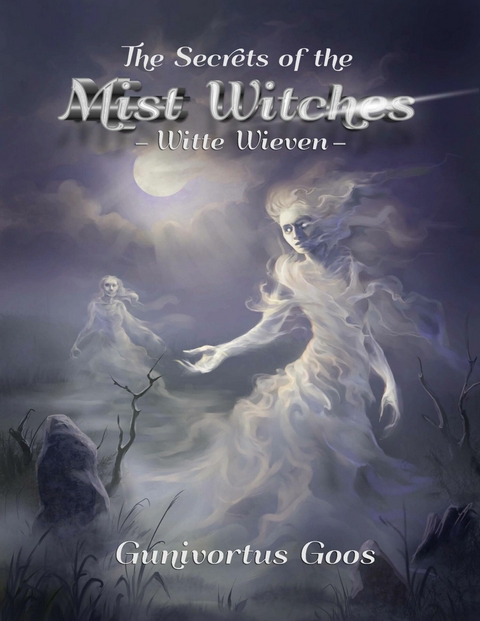
The Secrets of the Mist Witches (eBook)
256 Seiten
Books on Demand (Verlag)
978-3-7562-9709-2 (ISBN)
Gunivortus Goos previously published quite a few books and articles under his meanwhile given-up pseudonym GardenStone, but some years ago he started publishing under his legal name. Born in the city of Groningen, he is a Dutch, who some decades ago left his hometown and country and moved to Germany, where he, after several stations, now lives in a small town in the beautiful Taunus Hills in the German state of Hesse. Guus' (that's how his friends call him) 'addiction' is the research of specific historical topics of his personal interest, within which he is always eagerly looking for primary sources and related views and experiences of scholarly or practicing people, which he also uses to develop his own opinions. In his publications his concern is not to only reproduce current views and his own ones, but also to stimulate the reader to form his or her own opinion. For the same reason, where possible, he also includes controversial representations.
Voices of slumberous music,
Spirits of mist and of flame,
Moonlit memories left here,
By gods who long ago came ...
Wiliam Wilfred Campbell
Witte Wieven - White Mist Women
Spirits of mist
Mist spirits do not only occur in the small, limited area from which the "Witte Wieven" originate, but are much more widespread throughout world cultures. In order to substantiate this, legends and folk knowledge about mist spirits in general are presented in this chapter, some of which come from other, sometimes distant areas.
Depending on the area, they are described in very different forms, but are sometimes recognizable as a modification of the mythological figures occurring in the respective area. That these stories often take the form of legends shows the old folk knowledge, often with a possible reference to earlier beliefs. In the French legends about 'white women' aspects of Celtic mythology can be recognized, in the Polish, Bohemian and Slovak legends about them one recognizes beings from Slavic tradition.
There are legends about White Women in several areas of Germany and beyond, and yes they also exist in other regions and on other continents. There are, for example, the White Castle Woman, the White Mountain Woman, the White Mermaid, etc.; they can be recognized in some of the tales told in this book. In many areas there are such figures, and the well-known works of the mythologists (Jacob Grimm was one of them) tell about them in detail. White Women and also Wild Women are hardly represented as mist creatures. Wild Women are often said to be hairy all over their bodies, White Women are opaque in most of the stories and dressed like humans; this also applies in part to the Witte Wieven stories. It is often suggested that these spirits consist of an 'ethereal' substance; it is also said sometimes they were soul beings. In any case, most of the time they cannot be identified as nebulous figures - but the latter remark has to be put into perspective, because in most cases we simply do not know; the legends give no information about it.
These legends do make it clear however, that the folktales about Mist Witches, which are central in the next chapter, belong to the large group of legends about mist spirits which occur across several continents of the world.
A dark forest limits the field of vision, the moon shines through the sparse clouds, it has grown cool, the wind rustles through the leaves. The water in the nearby brook mumbles and the pattering waves in the small forest lake can be heard quietly from afar. There is a slight rustling on the ground when mice scurry over fallen leaves in search of food. An owl screams from above the treetops. And wafts of mist which constantly change their shape, sometimes large, sometimes smaller, move between the trees. They approach, as if in a rhythm or dancing or both, sometimes threateningly, and then withdraw again. In their forms, human-like figures can often be recognized, and they are, as everyone in a certain area knows, the 'Witten Wieven', the White Woman, who are also called Mist Witches.
However, whether this can also be generalized, i.e. whether generally fog is to be perceived in this form, may well be doubted. As already mentioned, white women are known in many parts of Europe, in France they are called 'Dames Blanches', 'Femina Saga' and sometimes also 'Dames Vertes’, meaning 'green women'.
Dame Blanche
They are particularly notorious in the forests of the Jura mountain range, where, as stories told, they look like fairies and like to play innocent, mostly good-natured pranks on humans; but walkers should not be tempted to follow them, otherwise they could get lost and fall into water or a deep ditch.
In contrast, there are family stories in which 'Dames Blanches' are portrayed as protectors of a kinsfolk; they help in particular with the procurement of food, because if they touch ailing plants, the plant should be strengthened.
The traditional Latin names for these beings prove that white women are a very old kind of supernatural phenomena: ALBAE DOMINAE, NYMPHAE OREADES OR ALBAE NYMPHAE.
Many of the legends from the Middle Ages are about women who were once human, women who, after their death, continue to exist as ghosts in the area where they once lived as humans.
While all these white and supernatural feminine beings have a human shape, their consistency remains practically always unclear. In the legends of where they dissolve and thus disappear, one could think of smoke or mist.
In order to put the above into concrete terms, a few examples of legends of folk knowledge about "white creatures" of a supernatural nature follow now (partially they are connected to mist),, before we proceed to the Witte Wieven or Mist Witches in the next chapter.
Germany
Weissenstein
Around the Raffenberg in the Weißenstein-Hünenpforte (a nature reserve, located in the region of the German city of Hagen in North Rhine-Westphalia) numerous legends and myths have grown up around the romantic rock formations in the 'Lennetal' (valley of the river Lenne), since the Middle Ages. Some of the stories handed down are dealing with "white women" who are said to have been up to mischief around the Weißenstein, which is a 189m high limestone rock, which was mentioned as far back as 1582 as 'Wittenstein' (Whitestone). Since it is often foggy in this area, and indeed, it is not actually a uniform mist but rather patchy, and the shape of the white women in the lore from there seems to be a non-corporeal form, it may also have been Mist Women here.
The "Nebelmännle” (Little Mist Man)
The Nebelmännle is a figure of mist that damages the grapevines on the slopes. These grapes can then no longer be processed to make wine, and become the prey of the Nebelmännle. In order to drive this figure away, the fog bell is rung when the fog is coming up in the vineyards. In order to secure the wine for himself, the Nebelmännle insists in the following legend that the ringing of the fog bell be stopped. In the legend there is talk of a Knight called 'von Bodman,' whose castle stood on the northwestern foothills of Lake Constance.
Today there are still the ruins of a castle there.
As a protection against the Nebelmännle, people ring the mist bell, as was usual in southern Germany. The bell was rung against bad weather in general, and particularly to drive away the pernicious spirits that reigned in it. The tolling bell would strike the Mist Man every time it rang, right near to his head. The idea of the Mist Man is even linked to an old legend of the gods, which is transferred to the widely traveled family of the noble family of“von Bodmann” through late localization. A Knight von Bodmann went on a journey into the heathen lands, near the sea, into a wilderness. There he met a little man. The little man led him to his dwelling, which was all overgrown with moss and grass, and served him food and wine. He immediately recognized the latter as being made from a native plant. When asked, the little man said,“I am not a natural person, but the mist itself, which benefits of what is perished in the wine barn. If you want to protect yourself from the spoilage of your grapes, never let the bell ring against the fog. Yet, it is time for you to go home.”, and through the sky the little one carried the knight home, where he found his wife just about to marry again. He identified himself to her through his wedding ring and the new bridegroom was sent away.
Translated from Wilhelm Mannhardt, p. 93
The ruins of the Bodmann Castle
Another version of this legend reads:
The practice of the ringing of the mist bell, which was supposed to scare away the mists, has since ceased; but the mist bell is still hanging on the old Bodmann Castle.
Ludwig Laistner
The German writer and literary historian Ludwig Laistner (1845-1896) discusses several mist figures in his book "Nebelsagen" (Mist Legends) from 1879, mostly from the southern half of Germany. Some examples from his book and brief comments on them follow now:
The Mist Woman or (Mist)goddess Urschel
1. Legend of the Mädlesberg, a rock formation near the town of Pfullingen on the edge of the Swabian Alp (in the German state of Baden-Württemberg):
A beautiful maiden once walked over the so-called Mädlesberg near the town of Pfullingen. Then she met a hunter who became furious with rage and lust; and because the virgin would not bow to his will, he tried to do violence to her. She finally fled; the hunter hurried after her and drove her to a steep cliff, where he was about to grab her with his hands. But in order to save her honor, the maiden plunged boldly into the depths, arrived safely below and walked on. As the hunter saw, he believed he could also take the plunge and threw himself down and found his death and punishment on the spot. It is also said that this maiden was actually one of the night maids of the Urschel Mountain and often sat and knitted on the Mädlesfelsen. . .
Translated from Laistner, p.109
The Urschel Mountain near Pfullingen was either named after a heathen goddess Urschel, who probably in the course of Christianization was demonized to a ghost, or (and this might be a later development) to expel the pagan origin, the catholic saint Ursula. Nearby to the mountain is also a Mist Cave, a famous dripstone cave, which in earlier days was also called Mist Hole,...
| Erscheint lt. Verlag | 22.4.2022 |
|---|---|
| Sprache | englisch |
| Themenwelt | Literatur |
| ISBN-10 | 3-7562-9709-8 / 3756297098 |
| ISBN-13 | 978-3-7562-9709-2 / 9783756297092 |
| Informationen gemäß Produktsicherheitsverordnung (GPSR) | |
| Haben Sie eine Frage zum Produkt? |
 EPUB (Wasserzeichen)
Größe: 12,3 MB
DRM: Digitales Wasserzeichen
Dieses eBook enthält ein digitales Wasserzeichen und ist damit für Sie personalisiert. Bei einer missbräuchlichen Weitergabe des eBooks an Dritte ist eine Rückverfolgung an die Quelle möglich.
Dateiformat: EPUB (Electronic Publication)
EPUB ist ein offener Standard für eBooks und eignet sich besonders zur Darstellung von Belletristik und Sachbüchern. Der Fließtext wird dynamisch an die Display- und Schriftgröße angepasst. Auch für mobile Lesegeräte ist EPUB daher gut geeignet.
Systemvoraussetzungen:
PC/Mac: Mit einem PC oder Mac können Sie dieses eBook lesen. Sie benötigen dafür die kostenlose Software Adobe Digital Editions.
eReader: Dieses eBook kann mit (fast) allen eBook-Readern gelesen werden. Mit dem amazon-Kindle ist es aber nicht kompatibel.
Smartphone/Tablet: Egal ob Apple oder Android, dieses eBook können Sie lesen. Sie benötigen dafür eine kostenlose App.
Geräteliste und zusätzliche Hinweise
Buying eBooks from abroad
For tax law reasons we can sell eBooks just within Germany and Switzerland. Regrettably we cannot fulfill eBook-orders from other countries.
aus dem Bereich


