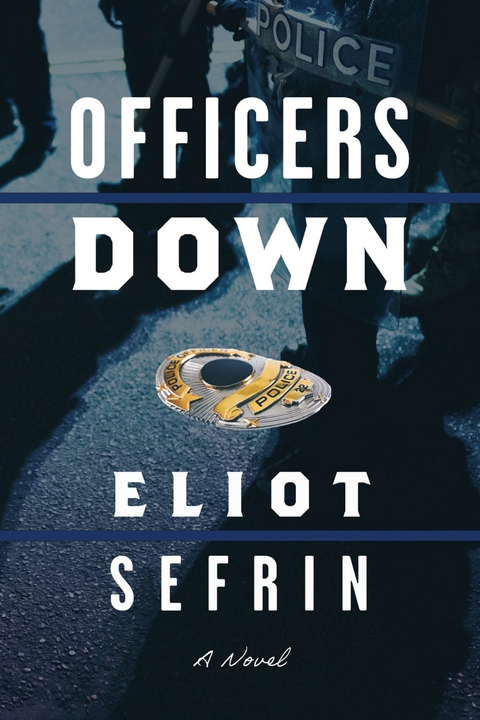
Officers Down (eBook)
430 Seiten
Bookbaby (Verlag)
978-1-6678-2238-9 (ISBN)
A pair of highly regarded New York City police officers - one male, one female, both white - accidentally kill an innocent Black teen in a poverty-stricken, minority neighborhood and face the consequences of an enraged community, a racially divided city, and their own emotional unraveling. This powerful and timely novel, based on a composite of real-life events, explores the sensitive and divisive issue of race relations in America within the context of a tragic police shooting that becomes a lightning rod for racial tension and the focus of a landmark civil rights case, while profoundly reshaping the lives of those most closely impacted by the incident. As the riveting drama unfolds amidst controversy, false charges, racial bias, and political maneuverings that threaten to overwhelm the facts of the case, both the officers and the family of the slain teen become immersed in intense inner crises as they struggle to come to terms with the tragedy. In the process, they come to experience the stereotypes, antipathy, and misunderstanding that often divide our communities - as well as the wisdom and emotions that can ultimately bind them and help them heal.
Chapter 1
Even in the glow of morning there was darkness. It was all that Matt Holland could see. Dank and dreary, like the cellar in which it dwelled, it had clung to the embattled New York City police officer all through his hellish ordeal, swallowing him up like a savage beast before burrowing deep inside him, as if to find a permanent roost.
Even now, with daybreak burnishing a cloudless, azure sky, Holland couldn’t stop thinking about how pitch-dark it had been in the cellar, black as a cave in the dead of night. He was blind, for all intents and purposes, when that shadow rushed him from out of nowhere. Never knew who or what it was. Never saw it coming until it careened headlong into him. Never fully grasped what had taken place until he was back at the 73rd Precinct station house with the Internal Affairs Division investigators lobbing questions, and NYPD brass flocking to the precinct in droves, and the darkness of the cellar engulfing him, part of him forever now.
“Detective Sergeant Holland,” an IAD investigator chirped, poking his head into the precinct commander’s office, where Holland awaited questioning.
Holland squinted, as if awakening from a long, deep slumber. It was seemingly all he had the strength to do, the past nine hours having drained him like a spent battery. His close-cropped, dusky hair was matted and flecked with droplets of blood, his complexion sallow, his eyes sunken and lifeless. Seated behind Captain Borelli’s outsized desk, the veteran officer seemed gnarled and shrunken from his normal six-foot frame, like a punch-drunk fighter slumped on his stool.
“Two minutes,” the investigator said. “We’re about ready to tee things up again.”
But the IAD shoofly may well have been invisible; Holland saw nothing of him. Instead, all he saw were the same vivid, jolting images that had haunted him all night. He saw the muzzle flash of his service revolver light up the apartment-building cellar on Amboy Street. He saw spidery silhouettes skitter across the musty, ashen vault, looming ominously on the ceiling and walls. He saw his partner, Rachel Cook, gasping for breath before dropping to her knees. He saw the boy’s face, ghostlike in the beam of Cook’s flashlight, appearing joyful at first, then frightened and bewildered.
… Then the angry throng of onlookers, cursing and shouting, as a phalanx of fellow officers hustled him and Cook into a waiting patrol car.
… Then the sterile, emerald corridors of Brookdale University Hospital, lined with gurneys and wheelchairs and empty, pained faces.
… Then his wife Katie, tremulous and tearful, reaching out to hold him close.
… Then the darkness again, desolate and suffocating and forbidding.
Everything would have been so different if it hadn’t been so dark down in that cellar—that’s what Matt Holland kept thinking now. None of this would have happened. He and Cook would have handled the 911 call routinely, nothing unwonted for a normal four-to-midnight tour, and everyone would have gone their merry way. The boy who’d run into him would be all right, tucked in bed at his family’s apartment, or waking to a gorgeous, summer day. The other kids in the cellar would be all right, too. So would Cook, off by now on that July 4th Fire Island junket she’d gushed about for weeks.
And Holland? He’d be all right, too.
By now, he would have arrived at Katie’s parents’ beach house, down the Jersey shore, waking from a good night’s sleep as daylight brightened the horizon and a balmy breeze blew in off the ocean. By midday, he’d be grilling steaks on the backyard deck, watching his eight-year-old twin girls romp along the shoreline and the seawater glint off Thomas’s skin as his twelve-year-old son barreled through the surf on a boogie board. There would have been fireworks at the boardwalk by nightfall and a festive Independence Day parade, with costumes and marching bands and floats. Then custard and saltwater taffy, and back to the house with Katie and the kids. Everything normal. Everything intact. The arc of his life pregnant with glowing possibilities, joyous memories, and an abundance of priceless riches.
Instead … there was this.
Instead of a much-anticipated holiday weekend off, Matt Holland sat in the fusty bowels of the 73rd Precinct station house in the Brownsville section of Brooklyn—exhausted, bewildered, pondering how everything in his life had gone so swiftly and frighteningly awry.
The IAD investigators were coming off a short break now, their interrogation having already stretched since shortly before midnight. There were hours to go yet before the dour-faced men with the tape recorders and legal pads would wrap things up and move their investigation to NYPD headquarters, where the probe would continue interminably.
“I’m sorry as hell that all of this happened, Matty,” Capt. Borelli said at the outset of Holland’s questioning. “My heart’s breaking for you. I just pray that you and Katie can stay strong through it all.”
Holland, though, could manage no more than a tepid smile.
By then, the officer had signed his formal statement and convened with Patrolmen’s Benevolent Association President Red McLaren, PBA shop steward Angelo De Luca, and union attorney Eddie Shearson. Capt. Borelli had handed his Unusual Incident Report to the I-24 man for typing. Holland and Cook, per NYPD protocol, had surrendered their uniforms and firearms and been discharged from the hospital, where they’d been examined for injuries and trauma.
“If there’s anything I can do for you, Matty,” Capt. Borelli had said, looking ashen and shaken himself. “Anything in the world … anything.”
But there was nothing Capt. Borelli could do … nothing anyone could. And so, the precinct commander had grudgingly left Holland alone, pledging that he’d keep an eye out for Katie when the investigators marched the officer downstairs.
First in line for the questioning was the deputy inspector in charge of the ten-precinct Brooklyn North. Next up were detectives from Firearms and Homicide, followed by investigators from the district attorney’s office and, finally, the shooflies from Internal Affairs. By then, the station house was flooded with NYPD brass, and the investigators were forced to move their interrogation from Capt. Borelli’s cramped, second-floor office to the precinct muster room downstairs.
Along about 2:00 AM, they delivered sandwiches and sodas, and broke for a while so that everyone could use the restroom. Portable fans were brought in, but they hadn’t helped. Heat poured in through open windows as if from a blast furnace. Flies and mosquitoes buzzed about. The entire muster room—crammed with unshaven, growly investigators—reeked of cigarette smoke, stale cologne, and human sweat.
The 73rd Precinct station house felt much the same. Drab and dimly lit, its white-tiled ceilings were stained with moldy watermarks … its paint-peeled walls plastered with official notices and WANTED posters. Adjacent to the muster room, a sergeant sat behind a massive wooden desk, cradling a telephone between his shoulder and ear. At a smaller desk, the I-24 man cranked out reports, the clacking of his typewriter keys echoing through a row of empty jail cells.
Outside the station house, it was obvious that something unusual was going on. Dozens of plainclothes officers—I.D.s dangling from breast pockets and neck chains—milled about on the sidewalk, mingling with late-platoon cops and others arriving for the eight-to-four tour. Patrol cars and unmarked sedans sat parked at odd angles to the curb. Even the station house itself looked especially weathered. A dingy, turn-of-the century Gothic structure, its begrimed windows were nearly opaque, its stone façade speckled with pigeon droppings. Amber metal lanterns flanked a pair of twelve-foot-high wooden doors, over which the precinct’s number was etched in glass. A sun-bleached American flag hung limply over the entranceway. Beyond the fortress-like structure, Brownsville stretched for blocks, blighted and morose in the early morning haze.
“What the fuck is goin’ on here?” a slack-jawed officer from the eight-to-four tour inquired. He was dressed in faded jeans and a blue-white New York Yankees tee shirt. A freshly laundered uniform was slung on a hanger over his shoulder.
“Ain’t ya heard?” a mutton-chopped cop named Terry replied. “It’s all over the radio an’ TV. Front page of the mornin’ papers, too.”
The other officers broke the news.
“Holy shit!” the newly arrived cop exclaimed. “Who was it?”
“Matt Holland,” Terry said.
“Holland? You’re shittin’ me!”
“Last guy you’d ever imagine, huh?” Terry said.
“Fuck, yeah!” the cop in the Yankees shirt said. “Who was he partnered with?”
“Rachel Cook.”
“Who?”
“Cook. A rookie. Female. On the job all of eight months.”
“Jesus Christ!” the cop in the Yankees shirt said. “Where’d it go down?”
“Amboy Street.” Terry dragged on a half-smoked Marlboro. “Cellar of some shithole apartment building.”
“When?”
“About nine last night.”
“What the fuck happened?”
“No one’s sure yet,” Terry said. “They’re still sorting things out.”
“Where’s Holland now?” the newly arrived cop asked.
“Capt....
| Erscheint lt. Verlag | 28.2.2022 |
|---|---|
| Sprache | englisch |
| Themenwelt | Literatur ► Historische Romane |
| ISBN-10 | 1-6678-2238-1 / 1667822381 |
| ISBN-13 | 978-1-6678-2238-9 / 9781667822389 |
| Informationen gemäß Produktsicherheitsverordnung (GPSR) | |
| Haben Sie eine Frage zum Produkt? |
 EPUB (Ohne DRM)
Größe: 1,1 MB
Digital Rights Management: ohne DRM
Dieses eBook enthält kein DRM oder Kopierschutz. Eine Weitergabe an Dritte ist jedoch rechtlich nicht zulässig, weil Sie beim Kauf nur die Rechte an der persönlichen Nutzung erwerben.
Dateiformat: EPUB (Electronic Publication)
EPUB ist ein offener Standard für eBooks und eignet sich besonders zur Darstellung von Belletristik und Sachbüchern. Der Fließtext wird dynamisch an die Display- und Schriftgröße angepasst. Auch für mobile Lesegeräte ist EPUB daher gut geeignet.
Systemvoraussetzungen:
PC/Mac: Mit einem PC oder Mac können Sie dieses eBook lesen. Sie benötigen dafür die kostenlose Software Adobe Digital Editions.
eReader: Dieses eBook kann mit (fast) allen eBook-Readern gelesen werden. Mit dem amazon-Kindle ist es aber nicht kompatibel.
Smartphone/Tablet: Egal ob Apple oder Android, dieses eBook können Sie lesen. Sie benötigen dafür eine kostenlose App.
Geräteliste und zusätzliche Hinweise
Buying eBooks from abroad
For tax law reasons we can sell eBooks just within Germany and Switzerland. Regrettably we cannot fulfill eBook-orders from other countries.
aus dem Bereich