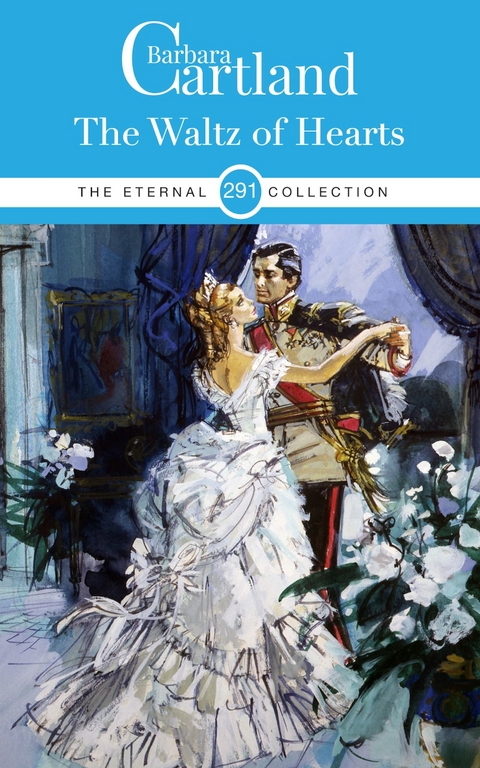
The Waltz Of Hearts (eBook)
245 Seiten
Barbara Cartland eBooks Ltd (Verlag)
978-1-78867-560-4 (ISBN)
Chapter Two
In a box watching a rehearsal taking place on the stage, Gisela with a feeling of some satisfaction thought that it was all going very well.
She had felt a little apprehensive as she and her father were driving into the City to see the Manager of the Court Theatre.
She obviously could not tell her father that Miklós Toldi had said that he would speak to the Manager because in no way could she explain her acquaintanceship with a man of whom he had never heard before.
Besides Gisela was quite certain that she would not be able to speak of the man who had kissed her without blushing.
After she had lain awake the first night, still feeling the rapture and wonder that he had evoked in her with his lips, it had been impossible to have any regrets or even recriminations.
But the following morning she had been ashamed and shocked at herself.
How could she have behaved in such a fast loose manner?
She was well aware that her mother would have been horrified at the idea of her being kissed by any man who she was not engaged to be married to.
But for a complete stranger, a man whose face she had not even seen, to kiss her in the Vienna Woods seemed in retrospect to be so incredible, just so completely unbelievable that Gisela kept telling herself that it had not really happened, but was just a figment of her vivid imagination.
But when she tried to do so, she could feel Miklós Toldi’s arms round her and his lips on hers
She could hear again the music playing in the leaves of the trees and so experience again the feeling that she was being swept up towards the stars and the ecstasy of it was almost too wonderful to be borne.
When she breakfasted very late with her father under the trees outside the inn, she told herself severely that she had to come down to earth and to think only of him.
He still looked tired, but he was as enthusiastic as a young boy at the idea of showing her Vienna and finding some of his friends from long ago.
“I may call on Johannes Brahms,” he said. “Frau Bubna has told me his address.”
“I think first, Papa,” Gisela answered, “that we should visit the Manager of one of the theatres who might offer you a Concert or a place in one of his shows.”
“They will all want me,” her father replied quickly.
But it was too quickly for Gisela not to realise that he was, if he was truthful, a little apprehensive that he might not receive the welcome that he hoped for.
Thanks, she was sure, to Miklós Toldi, when they arrived at the Court Theatre they were ushered immediately and with much ceremony into the Manager’s Office.
He was an elderly man, fat and bald and he rose from his desk with an unmistakable cry of delight.
“Herr Ferraris!” he exclaimed. “I can hardly believe it is you. But welcome, welcome to the City of Music!”
“You have heard of my success in Paris?” Paul Ferraris asked him.
“Of course I have and we now need you among us.”
From that moment everything went very smoothly and within two days Paul Ferraris was attending rehearsals for a show that was to open at the end of the week.
“We need you desperately,” the Manager told him. “We have a great baritone, Ferdinand Jaeger and a violin solo will be a delightful contrast, an item that is at this moment missing from the programme.”
Paul Ferraris had been thrilled.
“They have heard of me! I told you they would.”
“But, of course, Papa,” Gisela said. “Music is international and I just cannot believe that Vienna has been out of touch with Paris and Brussels for all these years.”
Sitting now far back in the box so that she could not be seen from the stage or from the auditorium, Gisela said a little prayer of thanks because her father looked so happy.
She knew from the way he walked onto the stage that he would play his best and forget the frustrations of the last year when he had often been too unhappy to play anything.
He had always been particular that Gisela should not associate with the theatre people, who, although he did not say so, often had morals that he disapproved of.
When her mother was alive, Gisela had always been left at home and the few times when she went to the theatre, it was to sit in a box or the stalls to listen to her father and never to go backstage to see him.
Now Paul Ferraris was worried about what to do with her.
He obviously could not order her to stay alone in the hotel where they were staying and to let her sit in the stalls with the director and the other people concerned with the production would mean that she would be mixing with them in a way that he considered undesirable.
“They are all performers like yourself,” Gisela argued with him, “and I do want to meet them.”
“Your mother would not approve,” her father replied firmly, “but leave everything to me. I will make the arrangements that I think best for you.”
Gisela had no wish to have an argument with him.
But she felt that if she was not here, he would not look after himself and would forget to have anything to eat when he should do so or in the excitement of meeting old friends would forget to return to the hotel.
When they reached the theatre, her father had a talk with the Manager, which resulted in her being shown into one of the private boxes at the back of the auditorium and then shut in, Gisela told herself with a wry smile, as if she was a wild animal.
She did not wish to complain and it was very fascinating to see the Court Theatre, which looked to her very beautiful, even though she was told that a new one was being built as this was not considered grand enough as the Imperial Theatre of the Capital.
The Vienna Opera House had been constructed several years later and it was the first public building on the Ring.
Gisela longed to visit it, but for the moment there was no time at all for sightseeing as her father insisted on rehearsing every possible minute of the day.
“I am rusty and out of practice,” he said, “and so, if I am to appear in front of the most critical musical audience in the world, I shall just have to work day and night, if necessary, to preserve my reputation.”
“You play beautifully, Papa.”
However, Gisela could understand his being a little nervous, for she had already learnt that the Viennese talked and thought of little but music and, when they were not playing, they sang.
Now she was listening to the orchestra and she thought that her father was right in saying that music in Vienna achieved a perfection which was not to be found anywhere else.
The orchestra finished and someone sitting in the stalls called out,
“Paul Ferraris!”
Her father walked onto the stage.
Even in his ordinary day clothes, which he always wore for rehearsals, he looked, Gisela thought, more distinguished and more handsome than any other man in the theatre.
He might wish to think of himself as an Austrian, but there was an authoritative air about him that she was sure was due to his English blood.
“Englishmen are always so aware of their own consequence,” her mother had said to her with a smile, “and, as at the moment they have such an unassailable position in the world, I am extremely proud, whatever your father might say, that he and I and you, my darling, are English.”
“You must not say so to him,” Gisela had said in a warning voice.
They had both laughed, knowing how fervently Paul Ferraris tried to prove that he was completely Austrian in thought, word and deed.
Now he stood for a moment looking round the theatre almost as if it was filled with an enthusiastic audience waiting breathlessly to hear what he had to say to them.
Then, as he lifted his beloved Stradivarius and Gisela thought proudly that no girl could have a more wonderful father.
He tucked his silk handkerchief under his chin, the conductor of the orchestra raised his baton and the exquisite strains of one of Mozart’s Concertos filled the air.
It was so lovely that Gisela felt that she was not in the theatre but in the Vienna Woods, with the lights of the City twinkling below, the stars bright in the night sky, the music coming not from the stage but from the leaves of the trees overhead.
Because she was in the woods, it was impossible for her not to feel that Miklós was with her and that the touch of his hand gave her a feeling of safety and security.
Then his arms were round her and his lips were on hers.
She was so intent on her thoughts that it was not until Gisela heard her father finishing the first item of his programme and pause before he started on the next that she came from her world of fantasy back to reality and realised that she was not alone in the box.
Somebody was sitting beside her and, because she thought that it must be the Manager, she turned towards him, ready to hear him praise her father’s performance.
But to her astonishment it was a man who she had never seen before.
Then, as she looked at him and saw his eyes looking intently at her, she knew, before he spoke and before there was any need for an explanation, who he was.
“You are just as I expected you to look,” he began.
His voice was deep and familiar and had been ringing in her ears ever since they had talked in the dark.
“Why – are you – here?” she asked. “I thought you said you were – going away.”
“I tried to do so,” he replied, “and I want to tell you about it. When can I see you alone?”
She stared at him in perplexity.
Then she said,
“I know...
| Erscheint lt. Verlag | 1.2.2022 |
|---|---|
| Reihe/Serie | The Eternal Collection | The Eternal Collection |
| Verlagsort | Hatfield |
| Sprache | englisch |
| Themenwelt | Literatur ► Historische Romane |
| ISBN-10 | 1-78867-560-6 / 1788675606 |
| ISBN-13 | 978-1-78867-560-4 / 9781788675604 |
| Informationen gemäß Produktsicherheitsverordnung (GPSR) | |
| Haben Sie eine Frage zum Produkt? |
 EPUB (Adobe DRM)
Kopierschutz: Adobe-DRM
Adobe-DRM ist ein Kopierschutz, der das eBook vor Mißbrauch schützen soll. Dabei wird das eBook bereits beim Download auf Ihre persönliche Adobe-ID autorisiert. Lesen können Sie das eBook dann nur auf den Geräten, welche ebenfalls auf Ihre Adobe-ID registriert sind.
Details zum Adobe-DRM
Dateiformat: EPUB (Electronic Publication)
EPUB ist ein offener Standard für eBooks und eignet sich besonders zur Darstellung von Belletristik und Sachbüchern. Der Fließtext wird dynamisch an die Display- und Schriftgröße angepasst. Auch für mobile Lesegeräte ist EPUB daher gut geeignet.
Systemvoraussetzungen:
PC/Mac: Mit einem PC oder Mac können Sie dieses eBook lesen. Sie benötigen eine
eReader: Dieses eBook kann mit (fast) allen eBook-Readern gelesen werden. Mit dem amazon-Kindle ist es aber nicht kompatibel.
Smartphone/Tablet: Egal ob Apple oder Android, dieses eBook können Sie lesen. Sie benötigen eine
Geräteliste und zusätzliche Hinweise
Buying eBooks from abroad
For tax law reasons we can sell eBooks just within Germany and Switzerland. Regrettably we cannot fulfill eBook-orders from other countries.
aus dem Bereich