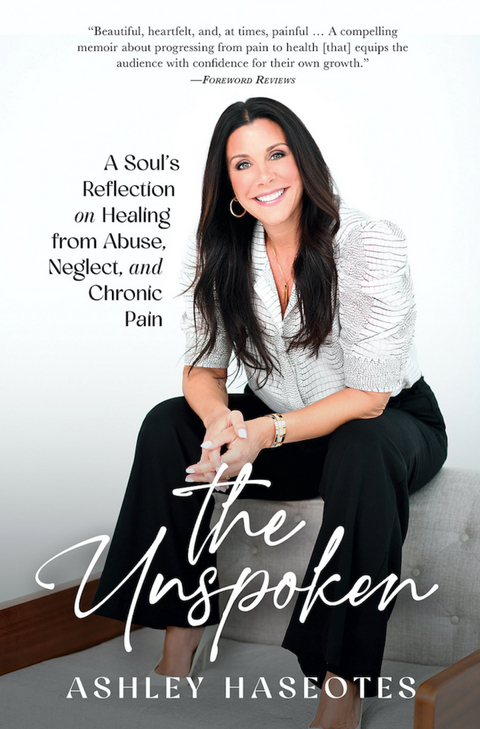
Unspoken (eBook)
100 Seiten
Made for Success Publishing (Verlag)
978-1-64146-678-3 (ISBN)

Chapter 1
Relationships
When you have a critically ill child and live in the hospital, the desire to have meaningful relationships with the strangers around you is immense. More often than not, friends and family either don’t show up or don’t know what to say that can help. The bottom line is, parents of sick children feel alone.
While getting a packet of crackers and cranberry juice one day, I made a new (and instant) friend. Her name was Nancy, and her son Sean had a very rare and aggressive cancer. They weren’t sure how much longer he would live. Nancy and I talked daily, either in the hallways of the pediatric cancer wing at Boston Children’s Hospital or by her son’s bedside. There was an understanding between the two of us. That’s precisely what happens to parents who meet inside the walls of a children’s hospital—where there can be few words needed to support a friend; where she knows that I know what she is thinking and feeling.
Nancy appeared to be a rock, strong and outgoing, and she openly discussed the reality of her son’s life expectancy. We shared this kinship; people had always described me as strong, too. To the outside world, Nancy and I were unbreakable. But on the inside, we were falling apart.
The two of us talked about what life was like for our families before cancer, how our husbands were having a difficult time dealing with our sons’ diagnoses, and how we desperately wanted a glass of wine. I snuck in the wine for us just a few days later and passed it around in paper cups to my friends like it was gold. They received it as such. As the weeks passed, Sean was getting weaker and weaker. His body was beginning to shut down, and Nancy began preparing.
She began planning for her son’s death as if she were getting ready for Christmas dinner. Everything was on point. His room was the “End of Life Room” at the hospital, which was reserved for families who chose not to bring their child home to die. It was private, tucked in at the very end of the long hospital hallway. It was always dimly lit, forgoing the fluorescent hospital lights, and part of Nancy’s plan was to bring in all of Sean’s bedsheets and comforter from home. She wanted him to be as comfortable as possible as he began his process of crossing over. I prayed with her, I prayed for Sean, and I asked God to watch over Nancy and her husband; for after Sean was gone, I didn’t think that their marriage would withstand their loss.
While I was visiting with my parents and Ari’s sister the following week in the family visiting room, a nurse came to get me. She turned the corner with a deer-in-the-headlights look on her face.
“Nancy is asking for you,” she said quietly. I knew exactly where I was headed. I was going to say goodbye to Sean. I stood up and gained my composure and began the walk to Nancy. I didn’t have any idea what I was walking into, which triggered my anxiety so intensely that I couldn’t feel my hands, and my arms felt tingly. But my friend needed me, so I pushed through my anxiety and did what I had to do.
When a child passes away, the nursing staff shut off the hallway lights; an indication to the other families to lay low and stay in their rooms. As I slowly walked to Nancy, I recalled the many times we talked about her discussions with Sean about death. Because Sean was worried that he wouldn’t be able to find his mom in heaven, they made a meeting place.
“We are to meet in the back-right side of heaven,” Nancy whimpered as I walked into their room. I embraced her and we cried together as Sean lay lifeless in his bed.
“Would you like to say goodbye?” she asked.
I sat down in her chair and closed my eyes. “Dear God,” I prayed silently. “Please take Sean with you to the gates of heaven. Please watch over his family. They are going to need your support now more than ever.” I wiped the tears from my eyes and thanked Nancy for giving me the opportunity to be a part of Sean’s life, and be with him at the end. I squeezed her hand and walked out of the room.
My first experience with death was when I was 10 years old, when my grandfather had a heart attack in front of me. Shortly thereafter, my grandmother died. Before I met Nancy and Sean, I had lost five people who were very close to me; three grandparents and two of my best friend’s mothers. However, not a single one of those deaths prepared me for Sean’s. Sean was 12 years old. He was not supposed to die.
My cousins and I were out to lunch with our grandparents when it happened. Stacie and I were the oldest of the first cousins, and we were together for her brother Chris’s eighth birthday. It was February vacation week, and the lunch was supposed to be a kickoff to a fun vacation. We were at one of the restaurants my grandfather built, an Italian place where all the locals ate in downtown Framingham. Everyone knew us—my grandfather was just one of those guys who knew everyone. We were all dressed up, and I had on my dress, tights, and black shiny shoes. I loved to go to the bathroom to hear them click on the tile floor. Click click. It made me feel so grown up.
As we all sat there, the air began to change, and I felt the shift in my head. I was getting dizzy and I couldn’t quite put my finger on the reason. Then I saw my grandfather put something under his tongue from his pill case. He uses those little white pills a lot, I thought to myself. I remember him giving me a bite once. They tasted like sugar.
My eyes were focused on my grandmother, who looked pensive. I was starting to get anxious, and I knew something was wrong. Meanwhile, my cousins were busy eating their buttered rolls. I looked at each one of them, wondering, Did they feel it, too? The dizziness? My grandmother put her hand on her husband’s and asked him if he was OK, and he nodded yes. He was lying. Sweat formed on his brow, and we all fell silent. Within a matter of minutes, everything changed. Our special date was turning into a nightmare.
And that was the exact moment the chaos broke out. The restaurant staff quickly took us kids out to the empty ballroom in the back. While I was being whisked away, I glanced backward as they laid my grandfather on the floor. It was like a car accident that you try not to look at while driving down the highway. You stare straight ahead until the last moment, when your view is about to get obstructed, then you turn your head to see.
I wanted to see what they were doing to my grandfather; what was happening. I would look, then look away. It was all too much. As the EMTs arrived and more people filled the room, I tried to see around them. They moved swiftly, giving him oxygen, taking his blood pressure, and talking to him.
“Ray, can you hear us, Ray, can you talk to us? Do you know what day it is, Ray?”
While all of this chaos was happening, my father arrived. The staff must have called him. They knew my father well because he helped with the construction of the restaurant alongside my grandfather. His big blue pickup truck pulled up and stopped within an inch of the window I was staring out of. He parked on the sidewalk, half in the street, jumped out of the truck and ran into the restaurant. I could see the strain and worry on his face, but at that moment, I felt the safest I had all day.
My mind raced. Thank God he is here, everything will be OK now, my dad is here.
I watched as my father got down on his knees beside my grandfather. He untied my grandfather’s belt and his shirt, trying to give him room to breathe. It was a delicate moment for me to witness, my father taking care of his father as he was filled with worry and fear. At that point, I don’t remember driving to the hospital or where my cousins were. I don’t remember talking in the car ride over either. My mind had shut down. It was trying to protect me.
My father and I pulled up to the emergency room, where we found my uncle crying alone in the hallway outside the entry doors. It felt cold in the hospital, like life was missing. I felt sick to my stomach, and as my father stood there, no one said a word. I wanted to go to my uncle, I wanted to hug him, but I just stood there frozen without saying a word. My father did the same. Then, in what seemed like an instant, as soon as we walked in, my uncle stormed off and left the hospital. My grandfather had died.
As early as 10 years old, I remember being able to feel the energy of those around me. I now know that I am an empath, but I didn’t figure this out until I was in my very late 30s. I was born this way, sensitive to everything and everyone around me. I could feel the shift in energy of my grandfather the day he left us. His energy was shifting rapidly because he was going to leave this earth quickly, and when that happens, the shift in energy is intense and swirling. It was much different from a person who has been sick for a while and is at the end of life. That energy shift feels a bit more subtle.
It took me months to recover from my grandfather’s passing because my body had absorbed so much during that time with him. I didn’t know then how to process and release the energy of others. Today, I know how to not only protect my own energy field so that I don’t absorb that of others, but I also know how to clear myself if I do pick up other people’s stuff.
Learning to live as an empath includes protection of your energy field, setting energetic boundaries and clearing, and, in my opinion, the...
| Erscheint lt. Verlag | 8.2.2022 |
|---|---|
| Sprache | englisch |
| Themenwelt | Literatur ► Biografien / Erfahrungsberichte |
| Sachbuch/Ratgeber ► Gesundheit / Leben / Psychologie ► Lebenshilfe / Lebensführung | |
| Schlagworte | dealing with trauma • emotional abuse • Enduring • energy healing • leukemia • Mother abuse • Reiki • Resilience • self-esteem and positive mental attitude • Suffering in Silence |
| ISBN-10 | 1-64146-678-2 / 1641466782 |
| ISBN-13 | 978-1-64146-678-3 / 9781641466783 |
| Informationen gemäß Produktsicherheitsverordnung (GPSR) | |
| Haben Sie eine Frage zum Produkt? |
 EPUB (Wasserzeichen)
Größe: 1,9 MB
DRM: Digitales Wasserzeichen
Dieses eBook enthält ein digitales Wasserzeichen und ist damit für Sie personalisiert. Bei einer missbräuchlichen Weitergabe des eBooks an Dritte ist eine Rückverfolgung an die Quelle möglich.
Dateiformat: EPUB (Electronic Publication)
EPUB ist ein offener Standard für eBooks und eignet sich besonders zur Darstellung von Belletristik und Sachbüchern. Der Fließtext wird dynamisch an die Display- und Schriftgröße angepasst. Auch für mobile Lesegeräte ist EPUB daher gut geeignet.
Systemvoraussetzungen:
PC/Mac: Mit einem PC oder Mac können Sie dieses eBook lesen. Sie benötigen dafür die kostenlose Software Adobe Digital Editions.
eReader: Dieses eBook kann mit (fast) allen eBook-Readern gelesen werden. Mit dem amazon-Kindle ist es aber nicht kompatibel.
Smartphone/Tablet: Egal ob Apple oder Android, dieses eBook können Sie lesen. Sie benötigen dafür eine kostenlose App.
Geräteliste und zusätzliche Hinweise
Buying eBooks from abroad
For tax law reasons we can sell eBooks just within Germany and Switzerland. Regrettably we cannot fulfill eBook-orders from other countries.
aus dem Bereich