Zum Hauptinhalt springen
Nicht aus der Schweiz? Besuchen Sie lehmanns.de
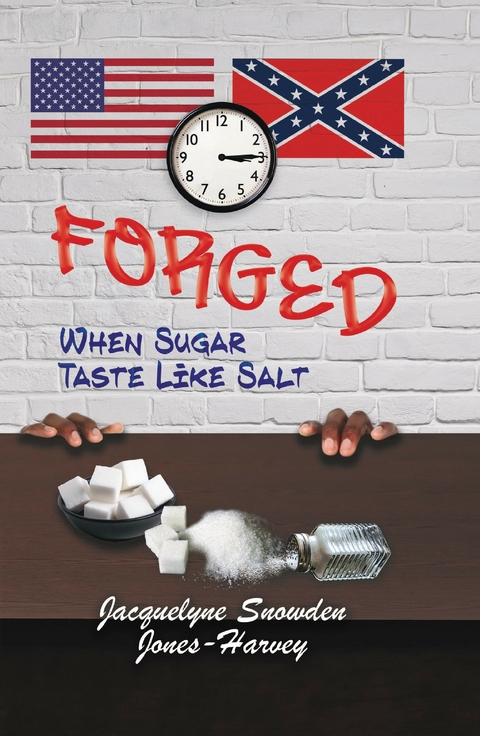
FORGED -  Jacquelyne Snowden Jones-Harvey

FORGED (eBook)

When Sugar Taste Like Salt
eBook Download: EPUB
2021 | 1. Auflage
378 Seiten
Bookbaby (Verlag)
978-1-6678-0618-1 (ISBN)
Systemvoraussetzungen
11,89 inkl. MwSt
(CHF 11,60)
Der eBook-Verkauf erfolgt durch die Lehmanns Media GmbH (Berlin) zum Preis in Euro inkl. MwSt.
  • Download sofort lieferbar
  • Zahlungsarten anzeigen
Forged: When Sugar Taste Like Salt is a unique story about the truths of life, which in this case, is unsettling to the human heart, disquieting to the soul, and disconcerting to the sense of justice to all humanity. Life brings about change, and as humans we must make adjustments to these changes if we're to evolve, and become better, and learn from our mistakes. Never in human history has it been so arduous or problematic to make those kinds of adjustments, than during the Jim Crow era in American History for the non-repentent white man. This is the backdrop for a tale of anguish and agony, that leaves a legacy of heartaches for a Negro girl growing up in West Monroe, Louisiana. Taking place during the dark and ominous Civil Rights era, Jacqueline Snowden is born 'to live out loud' despite being constantly reminded to be seen and not heard. This sordid and graphic story wasn't meant to be voiced to a nation that wants to sweep all of its dirty laundry under the rug. Jacqueline as a very young child knows that this concept, 'separate but equal' is unjust. If things are separate from their origin, what guarantees that its kept equal? This was meant to remain a secret because it was too disconcerting to share with the people who knew they weren't 'equal' . Being born Negro in America guarantees that you aren't treated equally. It took centuries for white America to acknowledge that slavery was wrong because it was the law for over four hundred years. The time came when white America needed to acknowledge that separate but equal was unjust,3 and to integrate with all deliberate speed. But for Jacqueline, integration was painful because separate but equal was a firmly established way of life. This autobiography exposes the filthy underbelly and impact on her journey to contest this law. Jacqueline Snowden forges her parents signature on a Freedom of Choice form and becomes, in fact, the first West Monroe High School Negro REBEL.
Forged: When Sugar Taste Like Salt explains why someone could place something in their mouth so essentially similiar in color and texture as sugar, and taste salt. We perceive things that we want as being sugary and sweet, when in reality, they are briny and dissatifying - distasteful once we receive them. The book is an autobiographic tale of a coming of age story of a young precocious girl testing the boundaries of Jim Crow society, challenging the separate but equal laws in a most unimaginable way. Told as an African groit would tell the plight, Jacqueline Snowden is the first to admit there is nothing exceptional about her growing up in segregated West Monroe, Louisana, mainly because nothing exceptional is expected of her. She weaves the stories of her educational misadventures from first to ninth grade in a segregated school. Born to a large family with strong ties and religious values, she is supported by a community of colorful charaters that enrich her sheltered life, so much so, she doesn't even realize that she is poor. Jacqueline is protected from a world she did not create, but she is conscious that something is wrong. She is also aware that even though she is young, she is called on a mission for change. As far back as she can remember, she has known "e;she would be first"e; There are numerous taboos, laws (written and unwritten), customs, and moral codes of conduct that Jacqueline must abide by to stay within the constraints of what is lawful and what is not, when trying to understand her miseducation in the strictly segregated town in northeastern Louisana. Forged: When Sugar Taste Like Salt is a unique story about truths of life, which in this case is unsettling to the human heart, disquieting to the soul, and disconcerting to the sense of justice to humanity. Life is about changing and as humans we must make adjustments to constant change. Never in human history has it been so arduous or problematic to make those kinds of adjustments, than during the Jim Crow era in American History. This is the backdrop for this story. This narrative is a fifty-year reflection on how integration adversely affected Jacqueline and everyone around her, both then and now. The story is about faith when faith in something greater than yourself isn't evident. It is about a wall of guilt and regret she bears for her radical choice, the consequences, of which, she must live with every day of her life. It's a novel that doesn't concede with apologies because white America isn't ready to perceive or acknowledge their transgressions against blacks. Even to this day West Monroe High School, known then and now as REBEL LAND, still supports the Civil War era separatist culture. The story is explicit in its understating of telling the facts yet, blunt about racial relationships on sexuality, spirituality, humanity, education and sibling rivalary. There is a truthfulness with the underlying story of a strained mother-daughter relationship, and feelings of betrayal when marital infidelities are revealed. Mental health issues are addressed at several points, because emotional trama is forever a daily component in the three years Jacqueline was a student at West Monroe High. There are no heroes in this story because many protagonists don't suffer the consequences or angst of their choices made in life. There are no signs broadcasting separate but equal,yet its there even today, alive and well in America. In Forged: When Sugar Taste Like Salt, the reader witnesses how a young, black girl copes when there is no redemption or absolution when so much is deserved. Judge for yourself.

CHAPTER 1
“BY CHANCE, BY CHOICE, OR BY CHANGE—
NOTHINGS GAINED WITHOUT CONSEQUENCES!”
By 1951, the year I was born, West Monroe Louisiana is the armpit of the state. It has never been progressive and open to change. The state is in need of a strong deodorant. West Monroe is not unlike many small northeastern Louisiana towns: its dingy, suffocating, dark, and dangerous, if you do not follow the unwritten taboos, rules and regulations set up in the Jim Crow South. The city was beyond segregated; it was totally isolated into small enclaves of black and white, haves and have not’s, and it was dominated by a few authoritative, homophobic, bigoted, white men. One white man had been the mayor for over forty years.
The Negro communities has a total of seven sections in the towns named by the locals as: Trenton, Haines Lane, The Quarters, Bob Crawford Quarters, Ward Nine, College Point, and Hickory Bend. Most of the Negroes lived in single-family rental homes which were inferior: without heat in the cold months, air conditioning in the summer, or hot running water ever. Many homes didn’t have indoor plumbing until the late 70’s. That’s what it was like to be a child in the 1950’s West Monroe, growing up in a small, close-knit Negro community. I’m a living authentication of what a village of people who share race is like when cultivated under such crude and rudimentary circumstances, and Jim Crow environment. I grew-up NEGRO.
I first lived at 315 Benson Street in Hanes Lane. I belonged because I lived in a two-parent home that was rare, but which gave me a firmer connection to the community in which I lived. My parents met in Lincoln Parish. My mother Lillie Mae Peevy was from Choudrant, Louisiana. Joe Snowden, my father, was from Ruston, Louisiana. After their marriage, they moved to the small town of West Monroe to raise a large family of seven children.
Lillie Mae Peevy, my mother, was tall at five-feet-six, and her build was medium and sturdy. There was nothing frail about her. She referred to her hands as “workers hands,” because they were large for a woman. She picked cotton as a young girl growing up on a farm. Ma Dear didn’t want any of her children to have to work as arduous as she did. “Anything worth doing was worth doing well. And in her house, all things were going to be done well and in order.” This was one of Ma Dear’s favorite sayings, and she drummed it into me day in and night out. We had a difference of opinions here. I believed the faster I could get chores done, the better. This was my way of thinking.
My mother was very striking with thick eyebrows, noticeable brown eyes, and skin the color of an afternoon sun in August. Her lips were full, shaped into a lover’s bow, and her nose was wide. Her raven-black hair fell well past her shoulders, and she loved allowing me or either of my sisters to brush it for her at night. She kept it curled and in style by rolling it up on strips of twisted brown paper sack. Ma Dear also hated having her picture taken with a camera. She never would explain why. To this day, very few pictures exist of Ma Dear. She shied away from the camera.
No one could ever say my mother was vain because she wasn’t one to stare in the mirror much. She used to always say to me, “Stop looking in the mirror, Barrett. You think you looking cute, but what you are doing is looking curious.”
My mother believed there is a place for everything—and all things had their place. She was very consistent with her words and actions. This philosophy bonded her purpose to her intent. The people in the community relied on my mother because she kept our house well-stocked and she was a faithful and loving neighbor to all; never hesitating to dole out good advice, cooking tips, or just a sympathetic ear. Ma Dear was available twenty-four-seven.
Ma Dear was very religious. I am not religious, but God and I have an understanding. I have a spiritual nature. I talk to God. God sometimes talks to me. Early on I have had a mission and that mission has been that “I would be first! I have never known where the directive came from and never questioned it but as a child, I knew something greater than myself guided me. Now, what I would be first at was never explained, but I knew at some point in my life, I would be first. I am often times on a mission of my own as a child that had nothing to do with my purpose.
I believed in justice and the humanity of man very early as a child. Instinctively, I have a strong sense of justice, and felt it was not only for white folks but it was for colored folks as well. I was aware of these concepts. I have a hard time focusing on the rituals of religious practices. It’s just part of my disposition to challenge the natural boundaries or limitations set before me and my mother believed in setting limits—strict ones. Yet, Ma Dear was fair and she was consistent.
If Ma Dear said, “I don’t want to hear a peep out of you,” my response was spelling the word p-e-e-p out loud, which resulted in a beat down. “Barrett, not another word from you and I mean it.” Under my breath, “w-o-r-d” would slip out of my mouth. It took me a while to learn to whisper. Just think, I was never tested for a short bus either. Ma Dear had problems with her vision, but apparently excellent hearing skills. It wasn’t that I was willfully disobedient; I just could not conform to the order of things, so Ma Dear consistently tore my butt up.
My father was a mechanic with only a third grade education but was referred to as Mr. Joe Snowden or simply Mr. Snowden. He allowed me to have free reign and set no boundaries on what he’d tell me about the world. I was a bonafide, “daddy’s girl” because my father lacked a lot in the parenting department, but I got a lot of perspectives about whites from his examples.
Once, he and I were in the car together driving by Hasley’s Cemetery in the white part of town. My father looked at me and said, “Rhett, there lies all the good white people in West Monroe.”
“Daddy what are you talking about? All those white people are dead,” I replied.
My father snickered. “Good, you get my point. One thing I can say about you Rhett is you are one smart little cookie. Nothing gets by you. Nobody gonna give my baby girl no wooden nickels.” I really didn’t understand, but he did plant the seed—good white people were dead white people! I attended a segregated church, was enrolled in a segregated school, and lived in a segregated community. I had little interaction with whites. The only times I saw a white person were the times I walked to the Jewish stores—Mr. Block’s or Mr. Hopper’s Stores. These two stores were in the black parts of town, and we shopped there for day-to-day necessities. I didn’t think much of it, but my father had a lot to say about the matter.
Daddy didn’t allow Ma Dear to run a tab at either store. He had no real trust in white people. Mr. Block and Mr. Hopper were supposed to keep exact records, but Dad believed that both storeowners padded their books. Unlike many people in our community, we didn’t have credit at the store. My dad was strange like that.
Daddy was very vocal about wanting them out of OUR neighborhood. Now my father with all his flaws, was not a man to use profanity. He substituted the words, ‘John Brown’ for the word, ‘goddamned.’ So, as children, when we heard the word ‘John Brown,’ all of us headed for cover. Even Ma Dear shut up!
Ma Dear was the enforcer of punishment in the family, but ‘John Brown’ was the key that unlocked daddy’s fury and we knew to head for a good hiding place.. So, when it came to the stores in the neighborhood, my father would express himself. He wasn’t a fan of either man. “John Brown! Why don’t them peckerwoods pack up and sell that outdated, over-priced, crap to their own people instead of down here living off of us.” Dad was a provider and a man of few words but when he spoke, all of us listened. He was E. F. Hutton.
My parents agreed on a few main things. One was the proper way to address any adult, which was, “Yes Ma’am. No Ma’am. Yes Sir., and No Sir.” Failure to do so was considered disrespectful and resulted in some type of punishment. There was zero tolerance to arguing back, even if certain you’re right. It was true, especially in the Snowden home. Ma Dear believed we were representatives of her, and she was not going to have us “showing out” in public.
“Barrett Snowden, you better not be out there showing your behind; having folks thinking I am not training you here at home. None of that smart mouth of yours either. Mr. Tibbitt came by here this morning and said you turned your head and didn’t speak to him.”
If any adult saw a Negro child misbehave, it was an adult’s sworn duty to step up and verbally correct that child immediately. The adult then reported the incident to the parent and whatever the grievance, it was met with swift and just punishment.
“Ma Dear, Mr. Tibbitt is so drunk he doesn’t even know if he’s in this world or on the moon, so how is he sure if I spoke to him or not?”
POP! POP! POP! Ma Dear thumped my head.
“See girl, that’s what I’m talking...

Erscheint lt. Verlag 31.12.2021
Sprache englisch
Themenwelt Literatur Biografien / Erfahrungsberichte
ISBN-10 1-6678-0618-1 / 1667806181
ISBN-13 978-1-6678-0618-1 / 9781667806181
Informationen gemäß Produktsicherheitsverordnung (GPSR)
Haben Sie eine Frage zum Produkt?
EPUBEPUB (Ohne DRM)
Größe: 1,6 MB

Digital Rights Management: ohne DRM
Dieses eBook enthält kein DRM oder Kopier­schutz. Eine Weiter­gabe an Dritte ist jedoch rechtlich nicht zulässig, weil Sie beim Kauf nur die Rechte an der persön­lichen Nutzung erwerben.

Dateiformat: EPUB (Electronic Publication)
EPUB ist ein offener Standard für eBooks und eignet sich besonders zur Darstellung von Belle­tristik und Sach­büchern. Der Fließ­text wird dynamisch an die Display- und Schrift­größe ange­passt. Auch für mobile Lese­geräte ist EPUB daher gut geeignet.

Systemvoraussetzungen:
PC/Mac: Mit einem PC oder Mac können Sie dieses eBook lesen. Sie benötigen dafür die kostenlose Software Adobe Digital Editions.
eReader: Dieses eBook kann mit (fast) allen eBook-Readern gelesen werden. Mit dem amazon-Kindle ist es aber nicht kompatibel.
Smartphone/Tablet: Egal ob Apple oder Android, dieses eBook können Sie lesen. Sie benötigen dafür eine kostenlose App.
Geräteliste und zusätzliche Hinweise

Buying eBooks from abroad
For tax law reasons we can sell eBooks just within Germany and Switzerland. Regrettably we cannot fulfill eBook-orders from other countries.

Mehr entdecken
aus dem Bereich
Mein Leben mit paranoider Schizophrenie

von Eric Stehfest

eBook Download (2025)
ZS - ein Verlag der Edel Verlagsgruppe
CHF 16,60
Eine besondere Freundschaft und der Weg zu mir selbst

von Ronja Forcher

eBook Download (2025)
Knaur eBook (Verlag)
CHF 17,55
Die Autobiografie

von Daniel Böcking; Freddy Quinn

eBook Download (2025)
Edition Koch (Verlag)
CHF 9,75