


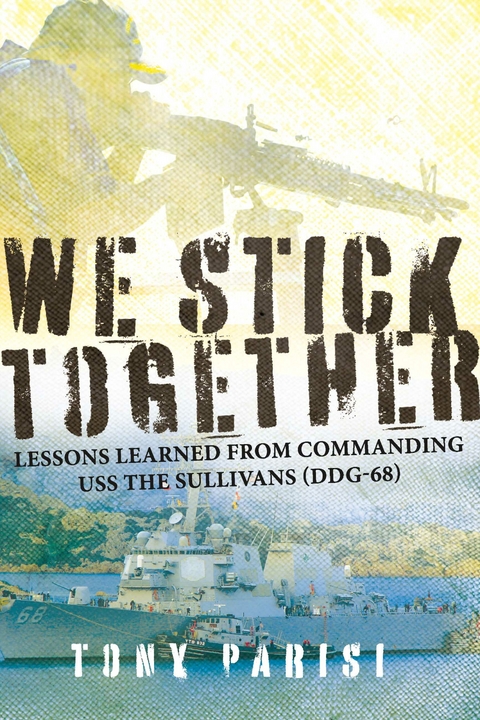
We Stick Together (eBook)
292 Seiten
Bookbaby (Verlag)
978-1-6678-1117-8 (ISBN)
"e;We Stick Together: Lessons Learned from Commanding USS THE SULLIVANS (DDG-68)"e; is a leadership memoir that takes readers along on a journey of discovery with the crew across the seas and into the soul. This book explores and explains what it means to be a surface warfare officer aboard an historic ship in the post-Cold War, post-9/11 world. Seasoned sailors and civilians alike will benefit from the many lessons learned in this short work. This memorable memoir explains how selflessness, character, truth, and the pursuit of excellence can bring meaning and fulfillment to all. Each chapter illuminates and entertains the reader with sea stories, pop-culture references, and historic truths that need to be re-examined and ruminated by all. Get ready for this positive, entertaining, and enlightening journey aboard a modern warship as told by the captain, the son of a fisherman and a simple kind of man, who believes in critical thinking, rock and roll, the American dream, and the importance of family. Captain Tony Parisi shares his personal journal entries and inner thoughts, taking the reader on a journey across the sea and into the soul.
Chapter 1
Change of Command, Underway Shift Colors
USS THE SULLIVANS (DDG-68) underway circa 2006
“All lines on deck, underway, shift colors, sound one prolonged blast,” announced the officer of the deck as USS THE SULLIVANS (DDG-68) got underway from Naval Station Mayport, Florida bound for Her Majesty’s Naval Base Clyde, Faslane, Scotland. It was June 5, 2006 and aboard the billion-dollar, Aegis guided missile destroyer named in honor of the five Sullivan brothers from Waterloo, Iowa, were 300 crew members, the off going captain, me, and our wives. The then commanding officer of the ship had decided to conduct the change of command at sea; and the only guests permitted were the off going and on coming captains’ spouses. This was his prerogative and decision. Based on the ship’s schedule, it was also the least disruptive and most appropriate venue for this time-honored event required by regulation and over 230 years of U.S. Naval tradition.
Reflecting on that day now, I imagine the crew had many questions running through their minds. The captain of a modern U.S. warship has great influence and impact on the day-to-day lives, aspirations, and careers of the sailors in his or her care. One evaluation, phone call, or email by the commanding officer could change the arc of a Sailor’s career. What kind of person and leader would the new commanding officer be? Will he be a screamer who worries more about his own career and fitness report rather than the needs of his sailors? Would he avoid or freeze up in stressful situations? Would he be competent, fair, and selfless or cruel, nepotistic, and self-centered? On June 5, 2006, I did not worry about such questions as I was fulfilling the major career milestone every surface warfare officer (SWO) strives for: command at sea. Life seemed to be moving so fast then that I did not have time to think about long-term issues such as how command of this ship would impact my character, my family, and my future. The time for reflecting on such questions would come much later. On this unseasonally cool and breezy North Florida morning my mind was focused on the task at hand: assuming responsibility for 300 sailors and the billion-dollar warship named after five American heroes.
The change-of-command ceremony was conducted professionally in working uniforms on the ship’s flight deck. Most of the ship’s crew not on watch were gathered and standing in ranks, their boots holding them fast in place on the non-skid surface of the flight deck as the hull wallowed slowly in the rolling seas. The ship was steaming eastward at bare steerageway (i.e., about 3 knots) within sight of the coast of Jacksonville Beach. The bridge team adjusted course to keep the winds to a minimum across the flight deck. There were no chairs, bunting, or frill. USS THE SULLIVANS (DDG-68) was haze gray and underway. Sea water spray and diesel exhaust clung around my head. My mouth was dry and my undershirt was damp with sweat. I was both excited and nervous but trying hard not to show signs of either state to the crew. The ship’s executive officer ran and emceed the ceremony, standing behind a well-used wooden podium with a single microphone and USS THE SULLIVANS logo attached to it. He flipped through a white binder with clear plastic sleeves protecting the pages, and followed the change-of-command script as required by U.S. Navy regulations.
The formalities of the simple change-of-command ceremony lasted less than 30 minutes. The event was professionally executed, short and to the point. The off-going captain said a few words of thanks to the crew and his wife and then read his orders. I read my orders and took command of THE SULLIVANS at sea, a mile or so off the coast of Mayport, Florida. I did not feel any different, but I was now the commanding officer of USS THE SULLIVANS (DDG-68) and responsible for all souls onboard and the good order and discipline of a crew I did not know yet.
Shortly after the ceremony ended, the offgoing former commanding officer, his wife, and my bride walked to the edge of the flight deck. It was time for them to go home. The appropriate flight deck safety nets were carefully lowered to open a path from the deck edge to the pitching and rolling sea tractor tug that would take them back to terra firma. I watched as some small whitecaps lapped both the tug and USS THE SULLIVANS (DDG-68). The seas were rolling a bit more now. We were at sea in the Atlantic during hurricane season and the winds were picking up. I kissed my wife goodbye and watched as she waited for the right moment to jump to the plastic orange steps of the swinging, rope ladder on the bobbing sea tractor tug. She looked frightened, but this was the only way home. She had no other option and had to get back to our two young children. She told me later that she was scared that if she jumped and missed she could fall between the tug and our ship and be crushed and disappear beneath the waves. I knew she could make the jump easily and did not realize until much later how frightening this experience was for her at the time.
As I watched my wife make it safely aboard the tug and head back into port, I turned my attention to the immediate task at hand: commanding USS THE SULLIVANS (DDG-68). I would not see her and my two young children for two months. Long absences from loved ones were not unusual for U.S. Navy sailors. Neither was compartmentalizing emotions and feelings, tucking them deep down inside to be dealt with sometime in the future, when the ship and all its responsibilities and worries were safely tied to a pier and someone else’s charge. I knew that I would miss my family, but in that moment I did not feel it. I only felt compelled to get to the bridge and ensure that we got the ship four hours ahead of PIM (plan of intended movement) in order to gain some time to conduct training as we crossed the Atlantic.
U.S. Navy ships have to file MOVREPs (movement reports) prior to sailing so that they can be tracked via the Navy World Wide Military Command and Control System. This practice was initiated as a lesson learned following the tragic loss of the USS INDIANAPOLIS (CA-35). USS INDIANAPOLIS (CA-35) was a Portland-class heavy cruiser tasked with carrying parts of the first nuclear weapon, Little Boy, to be used in war to the island of Tinian in the Pacific. On July 30, 1945, USS INDIANAPOLIS (CA-35) was torpedoed by a Japanese submarine and sank. Her crew numbered nearly 1,200 sailors. Three hundred Indie sailors went down with the ship, but almost 900 survived the initial attack and took to the sea in life boats, life jackets, or clinging to floating debris. However, because the ship had been conducting a very sensitive mission, its movements were kept secret and not shared with the appropriate U.S. Navy officials, who did not realize the ship was over-due. After several days lost at sea, only 316 sailors survived while the majority suffered horrible deaths from exposure, dehydration, and shark attacks.
The tragedy of USS INDIANAPOLIS (CA-35) faded from the minds of most Americans for many years until it resurfaced in the character of Captain Quint, the hard hearted shark hunter and skipper of the Orca in the movie Jaws, who was a fictional survivor of USS INDIANAPOLIS (CA-35). Peter Benchley’s novel about a killer shark became Steven Spieldberg’s blockbuster 1975 film Jaws, which scared many Americans from entering the ocean. The fear and horror that the survivors of USS INDIANAPOLIS (CA-35) faced in 1945 was not from a single animatronic shark but dozens, possibly even hundreds of real White Tipped and Tiger sharks. The survivors had to fend off constant shark attacks without the benefit of Captain Quint’s harpoons, scuba tanks, or rifle. Well over a hundred men were eaten alive like Captain Quint all because no one knew their ship’s voyage plan.
The MOVREP system allowed U.S. Navy ships to be up to four hours ahead or four hours behind their plan of intended movement. Most U.S. Navy commanding officers like to keep their ships four hours ahead of PIM so that they have time and space to train. Had the MOVREP system been in place in 1942, it might have saved at least one of the Sullivan brothers and certainly would have saved many more of the USS INDIANAPOLIS (CA-35) crew. MOVREPs were a costly lesson learned, which benefit all U.S. Navy sailors today.
When the captain enters the bridge of a U.S. Navy warship, the first person to see him or her annouces, “Captain on the bridge.” It is a very strange thing to hear this phrase and then realize that you are in fact the captain. There is no one coming to mentor or assist you anymore. It is just you and you alone. I knew the officers on watch that day wanted to make a good first impression on their new captain. The boatswain mate of the watch spotted me early and announced my arrival. I wanted to high-five him, but that would not have been appropriate so I stoically and calmly walked to the chart table and then climbed into the captain’s chair. My heart rate and blood pressure were elevated, as was my satisfaction with my new job. I looked out at the horizon about seven miles away. I was calm but also a bit anxious. I wanted to enjoy this moment, but I knew there was a mountain of work to do, including releasing the official messages regarding the change of command as well as planning for the days upcoming training events. For that brief moment, however, I chose to just sit still and listen to the orders being given by the personnel on watch and stare at the grayish blue horizon in front of me. It was only 10:30 in the morning, but it felt like late...
| Erscheint lt. Verlag | 23.11.2021 |
|---|---|
| Sprache | englisch |
| Themenwelt | Literatur ► Biografien / Erfahrungsberichte |
| ISBN-10 | 1-6678-1117-7 / 1667811177 |
| ISBN-13 | 978-1-6678-1117-8 / 9781667811178 |
| Informationen gemäß Produktsicherheitsverordnung (GPSR) | |
| Haben Sie eine Frage zum Produkt? |
 EPUB (Ohne DRM)
Größe: 48,9 MB
Digital Rights Management: ohne DRM
Dieses eBook enthält kein DRM oder Kopierschutz. Eine Weitergabe an Dritte ist jedoch rechtlich nicht zulässig, weil Sie beim Kauf nur die Rechte an der persönlichen Nutzung erwerben.
Dateiformat: EPUB (Electronic Publication)
EPUB ist ein offener Standard für eBooks und eignet sich besonders zur Darstellung von Belletristik und Sachbüchern. Der Fließtext wird dynamisch an die Display- und Schriftgröße angepasst. Auch für mobile Lesegeräte ist EPUB daher gut geeignet.
Systemvoraussetzungen:
PC/Mac: Mit einem PC oder Mac können Sie dieses eBook lesen. Sie benötigen dafür die kostenlose Software Adobe Digital Editions.
eReader: Dieses eBook kann mit (fast) allen eBook-Readern gelesen werden. Mit dem amazon-Kindle ist es aber nicht kompatibel.
Smartphone/Tablet: Egal ob Apple oder Android, dieses eBook können Sie lesen. Sie benötigen dafür eine kostenlose App.
Geräteliste und zusätzliche Hinweise
Buying eBooks from abroad
For tax law reasons we can sell eBooks just within Germany and Switzerland. Regrettably we cannot fulfill eBook-orders from other countries.
aus dem Bereich


