


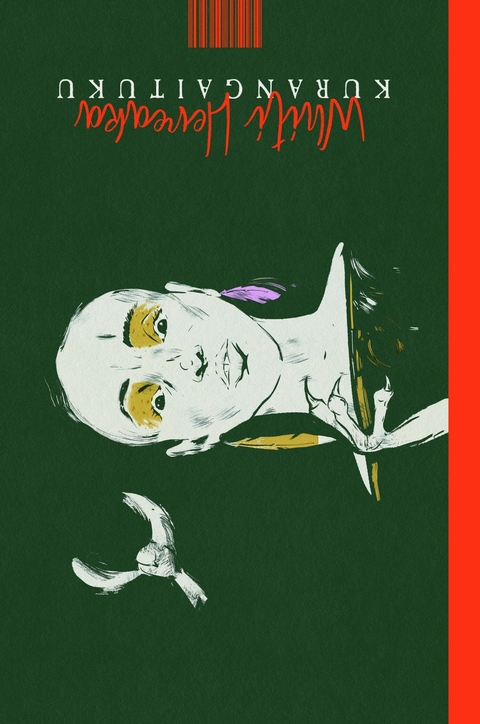
Kurangaituku (eBook)
350 Seiten
Huia (Nz) Ltd (Verlag)
978-1-77550-673-7 (ISBN)
Kurangaituku is the story of Hatupatu told from the perspective of the traditional 'monster', Kurangaituku, the bird woman. In the traditional story, told from the view of Hatupatu, he is out hunting and is captured by a creature that is part bird and part woman. The bird woman imprisons him in her cave in the mountains. Hatupatu eventually escapes and is pursued by Kurangaituku. He evades her when he leaps over hot springs, but Kurngaituku goes into them and dies.In this version of the story, Kurangaituku takes us on the journey of her extraordinary life - from the birds who sang her into being, to the arrival of the Song Makers and the change they brought to her world, and her life with Hatupatu and her death. Through the eyes of Kurangaituku, we come to see how being with Hatupatu changed Kurangaituku, emotionally and in her thoughts and actions, and how devastating his betrayal of her was.
I have waited so long for you to return to me. I mourned the loss of you for a while, convinced that you would not return. Had I imagined our connection? Did you not feel the same pull on your wairua when we were separated? You had forgotten me, forsaken me. The memory of you haunted me. I doubted my mind, my heart, my reality. How could I have been so wrong?
I sent miromiro to find you. Whisper a charm to the miromiro and he will sing to your errant lover—
Tihi-ori-ori-ori.
Bring her home. She is lost to me.
The sweet call of the miromiro winding the intentions of love into your heart.
Miromiro, a conduit for messages between lovers separated by the forest, by lands far away. The thoughts of your lover whispered from the shadows of the forest—you cannot see your lover, but you know that they are thinking of you, calling you back to their arms.
I whispered my love for you to the small bird and sent him to find you—across the forest, across mountains, across time. Did you hear my yearning for you in his melody? Did you think of me?
Tihi-ori-ori-ori.
A hum of recognition.
And you are here. Perhaps you thought we had been apart too long, that our bond had been severed. But we are entwined, aho twists over and under whenu. We are the fabric of each other—our lives must intersect. I have missed you, and I welcome you back with love.
I have a gift for you—a black sphere, almost perfectly round. I place it in your hand; it sits in your palm, your fingers must cradle it so it does not fall. It is lighter than you expect; it is not a dense mass of stone but something else, something yielding. The sphere feels warm in your hand; it is wet to the touch like a pebble pulled from a river—glossy obsidian, with flecks of white. It seems like the entire night sky has been captured within it. Hold it to your eyes. Through it you see everything—the black, the dark, the nothingness. Open your mouth, and place it on your tongue—it is too large for you to close your mouth, and I can see the panic in your eyes. Surrender to the feeling. The sphere changes—no longer round, the mass in flux, pooling on your tongue—it spreads out from your open mouth over your face. A scream enveloped by darkness. The dark invades your body through your eyes, your nose, your open mouth. It is the air in your lungs, the blood in your veins, the marrow in your bones. Let it invade you, colonise you, assimilate to it, until your body is no longer anything—it is part of the darkness. There is something in the dark, unseen, but known. Every instinct whispers monster. It is not the monster that is frightening—it is the dark.
I am dead.
Am I dead?
The world is dark and all that is left is darkness, a black void blankness. Let it be blank. Listen to the blank, the black, the dark. Blank is different from nothing. Nothing suggests, well, nothing. No. Thing. But blank is possibility —it may be filled, it may change, or it may remain. Blank.
Te Kore,
endless Te Kore, the void that stretches forever because there are no boundaries, no time. There is just Te Kore.
Te Kore,
endless Te Kore, the void that has no substance. There is nothing to perceive. There is nothing, just Te Kore.
Te Kore,
endless Te Kore, the beginning and the end. All the things that have been and will be, but cannot manifest in—
Te Kore,
endless Te Kore.
Everything, every possible thing, is enfolded together so very tightly that enormous heat is generated. It is the heat of creation, the blank feeling its potential.
And in the infinite void of Te Kore there is a hum, a hum of recognition, a prediction of change. We have started something. It is a beginning and in less than a second everything expands into—
Te Pō.
The darkness at last a presence, there is no longer an empty void. There is the night that stretches on.
Te Pō.
And in the darkness, the hum grows stronger. It is the hum of many voices, of infinite voices. It is all that has been, that will be, finding its form. Finding its will to be.
Particles combine and divide—the ripples of their coupling and divorce spread out and become great waves. Everything has changed.
Te Pō.
The darkness envelops. It invades. It is you and me and we are darkness.
Te Pō.
The darkness is complete, oppressive. It defines and shapes our form. It pushes down, and we push back.
Te Pō.
The darkness is our comfort, yet we continue to repulse it. The darkness that had defined our form has been replaced with space.
Te Pō.
The darkness is now an absence of light. We have perceived this. Our eyes have opened.
Te Pō.
And in the darkness, we listen for the hum. It is both within us and without us.
Te Pō.
The darkness is a womb—it has nurtured us, but we cannot stay within its confines forever.
Te Pō.
And in the darkness we realise that we are not alone. We are many who dwell in the darkness of—
Te Pō.
The darkness, o the darkness that has nurtured us, that has oppressed us and defined us. The darkness that is us must inevitably arc into light.
Ki te whaiao, ki te ao mārama.
A pinprick of light. It is the seed of potential. It is minute in the great void, this particle of light. I am tempted to say insignificant, but because it holds your attention, it is significant—you have imbued it with importance. Thus, this tiny speck has become the centre.
Watch as it continues to grow—the heat and light increase at a rate impossible for us to fathom. To our slow senses it is as if we are witnessing a great explosion. One moment we can hardly see the light, the next we are surrounded by it.
Meet me here at the centre. The centre of all that is known, all that will be.
We will create a world here from a few words, we will make a place where you and I will be comfortable. Let us first build a whare where we can share a story. A whare tapere, a house of storytelling and games. A pātaka kōrero, a storehouse of language. Dig foundations in the light, holes for posts—four. Our whare will be a simple rectangular shape; symmetry soothes and pleases. From afar, our whare shines in the blank, it is a tiny speck in the great abyss of Te Pō. It carries you and me. It is so small in the vastness, so vulnerable. How is it not crushed by the black? Be comforted by the thought that eventually night arcs into day.
We must continue. Walls. Plain for now, but by the end of our telling they will be carved by words and deeds—life, if you’d call it that, frozen in the moment. Past, present, future simultaneous. As it is; as it should be.
Below is the blank, the black—a floor is a necessity. Let us throw a mat on the floor. It is finely woven from flax fibre. The warp and the weft are tight; none of the blank shows through the minute holes, the pinpricks, the specks. Not a particle of blank shows through. The floor supports and yields. It is comfortable sitting here, perhaps even lying here, letting my words lull you to sleep.
Above are ridgepole and rafters, the backbone and ribs of the whare that envelopes us. Do you imagine yourself the heart? Keeping the rhythm of the place, letting the whare live. The kōwhaiwhai patterns have yet to be painted on the rafters and ridge—they too are blank, waiting for their story to begin.
What more do you need to be comfortable? A roof overhead, thatched as they were in old times. A window to let in some air. A door so that you can leave this place when it is time. Across the window, we will place a sliding panel so that we might shut out the world if we choose to. I will borrow it from a whare carved by expert hands long ago. Or perhaps, from this point of time, that whare has yet to be built. Perhaps it is our whare that will inspire the carver—his dreams are of our pare and our door. The door will depict a likeness of me. On the window, the likeness of Hatupatu.
The whare, now whole, must be blessed so that we may dwell together. I take water into my mouth, let it drip from tongue to beak to hand, and cast the drops into the corners. The water both cleanses and nourishes the seeds of potential here—we stand at the beginning and the end of a journey. I open a path so that my words might be fruitful, so that you may hear them and be satiated. I welcome you to this place that we have created. I welcome those whose lives I will invoke here—or at least, the part of their lives that I have glimpsed.
Let this place be filled with the things that we will need for the telling— a frayed taupō unpicked by my curious claws hangs in a corner; the pelts of two kurī, one black and one white, stretched out on drying frames; the fine cloaks and weapons that Hatupatu stole propped up against a wall—things I would have given freely, if I had been asked. A miromiro sings—tihi-ori-ori-ori—a lament for a lost lover.
Let this place be filled with love and betrayal, with death and life, with humans and non-humans, with upheaval and change.
These are the things we need for the telling. These are the things of my story.
Stories live through you and you through them.
A story does not live until it is told; the initial thought in the storyteller’s head is a quickening, it is the spark of something, it is the beginning.
I will try to share my story with you, but these shapes and groups that you think of as words cannot convey the experience. They are an approximation. Is it truly possible for anyone to understand the life of another? But I will tell you my story anyway—it is enough for you to have a taste, to run your tongue along the edge of my blade.
It is a...
| Erscheint lt. Verlag | 31.10.2021 |
|---|---|
| Verlagsort | London |
| Sprache | englisch |
| Themenwelt | Literatur ► Historische Romane |
| Literatur ► Märchen / Sagen | |
| Literatur ► Romane / Erzählungen | |
| Schlagworte | bird woman • Contemporary Retelling • Feminist literature • Hatupatu • Kurangaituku • literary fiction • Literature • Māori • Māori writer • Te Arawa • traditional story |
| ISBN-10 | 1-77550-673-8 / 1775506738 |
| ISBN-13 | 978-1-77550-673-7 / 9781775506737 |
| Informationen gemäß Produktsicherheitsverordnung (GPSR) | |
| Haben Sie eine Frage zum Produkt? |
 EPUB (Wasserzeichen)
DRM: Digitales Wasserzeichen
Dieses eBook enthält ein digitales Wasserzeichen und ist damit für Sie personalisiert. Bei einer missbräuchlichen Weitergabe des eBooks an Dritte ist eine Rückverfolgung an die Quelle möglich.
Dateiformat: EPUB (Electronic Publication)
EPUB ist ein offener Standard für eBooks und eignet sich besonders zur Darstellung von Belletristik und Sachbüchern. Der Fließtext wird dynamisch an die Display- und Schriftgröße angepasst. Auch für mobile Lesegeräte ist EPUB daher gut geeignet.
Systemvoraussetzungen:
PC/Mac: Mit einem PC oder Mac können Sie dieses eBook lesen. Sie benötigen dafür die kostenlose Software Adobe Digital Editions.
eReader: Dieses eBook kann mit (fast) allen eBook-Readern gelesen werden. Mit dem amazon-Kindle ist es aber nicht kompatibel.
Smartphone/Tablet: Egal ob Apple oder Android, dieses eBook können Sie lesen. Sie benötigen dafür eine kostenlose App.
Geräteliste und zusätzliche Hinweise
Buying eBooks from abroad
For tax law reasons we can sell eBooks just within Germany and Switzerland. Regrettably we cannot fulfill eBook-orders from other countries.
aus dem Bereich


