


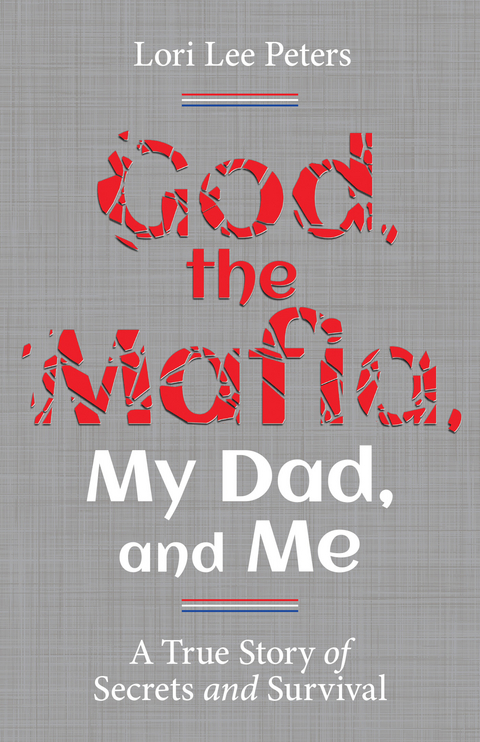
God, the Mafia, My Dad, and Me (eBook)
206 Seiten
Lioncrest Publishing (Verlag)
978-1-5445-2593-8 (ISBN)
In 1974, Lori Lee Peters was an impressionable thirteen-year-old growing up in the suburban town of Lodi, California. The wider world-from which her parents sheltered her and her sisters-fascinated Lori. She was curious about everything, informed about little, and dependent on friends to fill gaps with the knowledge she craved. Religion was a topic rarely discussed in her household. So when friends shared their beliefs about God as fact, Lori thought her days on Earth were numbered. She carried this news with her for decades as a deadly secret she couldn't share with her family. Little did she know that her father-her hero-had a secret of his own. In God, the Mafia, My Dad, and Me, Lori shares a tale of enduring love, unwavering courage, and the unbreakable bond between a father and daughter. These are the true stories of Lori and her father, Lou Peters, a former combat Marine who attracted the attention of the Bonnano crime family and was thrust into a spotlight he never imagined for himself. You'll learn about the strength required to protect those you love in battles no one else sees-not even the family you're protecting. Equal parts beautiful and tragic, this gripping memoir reveals the inexplicable ties that bind, the hope that's always possible, and the overwhelming power of love.
My Dad
Louis Edward Peters was born in New York City on August 9, 1931, in the midst of the Great Depression. The family struggled to find enough food, and my dad’s mother frequently stood in the soup line while nursing her infant son. After several difficult years, Dad was sent to live with his grandparents and two uncles in Carmel, Maine, where his father felt he would be better cared for.
At four years old, Dad struggled to adjust to his new life on a farm in the middle of nowhere with people he had never met. He clung to his teddy bear and carried it everywhere, wondering when he would see his parents again.
At age six, Dad started grammar school in Damascus, Maine, about a half-mile from the farm in Carmel. On the first day, Dad discovered that he was the only child in his grade. In total, twelve students in Kindergarten through eighth grade attended the one-room schoolhouse.
To the kids from Maine, someone from New York was a foreigner, so my dad stood out from the beginning. Then the other students discovered Dad’s father came from Greece, and the real teasing started. During the first couple of weeks, the older kids called Dad “greaseball,” which led to yelling matches but never ended in a fistfight.
Over the next few years, Dad made friends in Carmel, and together they played basketball and slid down snow-covered hills. During the summer, they camped out under the stars and talked about what they wanted to become.
Summers also involved fishing with his grandfather. They would go to the general store—which had everything from groceries to hardware—to pick up a bamboo pole and some line so they could fish for pickerel and white perch among the frogs and lily pads.
The one-room schoolhouse gave Dad more than a good education. Through the daily practice of reciting the morning prayer and standing for the Pledge of Allegiance, Dad gained a respect for God and country—a country where a little farm boy from Maine could grow up and become anyone and anything he wanted.
After sixth grade, Dad attended a brand-new multi-room school that covered seventh through twelfth grade. In December of his seventh-grade year, he jumped to the eighth grade and graduated second in his class of eleven. During his freshman year, however, Dad had a disagreement with the principal that couldn’t be resolved. As a result, Dad quit high school after the ninth grade and started working on his grandparents’ farm. During the summer, he plowed the fields with a team of horses and planted beans, corn, potatoes, and strawberries. During the harsh Maine winters, he and his horses hauled cut lumber from the woods to trucks headed to the sawmill.
For the first seven years that Dad lived on the farm, his parents rarely visited. Then, when my dad was eleven, his father had a heart attack and spent a few weeks in the veterans hospital in Maine. When he was released, my grandfather returned to New York City and to his job as a baker, while my expecting grandmother stayed on the farm with her parents, her brothers, and my dad. There, she gave birth to Paul, my dad’s younger brother. My grandfather was again hospitalized in Maine when my dad was sixteen. This time, when he was released, he stayed on the farm with his wife and children. For the first time since he was four, my dad lived under the same roof as his father and could finally get to know him.
During that time together, my grandfather passed on his baking skills, which helped my dad find work at a bakery in Bangor, Maine, as well as one in Waterville, to help support the family. He also began selling portrait appointments for Olan Mills Studios.
One night when he was eighteen, my dad ran out of gas while driving back to the farm after work. He was in a rural area without a gas station for miles around, so he walked to a nearby car and siphoned two gallons out of the tank, just enough to get back home. Unfortunately, as he screwed the tank cap back on, a policeman drove around the corner and caught him in the act. Dad spent the night in jail, and the next morning in court, the judge fined him fifty dollars and gave him six months’ probation.
That event changed my dad’s life. He recognized his mistake and vowed to never put himself in that position again. He wanted to make something of his life, something beyond working in bakeries and selling portraits.
Dad also wanted to make amends for his actions, so in December 1950, after he finished probation, Dad joined the Marine Corps and was shipped off to Paris Island, South Carolina, for boot camp, where he proved to be a sharpshooter with an M1 Garand rifle, winning the silver badge by scoring 212 out of a possible 250. After basic training, Dad spent a month at Camp Pendleton in California, and then left for Korea aboard the USS Pope, which carried nine thousand troops with the ninth draft.
Dad’s unit arrived behind the line in the evening. The commanding officer instructed his unit to dig foxholes, but between the frozen ground and exhaustion, they only dug three to six inches deep. When Dad and his unit awoke to mortar rounds all around them at two in the morning, they quickly got up and started digging deeper.
Later that morning, while the unit walked to the line, Dad wondered if he could actually shoot another human being. When he arrived at the front and saw all the wounded and dead Marines, however, something in him changed, and he didn’t have a problem after that. Seeing those soldiers on the ground made a man out of him very quickly. When it came time to fight, he fought. When it came time to shoot, he shot. One time when engaged in hand-to-hand combat, he was struck by a bayonet. He didn’t lie down and cry; he kept fighting because he knew if he didn’t, the enemy would kill him.
A few months later, a major from Washington DC visited Korea to teach Dad’s unit the latest techniques in hand-to-hand combat. According to my father, the major wore dress khakis and looked like he walked straight out of GQ Magazine.
Because my dad was a big guy like the major, he was picked to be part of the demonstration. The major told Dad to run over the knoll and come straight at him with his M1. It wasn’t every day that a sergeant had a chance to face off against a major, and Dad didn’t want to be insubordinate, so he carried his rifle more loosely than he normally would. As a result, the major knocked the M1 out of Dad’s hand and hit him in the balls so hard he almost passed out.
“Did you have to do that?” my dad asked, gasping.
The major laughed. “You weren’t protecting yourself very well. Come at me again.”
As soon as he caught his breath, Dad ran back over the ridge. If the major thought the guys on the line were a bunch of pansies, Dad would show him otherwise; he was already battling every day, so if the major wanted a fight, Dad was more than willing to oblige. This time when he approached the major, Dad held his rifle tightly. When the major tried the same move, my dad used his M1 to knock the gun out of his hand and then swung his M1 back and hit him across the face, breaking his jaw and knocking out half his teeth. That was the end of the major’s trip to Korea. He was immediately taken to the medical station and then sent back to the States. Dad was concerned that he might be court-martialed, but that never came to pass.
During his time in Korea, Dad became a sergeant with the First Marine Reconnaissance Division in the area around Heartbreak Ridge, including Punchbowl. He also participated in the first mass troop landing in a helicopter. One day when my dad’s unit returned from a training exercise, he learned that there was an advancement notice for Marine Corps sergeants and that his colonel had recommended him. The only problem was that the Marines required a high school diploma for this promotion, and my dad hadn’t gone past the ninth grade. The colonel told Dad to go to special services, where he could take a four-hour high school equivalency exam. If he passed, he would meet the requirement and be on his way to Quantico, Virginia, to become a lieutenant. Dad passed the exam, but the results came back three days after training in Quantico started, and he lost his opportunity to advance.
On December 3, 1953, he was honorably discharged from the Marine Corps and returned to Maine and to his job as a door-to-door salesman for Olan Mills Studios. But that only lasted for a couple of weeks. Dad knew he didn’t want to sell door to door for the rest of his life and that he needed an education to move ahead, so he decided to study engineering at the University of Maine. When he applied for the winter semester, the man at the admissions desk asked about his high school grades.
“I didn’t finish high school, but I passed the equivalency test,” Dad told him.
“Well, there is no way you can attend the University of Maine. You haven’t even been to school. You need to go to prep school and take these courses…then come back.”
“I don’t have that kind of time,” my dad replied. “What if I become a physical education instructor instead?”
The man shook his head. “There is no way you can get into the University of Maine. You are not qualified and could never pass.”
With that, my dad turned around and walked out. Within a week, he applied to Husson College, a small private school with about five hundred students. Dad met with Mr. Husson himself on three separate occasions, and he was accepted on a trial basis, using his high school equivalency exam.
Dad jumped around to different majors but finally decided on accounting. In 1957, he...
| Erscheint lt. Verlag | 2.11.2021 |
|---|---|
| Sprache | englisch |
| Themenwelt | Literatur ► Biografien / Erfahrungsberichte |
| ISBN-10 | 1-5445-2593-1 / 1544525931 |
| ISBN-13 | 978-1-5445-2593-8 / 9781544525938 |
| Informationen gemäß Produktsicherheitsverordnung (GPSR) | |
| Haben Sie eine Frage zum Produkt? |
 EPUB (Ohne DRM)
Größe: 1,6 MB
Digital Rights Management: ohne DRM
Dieses eBook enthält kein DRM oder Kopierschutz. Eine Weitergabe an Dritte ist jedoch rechtlich nicht zulässig, weil Sie beim Kauf nur die Rechte an der persönlichen Nutzung erwerben.
Dateiformat: EPUB (Electronic Publication)
EPUB ist ein offener Standard für eBooks und eignet sich besonders zur Darstellung von Belletristik und Sachbüchern. Der Fließtext wird dynamisch an die Display- und Schriftgröße angepasst. Auch für mobile Lesegeräte ist EPUB daher gut geeignet.
Systemvoraussetzungen:
PC/Mac: Mit einem PC oder Mac können Sie dieses eBook lesen. Sie benötigen dafür die kostenlose Software Adobe Digital Editions.
eReader: Dieses eBook kann mit (fast) allen eBook-Readern gelesen werden. Mit dem amazon-Kindle ist es aber nicht kompatibel.
Smartphone/Tablet: Egal ob Apple oder Android, dieses eBook können Sie lesen. Sie benötigen dafür eine kostenlose App.
Geräteliste und zusätzliche Hinweise
Buying eBooks from abroad
For tax law reasons we can sell eBooks just within Germany and Switzerland. Regrettably we cannot fulfill eBook-orders from other countries.
aus dem Bereich


