


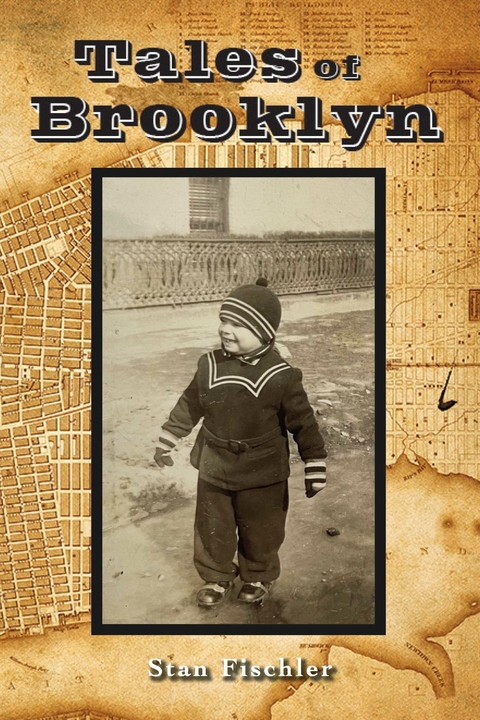
Tales of Brooklyn (eBook)
300 Seiten
Bookbaby (Verlag)
978-1-6678-0369-2 (ISBN)
Every hero must have an origin story, and that includes New York media icon Stan Fischler. Known by millions of sports fans as "e;The Maven,"e; Fischler has written over 100 books on hockey, baseball, and transit systems-now he turns to his own story. Fischler has written for national publications, met celebrities, and co-produced an award-winning documentary. But before all this, he was just a simple New York kid speeding around on his Roadmaster, riding the Coney Island Cyclone, and watching a double feature at the Kismet every Saturday. "e;Tales of Brooklyn"e; is a collection of humorous and poignant stories that gives a fascinating glimpse of growing up in New York City during the Depression and WWII eras. Fischler's intimate circle of family and friends will shape him into the Hall of Fame hockey writer that he becomes. Loaded with nostalgic scenes of joy and sorrow, this origin story presents us with the moments that made "e;The Maven."e;
MY AUNT HELEN -- OR BIG SISTER -- OR BOTH; TAKE YOUR PICK
She was my mother’s kid sister, but not by much. Only a couple of years separated them.
She was my big sister, so to speak, although we were separated by a lot of years.
Helen Friedman, alias “Hale,” lived on the second floor of 582 Marcy, one floor below us. Like everyone else in the family, she hung out in the downstairs living room -- or kitchen, if she wanted dinner.
I got to like my Aunt Helen at an early age and for a lot of reasons – mostly because she was nice to me 99 44/100 of the time.
Only once time did Hale let me down. Likewise, I disappointed her once, big-time.
Like my Mom and Aunt Hattie up in Albany, Helen was an athlete. When I was seven years old in 1939, I discovered two long slats of wood hidden behind the cellar door. Turns out that they were skis. Long before most folks took to the sport, Hale was riding New York Central’s Ski Train on Sundays up to Phoenicia, New York, two hours away.
The mountain – and I use the word very loosely – outside the Catskills village boasted the first rope tow in New York State. Aunt Helen rode the rails there almost every winter weekend until sadly, around 1946, The Central discontinued its Ski Train.
When Hale wasn’t skiing, she’d don her ice-racing blades and hustle over to the Brooklyn Ice Palace on Atlantic Avenue near Bedford Avenue and hope that Olympic gold-medal speed skater Irving Jaffee would ask her to do a pairs-only skate.
“All the girls wanted to skate with Irving,” Aunt Helen would say. “He was a good-looking guy, Jewish and an Olympic champ. I would love to have gone out on a date with Irving Jaffee.”
But that never happened.
As far as I could tell, not many guys dated Hale, and I never could figure out why. Granted, she wasn’t as pretty as Molly Fischler, my mom – nor as convivial as their sister, Aunt Hattie.
Yet Hale was attractive in a pleasant sort of way. She had a nice body, good legs and a warm, if not beautiful, face - punim, as we would say in Yiddish.
I didn’t worry too much about Aunt Helen’s love life, except once. She was an avid member of the New York Hiking Club and began dating a fellow member named Lyman Barry.
One night while I was hanging out on the first floor, Lyman came a-courtin’. I vividly remember having a feeling that maybe this guy actually would marry Hale. But he never showed up at the house again and that was that.
In her role as my big sister, Aunt Helen would take me places and do fun things, like invite me to her workplace. That was a big deal for me because of the work and the place.
This was 1942, the war was on and my aunt was working at what we called “a defense job” or “war work.”
Hale was nothing like the ubiquitous Rosie The Riveter. Her contribution to the war effort was accomplished in a small plant on Bergen Street, a few blocks south of Court on the fringe of downtown Brooklyn.
The factory produced goggles for the U.S. Army, Navy and Coast Guard. A neat guy named Harry Biegeleisen was her boss, and on my occasional visits, Mr. B would gift me with a pair of goggles of my choice.
Harry Biegeleisen, Inc., conveniently was located just a block from a very unusual subway station labeled Court Street. It happened to be the terminal of a “Shuttle” subway service in Brooklyn -- the curious HH Local.
Originally, the HH line was to be part of the Second Avenue subway planned in 1928 to run from Manhattan as a super-express all the way out to Brooklyn’s Coney Island.
Two stations in Brooklyn actually were built for the HH: the aforementioned Court Street and Hoyt-Schermerhorn, which encompassed no less than six tracks, two of which were reserved for the HH.
But The Great Depression wasted the blueprints for the Second Avenue line. Now, in 1942, all the HH had to show for itself was the shuttle connecting Hoyt-Schermerhorn and Court, a line on which I traveled with Hale to Harry Biegeleisen’s.
For little old me the HH was like a private, underground limo. Hardly anybody ever rode the HH because it operated virtually parallel to the existing GG Brooklyn-Queens crosstown local.
But I loved the HH for its Toonerville-type run. Often alone on the HH, I’d muse about what an evening with Hale would be like this time.
Once she finished work, we’d stroll along Court Street, enjoying each other’s company. But one such stroll remains riveted in my mind, I guess because of the timing and the weather -- it was snowing -- and Hale.
It was two weeks before Christmas, and although Court Street wasn’t known for its attractive stores, one establishment caught my eye because it wasn’t what it was supposed to be: an auto-supply shop.
Pyramid Auto’s show window didn’t feature tires or auto batteries. Instead of car jacks there was a Lionel electric train chugging past such table games as Big Business and Parcheesi. To say the least, I was riveted.
It was like the department store window in Jean Shepherd’s Christmas Story. And like Ralphie, I was very happy to merely gawk and appreciate the display for what it was: a toy department in an auto-parts store.
“Isn’t it neat?” I remarked to Aunt Helen. She nodded agreement, although I could tell that Hale wasn’t as appreciative of the O-gauge freight set that was circling the window as I was.
My favorite days with Aunt Helen were Sundays from 1940 until war’s end. This was good, outdoor stuff, far from the madding city crowd.
As a loyal member of the New York Hiking Club, she would be up early and head off to such exotic places as Bear Mountain State Park and Harriman State Park, where the air was clean and there were trails everywhere.
A hike with Hale was good stuff because her companions were fun people and they had no problems having a kid traipse along with them. One of my best trips with them involved what hikers called a trail-clearing expedition. The NYHC group that day crossed a pair of peaks on the Timp-Torne Trail.
Aunt Helen and I would ride the Cortlandt Street ferry from lower Manhattan across the Hudson River to Weehawken, New Jersey, where the New York Central’s West Shore Line had its terminal.
In the early 1940s, the NYC ran regular trains up to the Catskills. It was a colorful ride at water level along the Hudson in old passenger coaches pulled by a steam engine. I could have stayed on that train all day.
We’d get off at Tompkins Cove station and then walk a mile to the Timp-Torne trailhead. Our job was to cover the trail and clear the debris that clogged its path. It was pleasant, rewarding and good exercise.
The capper came at about 4:30 p.m. when the trail’s blue-and-white markers led to Bear Mountain Inn. All things considered, the warm, hospitable inn was about as pleasant a landing strip as one could seek at the end of a hike.
After a hearty, well-deserved dinner, we hustled down to the Bear Mountain train station. You could almost hear the tune -- “Waitin’ For The Train To Come In” -- as it whistled ‘round the bend overlooking the broad Hudson.
Steam locomotives always knocked me for a loop, and this was no exception. I was weary but never happier as the old Central West Shore chugged its way to Weehawken.
On another Sunday, we’d do our hiking somewhere near Millburn, New Jersey, or up in Westchester County, New York, not far from Ardsley, home of the best ice cream parlor this side of the DeKalb Avenue Sugar Bowl in my home borough.
Those were the good days with Aunt Helen. The bad one should have been a good one, but I botched it big-time.
Suffice it to say, I meant well when I invited Hale to be my guest at a hockey game at Madison Square Garden. I figured it would be a token of my appreciation for all the neat things she’d done for me.
This was a Sunday afternoon double-header at The Garden, and now we were immersed in the second game, involving the Eastern Hockey League’s N.Y. Rovers. Suddenly, a goal was scored that excited me.
To enhance my cheering in those days, I armed myself with a large cowbell which was well-attached to my right hand; ready to be rung at a second’s notice.
As soon as the red light flashed, signaling a goal, I jumped from my seat like a nut case and proceeded to ring the cowbell in triumph. Well, actually, that’s what I had in mind.
My intentions were good, but my aim was bad. As I finished my leap, the cowbell scored a direct hit on Aunt Helen’s jaw. Had the scene been in a Three Stooges movie, I’d have been on the floor pounding in laughter.
But my Aunt Helen was hurt – not go-to-the-hospital hurt but not far from it, either. Hale took the beating like the trooper she was but it also marked the beginning and end of her hockey-watching career.
Helen knew a lot about first aid and already had passed two courses during World War II. One was as a nurse’s aide, and the other as our neighborhood’s air raid...
| Erscheint lt. Verlag | 5.11.2021 |
|---|---|
| Sprache | englisch |
| Themenwelt | Literatur ► Biografien / Erfahrungsberichte |
| ISBN-10 | 1-6678-0369-7 / 1667803697 |
| ISBN-13 | 978-1-6678-0369-2 / 9781667803692 |
| Informationen gemäß Produktsicherheitsverordnung (GPSR) | |
| Haben Sie eine Frage zum Produkt? |
 EPUB (Ohne DRM)
Größe: 12,2 MB
Digital Rights Management: ohne DRM
Dieses eBook enthält kein DRM oder Kopierschutz. Eine Weitergabe an Dritte ist jedoch rechtlich nicht zulässig, weil Sie beim Kauf nur die Rechte an der persönlichen Nutzung erwerben.
Dateiformat: EPUB (Electronic Publication)
EPUB ist ein offener Standard für eBooks und eignet sich besonders zur Darstellung von Belletristik und Sachbüchern. Der Fließtext wird dynamisch an die Display- und Schriftgröße angepasst. Auch für mobile Lesegeräte ist EPUB daher gut geeignet.
Systemvoraussetzungen:
PC/Mac: Mit einem PC oder Mac können Sie dieses eBook lesen. Sie benötigen dafür die kostenlose Software Adobe Digital Editions.
eReader: Dieses eBook kann mit (fast) allen eBook-Readern gelesen werden. Mit dem amazon-Kindle ist es aber nicht kompatibel.
Smartphone/Tablet: Egal ob Apple oder Android, dieses eBook können Sie lesen. Sie benötigen dafür eine kostenlose App.
Geräteliste und zusätzliche Hinweise
Buying eBooks from abroad
For tax law reasons we can sell eBooks just within Germany and Switzerland. Regrettably we cannot fulfill eBook-orders from other countries.
aus dem Bereich


