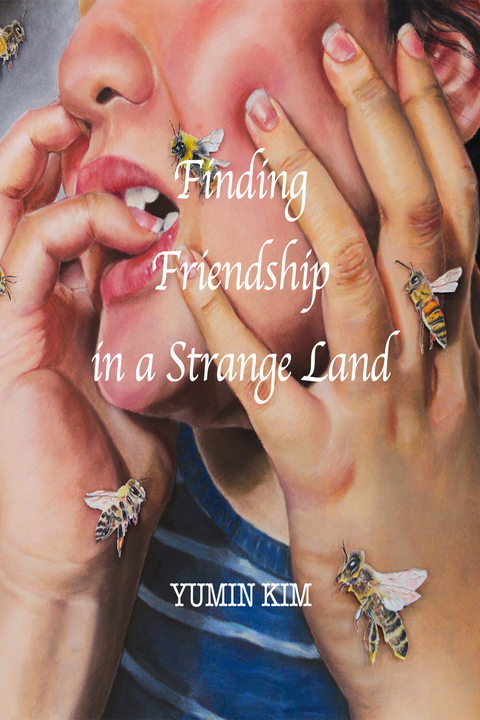
Finding Friendship in a Strange Land (eBook)
130 Seiten
Bookbaby (Verlag)
978-1-6678-0115-5 (ISBN)
This book is mainly about communication between others and me. Each chapter consists of one or more types of communication - spoken, written, or even unspoken, through my art - that influenced me or made me curious to learn about in more depth. Some of them include moments when I doubted myself or memories of cherished times gone by. Some chapters include research I did about things that I love, such as art and food. One of the chapters contains my view of the person I love and one concerns the regret I have about a certain person. Many of the relationships that I have had with my family and friends are also shown in this book, since they directly concern how we communicated with each other. I hope you will agree that communication makes us fully human. Being alive is a great privilege and a gift, made all the more precious by the ability to convey the most meaningful things in my life, that which touches me deeply, to my family, my friends and teachers, and to anyone else I might meet.
1
Home is Where the Feet Are:
Finding Friendship in a Strange Land
The first thing I noticed was how dark everything was. It struck me immediately, upon arriving at what was to be my new high school in the suburbs of Boston, how dim and amber-colored the lights were. In my public middle school back in South Korea, I was used to sharp, overhead lights that cast crisp shadows under my papers and desk. Now this dim light quickly erased the vision I had of American schools, which was that of a bright and lively scene as if from a high school musical. Instead, I was confronted with the image of a gloomy, dingy structure that looked more like a church than a school. How ironic, I thought, given that it was a private Catholic school I was attending.
The very first person I spoke to at school was our headmaster, busily greeting students on the opening day of classes. He asked me where I was from, and when I answered “Korea,” he attempted a joke that only he thought was funny: “North or South?” At that moment I felt a sudden rush of emotions: frustration that I might meet others equally insensitive as he was, combined with disappointment that this turned out to be the first conversation I had with anyone at the school.
As a freshman, I mostly ate alone at the very edge of the cafeteria with my earbuds in. I often watched videos or texted my friends in Korea who weren’t asleep, given the thirteen hour time difference. Most of the students seemed to have a group to sit with, but I preferred sitting at a table by myself.
Sitting alone during lunch wasn’t the hardest part of being at school. Working with other students and presenting to the class was far more difficult. It never got easy. Afraid to ask questions and unable to blend seamlessly into conversation, I had no one to discuss things with or ask for help. I sat quietly, while everyone else participated either by choosing to team up with others or settling in to do the day’s work individually. Debates proved to be the most uncomfortable form of group work for me. In a presentation before the class, I could at least fall back on using powerpoint slides to read rather than try to come up with words spontaneously in English, a daunting task. In a debate, however, there was no script to use for support. I had to listen to what others were saying and respond to their comments on the spot. I never liked debates when I was in Korea, so you can imagine that a debate in English became pure torture. With my class participation dwindling and having limited interactions with my peers, I barely spoke to anyone at school. I spoke more Korean with my mom on the phone than I spoke English during my first five months in the U.S.
Besides talking with my mom, I spent most of my time holed up in my room watching movies and TV shows. During the first couple of months, I kept in contact with my friends in Korea, but as time went on, they got increasingly busy with their work. I found myself waiting and constantly turning my phone over to check if anyone had responded to my urgent need to connect.
I remember the distinct moment I called and discovered my friends in Korea were embarked on a field trip to an amusement park. When the sound of laughter and chatter that filled my room ended, I realized how deafeningly silent it was. While they were giddy and full of excitement, I was in my bed, alone. It suddenly hit me that, for the first time, I would no longer be a part of their memories anymore, although at the time I felt more of a surge of envy and grief for lost future moments of happiness with them.
The only thing that made me feel better was talking to a Korean friend I met in Boston. She was there with her family, attending a public school far from mine. Despite this, we bonded quickly after realizing we came from the same area in Korea. Even though I had met her in Boston, she reminded me of my friends back home. Our common struggle with feeling like outsiders among our American classmates spurred us to spend more time together. Our friendship deepened quickly. I began to note down comments and thoughts consciously throughout the day; I had finally found someone with whom I could share all these important details.
While talking with an actual person instead of an image on a screen and developing a new friendship made me feel more settled, it also gave me an excuse for not trying harder to meet others who could be potential new friends. In some ways, having her as a friend led me to think that I didn’t need to form other connections. Our friendship allowed me to hold on to a remnant of my life in Korea.
But, to her credit, she encouraged me to make additional friends at school. She helped me realize that I was the one holding myself back by isolating myself. And it occurred to me that my self-isolation stemmed from fear - fear that I wouldn’t fit in with my “peers,” those with whom I was supposed to fit in, fear that I would get rejected or ridiculed by them, and fear of losing something fundamental about myself and my life, losing what I knew was familiar and not being sure what was going to take its place.
Those are common fears for anyone living in a foreign land, faced with understanding the language and customs of a radically different culture. In essence, Korea was still home to me. I hadn’t felt as if I could make a “home away from home” in the U.S. yet. Since I knew it so well and felt so comfortable in it by comparison with the U.S., I placed more value on life in Korea than the new one that was unfolding for me in Massachusetts.
It finally dawned on me that I was being too attached to the life I left behind, and that was a main reason I retreated so much into isolation at high school. Knowing I was going to live in the U.S. for the next couple of years, I first thought of my new home merely as a place of study, while I tried to keep Korea in my mind as a place of social and emotional life, a fuller, richer life than just that of schoolwork. I wanted to remain energetically involved in the lives of the people back home; so much so that I lost sight of what was right in front of me now. Because I was too focused on keeping up an active presence in my loved ones’ lives in Korea, I lacked motivation to make an effort to create my own community here.
It took a long time to recognize what I was doing fully and even longer to try to amend the thinking that underlay my isolation. For a while, it felt as if I were hanging by a thread over the edge of a sinking ship, with my only friend in Boston ready to catch and rescue me on a lifeboat below, bobbing about on a stormy sea.
Eventually I got the courage to face my fears about meeting new people. Perhaps what really happened was that I got tired of suffering from being isolated and saw I had the power to help myself. I saw it was up to me to make things better. Luck played a role as well. After several spontaneous, unplanned meetings with some new students, I found myself eager and able to converse and even make friends with them. While I am still shy about meeting new people, I have now made some new friends in places where I once felt so alone.
While I’m sure it happens regularly to just about everyone who lives in a foreign land, I remember going through periods of self-doubt, questioning whether I made the right choice coming to Boston. I had a lot invested in the move. So did my parents, my host family, and the school administrators, all of whom had put in so much time and effort into making it possible for me to be here. I didn’t want to disappoint them, of course. So when doubts arose, at first I tried to push them away by telling myself the opposite, that everything was fine, that I didn’t regret the decision. I did that in part because I wanted to believe it was the case. I didn’t want to add negative emotions such as anger at myself on top of all the other difficulties I had.
At other times, though, I let the doubts come. Now, I don’t try to fight them anymore. In a way I’m still unsure about whether I regret coming to Boston or not. Sometimes I feel as if I do, and at other times I don’t. I would be lying if I said that I didn’t miss people and life back home. Yet even though it’s been an exhausting, tumultuous, and emotionally taxing journey, if I ask myself whether I totally regret coming here, I can’t actually say that I do.
So I go back and forth with my feelings. Thinking about Korea, I remember the promises I made with my friends this past spring to eat “hot pot” dishes or...
| Erscheint lt. Verlag | 1.9.2021 |
|---|---|
| Sprache | englisch |
| Themenwelt | Literatur ► Biografien / Erfahrungsberichte |
| ISBN-10 | 1-6678-0115-5 / 1667801155 |
| ISBN-13 | 978-1-6678-0115-5 / 9781667801155 |
| Informationen gemäß Produktsicherheitsverordnung (GPSR) | |
| Haben Sie eine Frage zum Produkt? |
 EPUB (Ohne DRM)
Größe: 17,4 MB
Digital Rights Management: ohne DRM
Dieses eBook enthält kein DRM oder Kopierschutz. Eine Weitergabe an Dritte ist jedoch rechtlich nicht zulässig, weil Sie beim Kauf nur die Rechte an der persönlichen Nutzung erwerben.
Dateiformat: EPUB (Electronic Publication)
EPUB ist ein offener Standard für eBooks und eignet sich besonders zur Darstellung von Belletristik und Sachbüchern. Der Fließtext wird dynamisch an die Display- und Schriftgröße angepasst. Auch für mobile Lesegeräte ist EPUB daher gut geeignet.
Systemvoraussetzungen:
PC/Mac: Mit einem PC oder Mac können Sie dieses eBook lesen. Sie benötigen dafür die kostenlose Software Adobe Digital Editions.
eReader: Dieses eBook kann mit (fast) allen eBook-Readern gelesen werden. Mit dem amazon-Kindle ist es aber nicht kompatibel.
Smartphone/Tablet: Egal ob Apple oder Android, dieses eBook können Sie lesen. Sie benötigen dafür eine kostenlose App.
Geräteliste und zusätzliche Hinweise
Buying eBooks from abroad
For tax law reasons we can sell eBooks just within Germany and Switzerland. Regrettably we cannot fulfill eBook-orders from other countries.
aus dem Bereich