


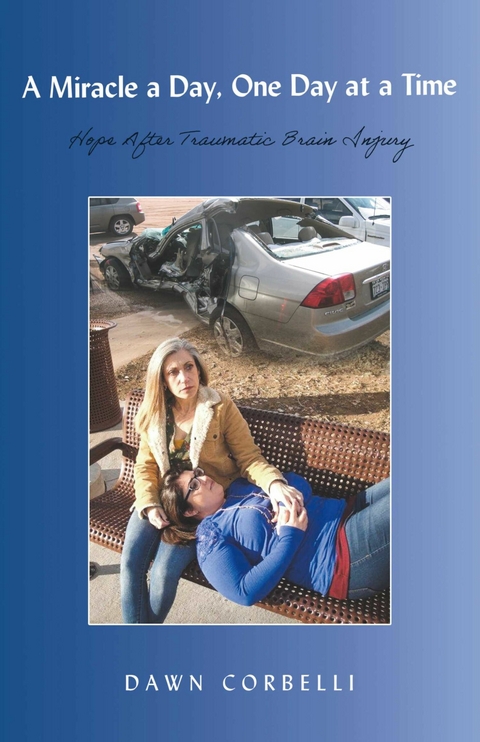
Miracle a Day, One Day at a Time (eBook)
248 Seiten
Bookbaby (Verlag)
978-1-0983-8640-5 (ISBN)
Dawn Corbelli served in the Air Force for three and a half years as a young adult and has a Bachelor's Degree in Applied Behavioral Science. She considers being married for 35 years so far, one of the greatest achievements of her life. Being a stay-at-home mom for many years, until her children approached adulthood, is something that was incredibly meaningful and fulfilling. Her family is her priority. Although struggling with mental illness and traumatic brain injury makes achieving some goals difficult for her, she is a tenacious fighter and does not give up. As an employee of the National Alliance on Mental Illness, Colorado, Dawn was presented the 'Giraffe Award' which is an award given annually to an individual that 'sticks their neck out.' This award acknowledges that with courage and determination, she increased mental illness awareness and reduced stigma by expressing herself in the media and by giving presentations to groups. She taught classes to families and friends of the mentally ill about mental illness. Dawn's dream of becoming an author has finally come to fruition. Dawn Corbelli is an advocate dedicated to helping others realize what life with a brain injury entails and to help brain injury survivors, caregivers, their families, and friends, know they are not alone. Dawn is her daughter Veronica's caregiver as she has a severe traumatic brain injury from the same car accident Dawn sustained her moderate traumatic brain injury in 16 years ago. Together they teach high school health classes, educating students, teachers, and counselors about brain injuries. Dawn has a positive outlook on life and continues to keep her strong faith in the Lord. Dawn Corbelli currently lives in Colorado Springs, CO, with her husband Greg, and both of her daughters, Kylie and Veronica.
Grappling with recovery after brain injury is an uncharted, grueling, and exhaustive gauntlet. Dawn Corbelli shares the good, the bad, the ugly, and ultimately the extremely positive and beautiful. I wholeheartedly recommend this book. Full review inside. Michael Nunley, Ph.D. Clinical NeuropsychologistMiracle a Day, One Day at a Time is an incredible memoir. Prepare to hear what courage is. Prepare to see the strength that comes from faith and love. This book is a revealing gift that gives knowledge and inspiration to anyone that goes through as many tears as it takes to know Dawn and Veronica's story. Kenneth D. Allred, Ph.D. Clinical PsychologistA Miracle a Day, One Day at a Time: Hope After Traumatic Brain Injury is a gripping memoir about a family's recovery after a near fatal car accident in Colorado Springs. Dawn Corbelli and her 15-year-old daughter Veronica sustained traumatic brain injuries. This book contains an emotional reminiscence of the past 12 years as they tried to put their lives back together. Dawn Corbelli is dedicated to helping others realize what life with a brain injury entails and to help brain injury survivors, caregivers, family, and friends know they are not alone in their experience. My daughter Veronica and I now speak at high schools about our traumatic brain injury journey and educate anyone who will listen by doing interviews, radio shows, and podcasts. dawncorbelli.com This memoir contains adult content that is inappropriate for children.
Chapter 1
Our Future Starts Today
February 13, 2008
The day my 15-year-old daughter Veronica and I almost died—February 13, 2008—was a perfect Colorado mid-winter day, sunny and bright. From the passenger seat of our Honda Civic, I squinted against the glare from the sun setting behind the mountains to the west. As she drove away from the house, Veronica flashed the ASL “I love you” sign through the window, and my husband Greg signed it back to her as he drove past us going home. We were on our way to Walmart to get a Valentine’s Day card for him.
Barely a month earlier, on January 11, Greg, our 17-year-old daughter Kylie, and I took a flight out of Colorado Springs, Colorado. Greg and I were taking Kylie to Cayde Canyon Achievement Center, a boarding school that helps children ages 5 to 18 who suffer from numerous difficulties, including neurological disorders, trauma, abnormal psychopathology, and substance abuse, that affect how they behave.
Kylie is our child. But Kylie had physical illnesses that were not properly diagnosed. Within standard 15-minute appointments, doctors did not have time to adequately assess her condition, and these affected her daily behavior. We did not understand what she was feeling or going through. She could not control behaviors that provoked us, set us against each other, and created stress in our family. Medication had helped, but she needed help in other ways that we could not provide. At first, Kylie thought we were sending her away because she was a horrible person. We were not sending her to Cayde Canyon so someone else would deal with her. Rather, out of love, we were taking her to a place that could help all of us, as a way to bring our family back together as a unit.
Cayde Canyon was our last chance to help Kylie before we put her out into the world as an adult. We did not know how long Kylie would be there before the therapists decided she was ready to come home. No affection or physical touch was allowed between anyone at any time while she was there. Kylie was permitted three 20-minute phone calls per week and visits on weekends. We are a deeply affectionate family, and the thought that no one could hug Kylie during difficult times made us terribly sad. Leaving Kylie was the absolute worst thing our family had ever experienced in our 20 years together. Naïvely, we never thought we would have to live through anything more traumatic than that moment.
The Accident
Because we lived so far away, Greg and I decided to fly to visit Kylie one weekend each month of her stay at Cayde Canyon. After one month, we made our first visit to see Kylie, returning on Sunday evening. That Wednesday was the day before Valentine’s Day. As Veronica and I headed for the door, she asked if she could drive to get the driving time for her permit. I tossed her the keys, and we were on our way.
Veronica stopped at the intersection of Bradley Road and Powers Boulevard, a cross-street stop sign. I looked left, but all I saw was the back of Veronica’s head. Next, I glanced right as I cleaned my glasses. Nothing.
The next thing I knew, instead of heading south on Powers, somehow our car was in the right-turn merge lane on Bradley, still facing west. I was confused and dazed, unable to grasp what had happened. Until I read the accident report, 12 years later, I never really understood the circumstances of the crash. The vehicle that hit us was a 4x4 truck going 60 mph, and the force of the impact catapulted our car clear over the median island on Bradley.
Accident Report
Strangely, in the immediate aftermath I was calm and serene. I knew if I had died, it would have been peaceful. I could feel a protective presence, a bubble in the car, like hands that held both Veronica and me in a warm embrace.
Once I looked at the windshield, though, I recognized that something was terribly wrong. Veronica was squeezed up behind the steering wheel, her seat crammed over to where the center console used to be. Her head drooped unnaturally. Although my seatbelt was still buckled, my seat was shoved several inches out of the right side of the car.
My eyes blinked slowly. I realized I was screaming—a combination of fear, confusion, and pain in my back and left leg. Even before the emergency vehicle arrived, someone, somehow, found my purse and pulled out my cell phone. I have no idea how they knew which number was my husband’s, because it was only labeled with his name. I believe that caller was an angel; Greg arrived at the scene of the accident only moments later.
Our neighbor Forrest was driving home from work and showed up just as the emergency vehicles arrived. He held my hand and told me, “It’s OK, sweetie, you’re going to be all right,” over and over. I remember how comforting his familiar voice was through the chaos and terror.
When the Jaws of Life finished cutting off the roof of the car, the doors fell off. Many times over, we heard what a miracle it was that anyone could be pulled out of such wreckage alive.
I recall being lifted out of the car and set on a gurney. One of the EMTs cut my clothes off and immediately covered me with a sheet, but I remember being embarrassed that someone might have seen me naked.
Flight for Life was called for Veronica, but the wind was too strong that day, so Veronica and I were sent off in separate ambulances. Forrest told Greg, “Go! Be with Veronica!” By then, her blood pressure was 52/0. Her occasional but barely audible moans were the only thing that told him she was still alive. Through a throat tight with tears, Greg just kept choking out the words, “Hold on, baby. We’re almost there.” Once at the hospital, Veronica was rushed into surgery. The most immediate concern was her severely swollen stomach, which the doctor cut—belly button to sternum—to check for internal bleeding. Fortunately, the swelling was due to a gas bubble. Our guess is that either she saw the truck coming and took a deep breath, swallowing air on impact, or the crash itself forced the air into her stomach. Unbelievably, neither of us had any significant cuts. Yet later, in the back seat of our car, Greg found my coat, its folds filled with broken glass.
Many of our friends lined the hallways of the emergency room. As Greg came in my room to check on me, he was surprised to see our friend Rick and asked what he was doing there. Rick said, “I’m checking on our girls.” Even 12 years later, Rick’s support through our trauma makes Greg extremely emotional.
As I lay in my room in the ER after an array of X-rays, a CAT scan, and plenty of pain medicine, two thoughts stuck in my mind: I had not made it to Walmart to buy Greg a Valentine’s Day card, and the EMTs cut off my new Victoria’s Secret bra, my new jeans, and my favorite corduroy jacket. I was obsessed with those thoughts, telling everyone I saw, men and women alike. I also fretted that all our friends crowding the hospital hall would see that I was naked underneath the sheet. I don’t even remember being changed into a hospital gown.
A coworker of Greg’s, a man I hardly knew, came in my room, and I told him, crying, about the Valentine’s Day card. This kind man went right out somewhere and got a card for me to sign—even though my signature was an unrecognizable morphine-distorted scrawl. And within a few days, one of our friends went to Victoria’s Secret and bought me a new bra—hot pink with a silver sequined star above one breast. I liked it so much that Greg gave our friend some money and asked her to go back and buy two more in different colors.
Looking back now, these small acts of kindness seem so trivial, but together, they were abundant, and to me, they were blessings—tangible manifestations of God working in our lives.
Aftermath
Greg wanted to be with both Veronica and me, but since that was impossible, some friends stayed with me while he was with Veronica. Many friends came to the hospital to support us, simply by their presence. The care of our friends throughout this nightmare was an enormous blessing we are endlessly grateful for.
The hospital assessment determined that I had five breaks in my pelvis, one in my sacrum, and a moderate concussion resulting in almost complete short-term memory loss, which lasted approximately seven weeks. I needed nine staples in my head. I was in the hospital for a total of three weeks. The first week I was on the fifth floor, in a private room with one nurse for every two rooms, then I was moved to the sixth floor, where I shared a room, and the hospital staffed one nurse per hall. My last two weeks were spent in the rehabilitation unit on the seventh floor.
That first night, I was delirious from pain. No amount of medication could take the pain completely away for any length of time. I was given a morphine drip, with a button to push to release the drug into my vein when I needed it, but the drip only released every 15 minutes. I felt like I needed pain meds much more often than that, so I just kept pressing the button, to no avail.
I was extremely thirsty but was not allowed to...
| Erscheint lt. Verlag | 1.9.2021 |
|---|---|
| Sprache | englisch |
| Themenwelt | Literatur ► Biografien / Erfahrungsberichte |
| ISBN-10 | 1-0983-8640-X / 109838640X |
| ISBN-13 | 978-1-0983-8640-5 / 9781098386405 |
| Informationen gemäß Produktsicherheitsverordnung (GPSR) | |
| Haben Sie eine Frage zum Produkt? |
 EPUB (Adobe DRM)
Größe: 7,6 MB
Kopierschutz: Adobe-DRM
Adobe-DRM ist ein Kopierschutz, der das eBook vor Mißbrauch schützen soll. Dabei wird das eBook bereits beim Download auf Ihre persönliche Adobe-ID autorisiert. Lesen können Sie das eBook dann nur auf den Geräten, welche ebenfalls auf Ihre Adobe-ID registriert sind.
Details zum Adobe-DRM
Dateiformat: EPUB (Electronic Publication)
EPUB ist ein offener Standard für eBooks und eignet sich besonders zur Darstellung von Belletristik und Sachbüchern. Der Fließtext wird dynamisch an die Display- und Schriftgröße angepasst. Auch für mobile Lesegeräte ist EPUB daher gut geeignet.
Systemvoraussetzungen:
PC/Mac: Mit einem PC oder Mac können Sie dieses eBook lesen. Sie benötigen eine
eReader: Dieses eBook kann mit (fast) allen eBook-Readern gelesen werden. Mit dem amazon-Kindle ist es aber nicht kompatibel.
Smartphone/Tablet: Egal ob Apple oder Android, dieses eBook können Sie lesen. Sie benötigen eine
Geräteliste und zusätzliche Hinweise
Buying eBooks from abroad
For tax law reasons we can sell eBooks just within Germany and Switzerland. Regrettably we cannot fulfill eBook-orders from other countries.
aus dem Bereich


