


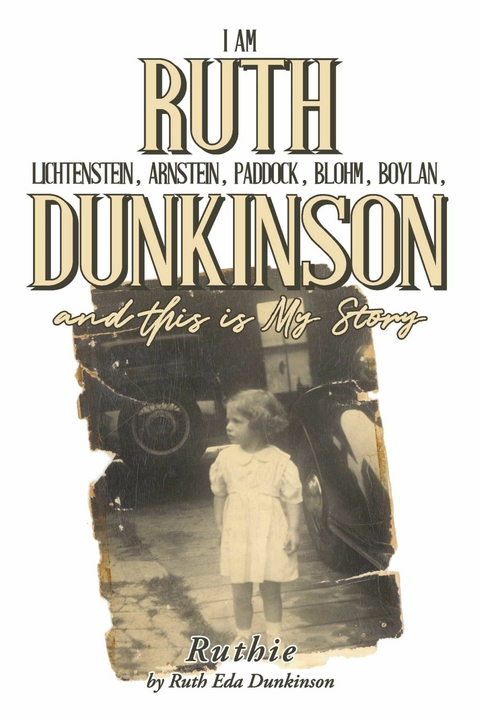
I Am Ruth Lichtenstein, Arnstein, Paddock, Blohm, Boylan, Dunkinson and this is My Story (eBook)
324 Seiten
Bookbaby (Verlag)
978-1-0983-8261-2 (ISBN)
This is an unforgettable autobiography about a woman who exemplifies a life worth living. Ruth Dunkinson's life has been filled with excitement, adventure, and unexpected twists and turns. Get ready for a journey that begins in Newark, New Jersey, and takes her to New York, Florida, Cuba, North Carolina, and more! This must-read memoir reminds readers that life is a journey filled with lessons and stories to be shared. Ruth was born to German Jewish immigrant parents. When she was three years old, her parents divorced, leaving her grandmother and mother to raise her - along with a babysitter who became a world-famous entertainer! This autobiography is a reminder that there is no set script to life. At twenty, Ruth left home for Florida with the man she loved, and they experienced rough seas on a failed fishing trip to Cuba. The affair was short lived, producing a son. Despite a failed ensuing marriage, Ruth continued her journey that led her to work as a secretary in the Miami boating industry, and eventually to managing a gun shop in North Carolina! Late in life, Ruth survived end-stage renal failure, and prioritized travel to meet family. Ruth's life reminds us that life is filled with excitement, triumph, and speedbumps. So, get ready to turn these pages and enjoy the ride!Honorable Mention at Los Angeles Book Festival held April 23, 2022
Chapter 2:
Hans and Gina
By a Justice of the Peace, Hans and Gina were married in a civil ceremony in Newark, New Jersey, on New Year’s Eve, 1936. Her words of warning to me:
“Never marry on a holiday, in the event things do not work out well.”
Along with Helena, they set up housekeeping. A year later, Heinrich and Matilda arrived from Germany and moved in with the family. There were five adults, and only two were capable of finding jobs. Gina was able to find employment at the Haines Department store in the curtain and drape department. She gained her experience while working with her father.
Hans worked in manual jobs at the docks. Loading and unloading the cargo vessels at the Port of Newark, the busiest container shipping port on Newark Bay.
By March, Gina realized she was pregnant. She went to her mother, Helena,
“Was it honestly time to have a baby? We are just settling in, and things are rough now. Oh, Mutter, I will not be able to continue working, and you will have to take care of the baby. I’m thirty, really; how many more years do I have to have a child?”
“Ginschin, this is wonderful. It is a good start in the new country. The child shall be an American. Yes, I will take care of the child. Everything will work out.” Her answer gave Gina a much more positive outlook.
All my life, while my mother was still alive, I heard the story of how I was almost born on Thanksgiving Day. It had been a day with Uncle Bruno; I called him Brupa Aunt Flora and cousins Walter, aka Wawa and Bobby. Aunt Flora, a short round woman, had prepared a proper American Thanksgiving feast.
Suddenly, while eating turkey, stuffing, potatoes, and vegetables Gina developed labor pains. Close to panic, Cousin Bobby sprang into action and took Mother and Grandmother to the hospital, only to return hours later with a still pregnant Gina. My father was neither present on that day, nor for my birth four days later; he was on a sit-down strike. If he had walked away, he would have had to cross the picket line and pay a fine to the union bosses and inevitably lose his job.
On November 30, 1937, Ruth Eda Lichtenstein was born in the Presbyterian Hospital in Newark, New Jersey. My mother, Regina Agnes Rosenthal Lichtenstein, chose Ruth’s name as it was diminutive and not too many modifications could be added or subtracted other than Ruthie. Gina wanted a counterbalance for the long last handle.
Hans did not get home from the sit-down strike for two days. Upon seeing his new daughter, he announced,
“The child has a chicken neck.”
Dad would play with me, throw me in the air, and listen to me squeal. One memorable day he tossed me too high, and my little head struck the ceiling lamp. There was no damage to me, but the commotion it wrought as Grandma Helena came to my rescue was detrimental.
It did not take long for things to deteriorate. Helena was a domineering woman who wanted to run things, and Hans was a German man who felt that was his position. Helena would tell him,
“Hans, you have to learn more English, then you can get ahead in life.”
She spoke German and French and, with a distinct German accent, she spoke English well. Smattering his English with German words and a heavy southern accent made him difficult to understand. Stubborn as he was, even considering learning better English was unthinkable. His retort to her was,
“No, I don’t need to learn more English. I have a job, and they understand me fine. You stay out of my business.”
He did not like his mother-in-law at all. I do not think she or the rest of the family cared for him. When I got older, he used to tell me,
“She was a bitch.”
Grandmother Tilley wanted to entertain me. I was barely a year old. She gave me a box of something, and when I shook it, it made a noise. I was fascinated with the new toy. When Helena spotted what I had in my hand, she became agitated with Tilley,
“How can you give something like this to a child? Can’t you read English? It is a package of aspirins.”
She grabbed the package from my little hand, and I started screaming. Helena tried to quieten me to no avail until Mother picked me up.
The conflict and drama in the house caused my mother to scream. She was a spiteful woman, and with intention, she meant to annoy her in-laws. Gina was well aware that orthodox Jews do not eat bacon. To show her dislike of kosher customs and the old country religious laws, she spitefully cooked bacon, burning it and smelling up the house. Tilley came out of her room saying,
“Oh, was ist das?”
Her face showed disgust; she wrinkled her nose, dabbed her mouth to dispel the odor, shook her head, and looked at Gina.
“Was machst Du Ginchen?”
Hans came into the kitchen after hearing the tone of his mother’s voice, and I followed him.
Upon entering, he asked,
“Gina was ist das?” Seeing a potential argument, he said, “Ruthie, leave the kitchen,”
“Don’t talk to her in such a harsh tone, Hans; she’s just a baby,” Gina screamed at him.
“What is going on here?” Helena inquired, sticking her head into the kitchen. Looking at Gina, she demanded, “What is that smell?”
“Mutter, its bacon, don’t you know?” Gina responded.
“Gina, this was not necessary. Ach, it smells terrible.”
Hans looked at Helena and said in a nasty tone, “Raus mit Dir. I’ll handle this.” Disgruntled, Helena left the kitchen and went to her room.
In the kitchen, Hans and Gina were still arguing. “Gina, why did you do this?”
“Because I’m tired of all the fuss about the food. Every time I open the icebox door, your mother sticks her head out of the bedroom door and asks me what I’m doing. I live here too; I can go into the icebox.”
“But why would you cook bacon when you knew it would make trouble?”
“Make trouble; everything is trouble; I cannot move an inch around here; someone is always watching me. Your dad is the only kind person here. He always asks me how I am. He hardly ever comes out of his room because he is afraid to say anything wrong. Tilley is always saying, ‘Shh, shh.’”
Hans was frustrated; he could not make sense out of the whole thing. He thought Gina was unreasonable. His face turned red; he was losing control. He pushed Gina, and she fell to the kitchen floor.
Looking down at Gina, Hans venomously shouted,
“That is what you deserve, Gina. No more nonsense like this again.” Being in the hallway, I heard it more than I saw it. And I quickly ran to Mommy’s side.
“Mommy, Mommy, Daddy put you on the floor.”
Getting up, she hugged me. “Ruthie, I’m OK. Daddy did not mean it.”
One day on a visit to Aunt Flora and Uncle Bruno, I immediately told them, “Daddy threw Mommy on the kitcen floor.” I could not say the word correctly.
Life in the apartment had become unbearably stressful. Privacy was at a premium. The old folks never left the house, and the new couple could not escape, even for an evening of pleasure. To Gina’s distress, the marriage was not working. Had there been a time when this family could have gotten to know one another, it might have worked in their favor, but everyone was a stranger. The short courtship had not allowed for any conversation between the parents of each partner. Thrown together, due to circumstances, was proving to be a considerable hardship.
My father and my maternal grandmother were never going to get along. The bickering between the two was constant. There was no way out of this chaos except dissolution.
Divorce was not prevalent in 1939. Recorded state files show that under times of duress, such as war, it became more common. Divorce usually took three years of separation before the decree would become final.
Gina’s grandparents were married for fifty years. Hans’ parents were married at least forty-five years.
In the end, Gina decided that she could not raise a child, work a job, and take care of the home alone with the constant stress level. They arranged to dissolve an unhappy marriage.
Over the years, there were no repentant words. The bitterness remained to the end.
Dad, Oma, and Opa sat in the living room, watching the progress of our move. I went to Dad’s side and whispered, “I will miss you, Daddy,” tears in my eyes. He gently patted me on the head, and in a choking voice, he muttered,
“Be a good girl Lizbet.”
It was his pet name for me. I gave him a big smile through my tears. I walked over to my grandparents and smiled shyly; in a quiet voice, I said,
“Goodbye.”
Oma took my hand and kissed it while Opa leaned forward and put...
| Erscheint lt. Verlag | 19.8.2021 |
|---|---|
| Sprache | englisch |
| Themenwelt | Literatur ► Biografien / Erfahrungsberichte |
| ISBN-10 | 1-0983-8261-7 / 1098382617 |
| ISBN-13 | 978-1-0983-8261-2 / 9781098382612 |
| Informationen gemäß Produktsicherheitsverordnung (GPSR) | |
| Haben Sie eine Frage zum Produkt? |
 EPUB (Ohne DRM)
Größe: 23,0 MB
Digital Rights Management: ohne DRM
Dieses eBook enthält kein DRM oder Kopierschutz. Eine Weitergabe an Dritte ist jedoch rechtlich nicht zulässig, weil Sie beim Kauf nur die Rechte an der persönlichen Nutzung erwerben.
Dateiformat: EPUB (Electronic Publication)
EPUB ist ein offener Standard für eBooks und eignet sich besonders zur Darstellung von Belletristik und Sachbüchern. Der Fließtext wird dynamisch an die Display- und Schriftgröße angepasst. Auch für mobile Lesegeräte ist EPUB daher gut geeignet.
Systemvoraussetzungen:
PC/Mac: Mit einem PC oder Mac können Sie dieses eBook lesen. Sie benötigen dafür die kostenlose Software Adobe Digital Editions.
eReader: Dieses eBook kann mit (fast) allen eBook-Readern gelesen werden. Mit dem amazon-Kindle ist es aber nicht kompatibel.
Smartphone/Tablet: Egal ob Apple oder Android, dieses eBook können Sie lesen. Sie benötigen dafür eine kostenlose App.
Geräteliste und zusätzliche Hinweise
Buying eBooks from abroad
For tax law reasons we can sell eBooks just within Germany and Switzerland. Regrettably we cannot fulfill eBook-orders from other countries.
aus dem Bereich


