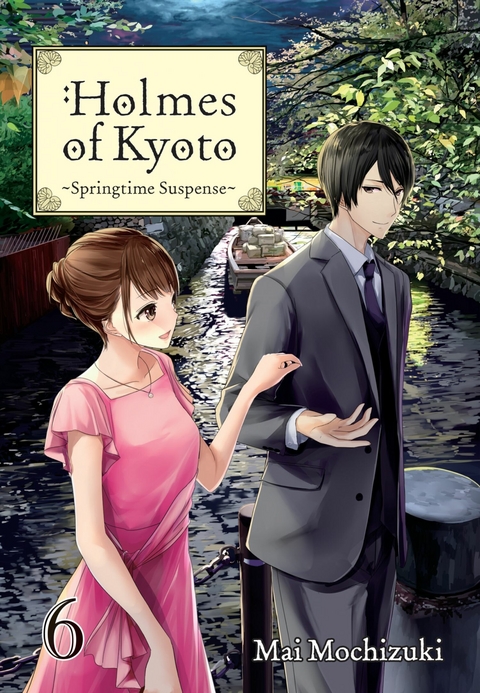
Holmes of Kyoto: Volume 6 (eBook)
250 Seiten
J-Novel Club (Verlag)
978-1-7183-7658-8 (ISBN)
Kiyotaka and Aoi have finally confessed their feelings for each other and are now dating. One day, they learn of a string of thefts in Kyoto: someone is stealing Buddhist works of art from art collectors. Then Komatsu, the detective they met at Yoshida-Sanso Inn, comes to Kura to ask for help finding his missing daughter. The two cases turn out to be intertwined...
Kiyotaka and Aoi have finally confessed their feelings for each other and are now dating. One day, they learn of a string of thefts in Kyoto: someone is stealing Buddhist works of art from art collectors. Then Komatsu, the detective they met at Yoshida-Sanso Inn, comes to Kura to ask for help finding his missing daughter. The two cases turn out to be intertwined...
Prologue
If you walk through the shopping district at the intersection of Teramachi Street and Sanjo Street, you will find a small antique store nestled in the rows of shops. Its name is simply Kura, meaning “storehouse.” The place feels more like an old-fashioned cafe than an antique store: a blend of Japanese and Western aesthetics reminiscent of the Meiji and Taisho eras. Jars, tea bowls, and other antiques are neatly arranged on the lines of shelves. There are also Western antiques such as tea sets, candlesticks, and bisque dolls.
I, Aoi Mashiro, first wandered into this store last March. An unexpected turn of events led to me working here, and it’s been a full year since I started. I was in my second year of high school back then, but now I’ve become a third-year.
Kiyotaka Yagashira—nicknamed Holmes—works there too. He’s a handsome young man with a slim build, pale skin, slightly long front bangs, and refined features. His nickname comes from his exceptional eye for observation and appraisal, his knack for appraisal, and the fact that his surname has the character for “home” in it. Right now he’s a grad student at Kyoto University. He’s also the grandson and apprentice of this store’s owner, the nationally certified appraiser Seiji Yagashira. He calls himself an appraiser-in-training, but even leading figures in the antiques industry recognize his skill. He’s also my mentor who teaches me all sorts of things about fine art. True to his appearance, he’s gentlemanly, kind, graceful, and well-mannered—but at the same time, he’s quite eccentric. He’s wicked at times, stubborn, and hates to lose. What’s more, he even has a bit of a black-hearted side. As you can see, he’s not very straightforward. I fell in love with this not-straightforward man, and after many twists and turns, we started dating just a week ago. Holmes is my boyfriend now...although I still find it hard to believe.
I glanced at Holmes, who was sitting at the counter. Feeling a smile coming on, I quickly looked away.
Suddenly, I heard the sound of a retro phone ringing. It was Kura’s landline.
Holmes picked up the receiver and said with a smile, “Hello, you’ve reached the antique store Kura. Oh, hello, dad.” His voice relaxed upon realizing that the caller was his father, Takeshi Yagashira, who we call “Manager.” Holmes’s relatives know that he always keeps his cell phone on silent at work, so when they need to talk to him, they call the store’s phone.
“The wooden boxes behind the counter?” Holmes turned around and opened the cupboard behind him. There were two boxes inside. “Yes, I see them. Both of them? All right. Bye, then.” He nodded and hung up.
What did the manager ask him to do?
Sensing my unspoken question, Holmes immediately said, “Ueda left things with my father again. He wanted me to appraise them.” He placed the boxes on the counter.
“Are these Ueda’s own things?” I asked.
“No, apparently they belong to the director of a client company, so there might actually be something worthwhile in here.” He smiled.
Ueda was an old friend of the manager. He ran several businesses, with his management consulting company being the main one. This meant that he had a lot of connections and was on friendly terms with managers of large corporations. He was smart and good at business, but unfortunately he had terrible judgment when it came to antiques. Most of the things he brought in for Holmes to appraise were forgeries. He was a poor connoisseur—but this time, the items belonged to a director he knew. This meant there was a chance that they were genuine.
“It’s been a while since our last study session,” Holmes said. “Shall we borrow what Ueda brought in to have one?” He placed his index finger in front of his mouth and smiled, his eyes narrowing into arcs.
“O-Okay.” I blushed slightly. That gesture of his was my weakness.
“I’ll make coffee. Please have a seat and wait.” He stood up, pulled a chair out for me, and went into the kitchenette to prepare the coffee.
I bowed and excitedly sat down at the counter. Holmes’s lectures about antique art began last summer break. At first they were fun, casual lessons, but since I showed so much interest, he became more enthusiastic in his teaching too. Our study sessions continued after summer break ended, and thanks to them, I had the opportunity to see many genuine works of art in a short period of time. I think my eyes are getting better too, bit by bit—but that’s only compared to other people my age. I’m still a fledgling. Then again...I’m sure I haven’t even caught up to Rikyu yet, and he’s younger than me.
Just when I was starting to feel a bit depressed, the scent of coffee tickled my nose.
“Why the long face?” Holmes asked, placing a cup in front of me.
“Oh, no, it’s nothing,” I said, shaking my head.
He sat down across from me and slipped on his white gloves, not pressing the matter. I took my non-slip appraisal gloves out of my apron pocket too and put them on.
Holmes carefully picked up one of the wooden boxes and opened the lid. Inside was a pale-colored tea bowl.
“Is that Kizeto ware?” I asked.
“Yes, it’s a Hakuan tea bowl.” He looked down at it, smiling happily.
“Hakuan...? What’s that?”
“Is this your first time seeing one, Aoi?”
“Yes, I just thought it was a Kizeto tea bowl.”
“That’s correct too—Hakuan is also called the Kizeto of Rikyu’s era. There are various theories as to how it came about, one of which is that it was an imitation of the pottery from Hoeryong, North Korea. The pieces were created in Mino Province, during the short time span from the Momoyama period until the early Edo period. Also, it’s said that the name ‘Hakuan’ came from Hakuan Soya, a medical officer of the Edo shogunate who was very fond of the tea bowls.”
“I see. This is authentic, right?”
“Yes, it is.” He looked back down at the tea bowl, which he was holding with both hands. “Hakuan tea bowls follow an old convention called the ‘Hakuan Ten Vows.’”
“What’s that?”
“It refers to a set of conditions that tea bowls, tea containers, and whatnot must meet. Hakuan’s ten vows are: one, loquat-colored; two, sea cucumber glaze on the body; three, a ‘crescent moon’ foot; four, fine wrinkles; five, pulpy clay; six, ripples; seven, a tea well; eight, minute cracks all over the surface; nine, an outward-curving lip; and ten, spots in the glaze. There are actually two other conditions—a ‘bamboo node’ foot and a glaze stain inside the foot—making for twelve vows in all.”
“Wow...” was all I could say in response. I looked down at the tea bowl. “This meets all of the conditions, right?”
“Yes, this is very clearly an authentic piece.” Holmes nodded, seeming satisfied. He gently put down the tea bowl and picked up the other box, which was tied with string. He held the box in one hand and carefully untied the string with the other. Since string deteriorates over time, Holmes taught me before that it’s dangerous to hold wrapped items by the string.
He opened the lid and his eyes widened. “This is...” he murmured, taking off his gloves to pick up the tea bowl with his bare hands.
I blinked in surprise. “Wh-Why did you take off your gloves?”
“Huh?” He looked at me. “Did I never tell you...?”
“A-About what?”
“Gloves are typically worn for appraising hanging scrolls and other works of art, but ceramics such as tea bowls are appraised without gloves.”
“Huh? But you always wore gloves before, right?”
“Yes, I kept my gloves on for things that didn’t require the sense of touch to appraise. This is because many customers dislike it when you touch their items directly. Since it’s not common knowledge that appraising ceramics requires taking off gloves, people often get upset and yell, ‘Why aren’t you wearing gloves?!’ Even when people leave their antiques here to be appraised, they sometimes specify to wear gloves. So as a general rule, I keep my gloves on to not hurt their feelings.”
Makes sense. I can see why someone would question it if he touched their precious tea bowl with his bare hands.
“One of the reasons why gloves aren’t worn when appraising ceramics is the risk of them slipping out of your hands, which is why I wear non-slip gloves,” he continued. “I can appraise most things that are brought in by their appearance alone—I don’t need to feel them. So it’s possible that you’ve never seen this happen before.”
I had heard that before—that Holmes and the owner could often determine something’s authenticity without touching it.
“But I make an exception when a ‘serious’ appraisal is needed,” Holmes said with a sharp look in his eyes.
What kind of piece is this? I wondered, looking at the tea bowl in his hands. It was whitish, and at first glance it seemed like Shino ware. Its foot was taller than any Shino tea bowl I’d seen, though, and its shape narrowed towards the bottom at an extreme angle.
“The shape is unusual, but it’s real,” Holmes said enthusiastically, gently cupping it in his hands.
“It’s a Shino...
| Erscheint lt. Verlag | 7.10.2021 |
|---|---|
| Reihe/Serie | Holmes of Kyoto | Holmes of Kyoto |
| Übersetzer | Minna Lin |
| Sprache | englisch |
| Themenwelt | Literatur ► Krimi / Thriller / Horror ► Krimi / Thriller |
| Schlagworte | Drama • female protagonist • History • Light Novel • Mystery • Romance • Slice of Life |
| ISBN-10 | 1-7183-7658-8 / 1718376588 |
| ISBN-13 | 978-1-7183-7658-8 / 9781718376588 |
| Informationen gemäß Produktsicherheitsverordnung (GPSR) | |
| Haben Sie eine Frage zum Produkt? |
 EPUB (Ohne DRM)
Digital Rights Management: ohne DRM
Dieses eBook enthält kein DRM oder Kopierschutz. Eine Weitergabe an Dritte ist jedoch rechtlich nicht zulässig, weil Sie beim Kauf nur die Rechte an der persönlichen Nutzung erwerben.
Dateiformat: EPUB (Electronic Publication)
EPUB ist ein offener Standard für eBooks und eignet sich besonders zur Darstellung von Belletristik und Sachbüchern. Der Fließtext wird dynamisch an die Display- und Schriftgröße angepasst. Auch für mobile Lesegeräte ist EPUB daher gut geeignet.
Systemvoraussetzungen:
PC/Mac: Mit einem PC oder Mac können Sie dieses eBook lesen. Sie benötigen dafür die kostenlose Software Adobe Digital Editions.
eReader: Dieses eBook kann mit (fast) allen eBook-Readern gelesen werden. Mit dem amazon-Kindle ist es aber nicht kompatibel.
Smartphone/Tablet: Egal ob Apple oder Android, dieses eBook können Sie lesen. Sie benötigen dafür eine kostenlose App.
Geräteliste und zusätzliche Hinweise
Buying eBooks from abroad
For tax law reasons we can sell eBooks just within Germany and Switzerland. Regrettably we cannot fulfill eBook-orders from other countries.
aus dem Bereich