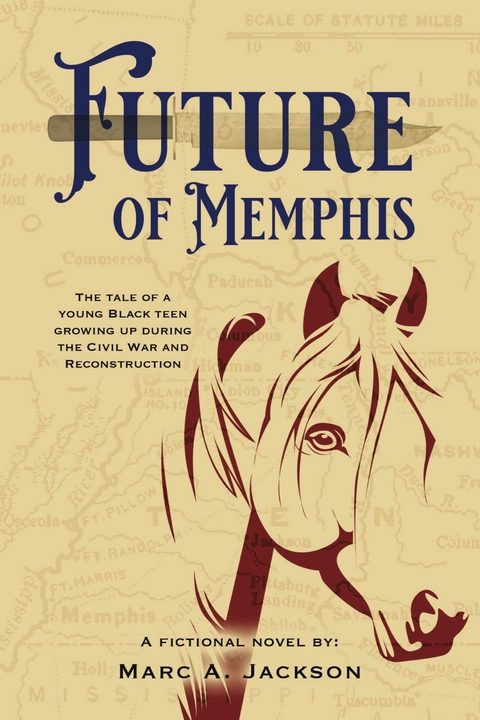
Future of Memphis (eBook)
294 Seiten
Bookbaby (Verlag)
978-1-0983-8938-3 (ISBN)
A Black boy is born in the 1850s in Memphis, Tennessee to Free Black parents. We follow him through The Civil War and Reconstruction. The book goes into detail about the political and emotional landscape of the time. His morals, knowledge, and spiritual base are put to the test as a tragedy occurs that alters his course in life. An unusual alliance puts him in various unique adventures with consequences that further shape his life and maturity. The book follows two trajectories. On one hand, it is a coming-of-age fictional adventure story of an exceptional trio of teens as they try to understand what promise a post-Civil War America holds for each of them. Parallel to this storyline is a well-documented history of American political and social upheaval that transpired during that same time.
Chapter 1
The Beginning
The plantation my Pa was born on was owned by the Greene family. It was a 200-acre property and was located just north of Memphis along the Mississippi River. Master Greene was a shrewd businessman as he foresaw Memphis becoming a hub of commerce and transportation. Ambitious and driven as a young man, he traveled to the new Arkansas Territory. He purchased a small herd of wild horses with the small inheritance he received and all the money he could borrow. The horses were saddle-broken and delivered to a Memphis stockyard. Then he leased some grazing land that was nestled in between two large plantations north of town. In town, he sold enough horses to fund another trip to the Territory and repeated the process again and again. If a horse showed promise, he moved it to a separate pasture to stud. After a few years, he paid off his loan and purchased outright the land he had leased. Then he bought slaves and had them till some of the grounds and grew cotton on it. Memphis was a primary cotton market and brokerage hub, so he had a convenient location to sell his product just down the road. He even made money off his neighbors by leasing them his workhorses to help till the land during planting season and get their cotton to market during harvest. With the money from the cotton sales, he built himself a large mansion and married.
Memphis was flourishing, and new communities for the wealthy Memphis businessmen began to rise around the city. The main symbol of wealth for the aristocratic class was the mansion. Always looking for new ways to flaunt their wealth, the next big thing became the show horse and carriage. With these, a man could display his wealth all around town, not just in one place as his home. Master Greene had successfully bred precisely the type of horses the rich wanted. His affluent clients demanded a spirited horse but still be obedient to commands. He took a trip to Kentucky and hired a young racing horse trainer for his high-end horses. These horses required a type of training different from the ordinary stock horses. He didn’t employ the trainer because he loved horses, as they were just a commodity to him no different than a bale of cotton. It was merely about dollars and cents. He knew his horse business would thrive if his horses were professionally trained. He was correct, and his horse operation did as well as his cotton business. He amassed a great deal of wealth and power in the community.
Whenever my Pa talked about early life on the farm, every story was full of pain and misery. The barbarity of his stories saddened me, but Pa said I must know these things. ‘These things’ revealed the atrocities man could do to another man or a group of people. ‘These things’ showed the extent of a man’s desire for wealth and power. ‘These things’ exposed the depravity and bloodlust of some men.
Master Greene was a brutish man, and my Pa said his father’s back bore testimony to it. My grandpa was bought by Master Greene as a slave to saddle-break the stock horses and work in the stable. He did his job well, but when things didn’t go as Master Greene planned for any reason, my grandpa paid for it both verbally and physically.
The planter class needed slaves, as cotton production was labor-intensive, and the Greene Plantation owned over twenty. All of Master Greene’s slaves lived in a series of one-room shacks nestled together about a few hundred yards north of the mansion near the cotton fields. A grove of trees hid the community from the direct sight of the estate. Grandpa, Pa, and the other slaves would huddle around small fires at night and tell stories and work on their personal projects.
For slaves, selling homemade crafts or extra produce raised beside their shack was one of the few ways to acquire money to get items not furnished to them by their masters. Most Planter’s cast a blind eye to this, and country folk supported this, but not Master Greene. He felt this would lead to self-sufficiency, and he wanted his slaves to be totally dependent on him. They had to hide their tools and money well because Master Greene felt any cash or asset a slave owned threatened his power over them. He had a couple of goons he called overseers regularly conduct raids on his Black settlement. They ransacked the slave’s homes to see if anyone had anything they weren’t supposed to have. Public naked whippings, whether man or woman or worse, befell anyone caught with banned items. Fear and horror were the tools of choice for Master Greene to keep his slaves in line.
One day Grandpa was caught with a chisel he had bartered for as a gift for Pa and was beaten so severely he was never the same again. Grandpa’s only dream was to see his son, my Pa, free one day. Pa and Grandpa were community leaders because of their wisdom and character, although neither had any school education. No Black person could read or write on Master Greene’s plantation as he vowed to kill ANY slave on his property that could.
My Pa was practically raised in the stables and learned everything about a horse farm, starting from the bottom, shoveling horse manure. As a young boy, he followed the trainer everywhere, and seeing his desire, he was befriended by him. He taught Pa everything he knew about racehorses, and Pa absorbed that knowledge. Pa had a natural touch with horses, and the most skittish of horses would allow him to approach them. After a dozen years of working for Master Greene, the trainer left to return to Kentucky. The day he departed, he confided to Pa that he just couldn’t see himself working for that vile man for the rest of his life. He also stated that he told Master Greene that Pa was perfectly capable of running the stable except for the bookwork. So Master Greene hired a stable foreman to keep the books, and Pa became the trainer. Everyone knew it, and everyone called him Trainer, but the only title Master Greene called Pa was “that stable boy.” That was a step above “that stable niggah” which is what he always called my grandpa.
When the elder Master Greene died suddenly, his only son Captain Greene resigned his commission in the U.S. Cavalry. He returned to the farm, as he was the sole survivor of his father’s property and wealth. His mother had died during his childbirth, and his father never let him forget it. He was raised by the house slaves, yet his father’s racist views were always physically and verbally displayed. Master Greene desired his son to become a banker or politician. He wanted the Greene name to have power and influence in the elite Memphis community. They considered Master Greene ‘too crass’ to be invited into their circle. The younger Greene only wanted to be around horses. The elder Greene never allowed his son to go to the stables, or anywhere else, unless he was present. He trusted no one when it came to someone possibly ‘polluting’ his sons’ mind with ideas like abolition or equality of the races. Even the son tired of his father’s overwhelming preoccupation with White supremacy. The younger Greene was all too happy when he was sent off to a Military Boarding School at a young age. He then went to West Point before accepting his commission in the U.S. Cavalry.
When the Captain finally arrived at the plantation, the first thing he did was meet with the overseers and the stable foreman. After that meeting, the foreman told all the slaves to assemble at the stable. All the slaves were on pins and needles before the meeting. They were concerned about what kind of master the Captain would be and what would happen to them. When he arrived at the stables, he introduced himself and said that he was not his father and to expect some changes on the plantation. He told the slaves to select a spokesman, and that person was to come to the mansion at sundown. They chose Pa, and after a brief prayer for him, everybody returned to work. The Captain spent the rest of the afternoon on horseback, touring his property and stock before returning home to review the books.
That evening Pa showed up at the mansion as directed, unsure of what to expect. The maid answered the door when he knocked and showed him into the parlor while she went to notify the Captain he had arrived. Pa was awestruck! This was the first time in his life he had been inside the mansion.
“Trainer! I’m so glad they picked you as spokesman! We have so much to discuss!” The Captain paused and then extended his hand. “Please excuse me. I haven’t forgotten my manners; I’m just so used to saluting or being saluted.” Pa shook his hand and was a little unsteady, as he had never shaken hands with a White man before. “What name does everyone call me by?”
“Why, Captain, Sir!” answered Pa.
“Then Captain it shall be!” The Captain hesitated in a moment of reflection. “It seems like just yesterday. How I used to admire you as you worked the horses. I would watch you by the stable every morning from my bedroom window. I wanted to grow up and be just like you, and that infuriated my father… Well, that’s history now.”
The Captain went to a small table that had a sheet of paper on it and an inkwell. He wet the quill. “What grievances do your people have?” Pa hesitated, and the Captain reassured him to speak his mind.
“It’s the public stripping and whipping, Sir.”
“I see. Yes, nasty business. I agree, no stripping of women and children, and no stripping of men below the waist. The lash is not to be used without my express approval. Crimes like theft and insubordination must have consequences just as we have in the Army. I will endeavor to find a punishment for crimes commensurate with the...
| Erscheint lt. Verlag | 30.7.2021 |
|---|---|
| Sprache | englisch |
| Themenwelt | Literatur ► Historische Romane |
| ISBN-10 | 1-0983-8938-7 / 1098389387 |
| ISBN-13 | 978-1-0983-8938-3 / 9781098389383 |
| Informationen gemäß Produktsicherheitsverordnung (GPSR) | |
| Haben Sie eine Frage zum Produkt? |
 EPUB (Ohne DRM)
Größe: 907 KB
Digital Rights Management: ohne DRM
Dieses eBook enthält kein DRM oder Kopierschutz. Eine Weitergabe an Dritte ist jedoch rechtlich nicht zulässig, weil Sie beim Kauf nur die Rechte an der persönlichen Nutzung erwerben.
Dateiformat: EPUB (Electronic Publication)
EPUB ist ein offener Standard für eBooks und eignet sich besonders zur Darstellung von Belletristik und Sachbüchern. Der Fließtext wird dynamisch an die Display- und Schriftgröße angepasst. Auch für mobile Lesegeräte ist EPUB daher gut geeignet.
Systemvoraussetzungen:
PC/Mac: Mit einem PC oder Mac können Sie dieses eBook lesen. Sie benötigen dafür die kostenlose Software Adobe Digital Editions.
eReader: Dieses eBook kann mit (fast) allen eBook-Readern gelesen werden. Mit dem amazon-Kindle ist es aber nicht kompatibel.
Smartphone/Tablet: Egal ob Apple oder Android, dieses eBook können Sie lesen. Sie benötigen dafür eine kostenlose App.
Geräteliste und zusätzliche Hinweise
Buying eBooks from abroad
For tax law reasons we can sell eBooks just within Germany and Switzerland. Regrettably we cannot fulfill eBook-orders from other countries.
aus dem Bereich