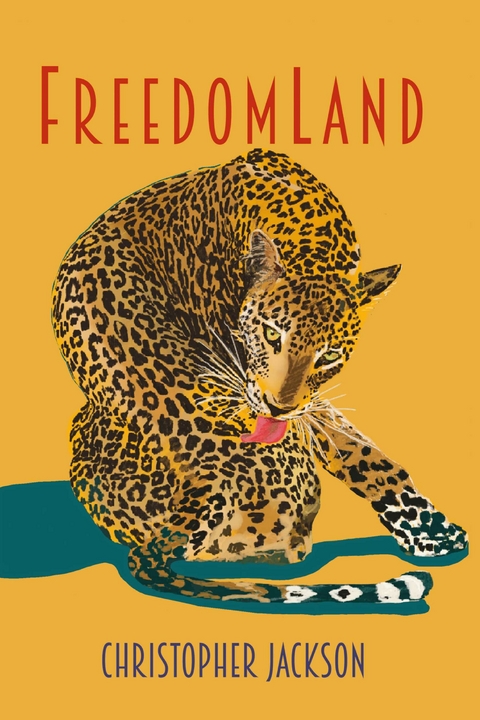
FreedomLand (eBook)
300 Seiten
Bookbaby (Verlag)
978-1-0983-8030-4 (ISBN)
Can the Red and Blue extremes of America ever get along? Can men and women? Possibly...if held at gunpoint and an African leopard is involved. In one memorable night Gage Randolph steals the Confederacy's most sacred Civil War relic, gives a ride to America's dumbest domestic terrorist, and accidentally kidnaps a liberal cable TV host. This wildly incompatible group needs to lie low and a bankrupt restaurant run by Gage's friend, Bud Roy Roemer, is the perfect hideout. Extricating themselves from a litany of felonies-only some of which they committed on purpose-is complicated by an African leopard Bud Roy's fianc brings home to join the Roemer household and a tenacious deputy sheriff intent on righting a past wrong. Trying to stay one step ahead of the law and out of paw's reach of carnivorous African mega fauna, Bud Roy and Gage seek guidance and inspiration from two uniquely grotesque American institutions: a talk radio host who dispenses pellets of white rage over the airwaves four hours a day, and a lawyer with very few ethical redlines. The answer to their problem, they discover, is cruising 13 miles off the North Carolina Coast. Freedomland is an exploratory oil rig converted into a luxurious, mobile, sovereign state by a tax-hating Silicon Valley billionaire who loves America so much he can't wait to leave it. For this collection of misfits-and one angry leopard-getting to Freedomland proves difficult. But leaving is murder. FreedomLand's satiric look into the ailing heart of America skewers the political right and left as they battle over the issues animating the American conversation: gun control; the wasteland that is talk radio and cable news; the idiocy of white supremacy; misogyny; remembrance of the Civil War; and the increasing disparity between the super rich and everyone else. Why? Because sometimes things are so bad all you can do is laugh.
Chapter Two
At 9:50 a.m. on a Friday, unshaven, reeking of vodka sweat, and sourly contemplating unemployment, Bill Spark arrived at the FM radio station where he worked to fill his four-hour sliver of Cincinnati’s airwaves for the last time.
Picking his way through a jumble of cubicles and administrative assistants with the overly purposeful strides of a man clinging tenuously to bipedalism, he entered his usual sound booth, locked the door, and kicked off his last show with Twisted Sister’s “We’re Not Gonna Take It.” Backed by the fierce urgency of Dee Snider’s growling baritone, the soon-to-be unemployed radio jock launched into the epic rant that would make him famous.
“Yes, I am inebriated,” he declared. “Drunk on freedom, high on personal responsibility, stoned on hard work.”
So moved by his own eloquence that he forgot it was radio, Bill Spark stood up.
“I’m mainlining the same smack our Founding Fathers OD’d on when they conceived a nation where, if you work hard, pay your bills, and don’t screw up, the government will let you alone and you can be all you can be. A land where you tend to your own and your neighbors do the same, and if they don’t, well, that’s their problem, not yours. I know it must be a dream because it sure as hell isn’t the land I see outside my window,” Bill said, waving his hand dramatically at a calendar of Kate Upton, the sole feature on the windowless beige walls of the sound booth, hung there in defiance of management’s prohibition against “sexist office adornments” by the station’s Morning Menace shock jock duo of Tweeter and the Deek.
An hour into Bill Spark’s diatribe, the station manager suggested cutting the power and kicking him off the air. Higher-ups demurred. Remarkably, the renegade DJ was still running ad spots for boner medicine, laser hair removal, hemorrhoid relief, guilt-free end-of-life care for aging parents, and the other necessities that people who had come of age on eighties music were beginning to require. Bill Spark’s ravings were, at worst, revenue neutral. There was even an unspoken yearning by some in management for an on-air suicide; radio was a medium where that could work, especially if he used a gun.
A format change at his station and an inability to find another job in an industry that was changing in ways Bill could neither anticipate nor comprehend had driven him to straddle the fine line between outrage and insanity that so often leads to fame and fortune in the internet age. The final straw had come in the form of his sole job offer from a small station in the village of Umiujaq, nestled on the northern shores of Hudson Bay in a part of Canada so bitterly cold and remote even Canadians didn’t go there. Bill had thought updating the four hundred-odd Umiujaqians on the latest polar bear mauling or emceeing the annual seal-clubbing festival would be a waste of his talent. Out of options, he had called in sick and gone on a three-day bender that provided the magic elixir of self-pity, sleep deprivation, anger, despair, and Ketel One needed to fuel his transformation from amiable mid market disc jockey to right-wing radio firebrand.
Unaware that his diatribe was going viral, Bill worked his shift; offered a populist, if not altogether paranoid four-hour thesis on what ailed the United States; and bid farewell to Cincinnati at 2:00 p.m. on the button: “This is Bill Spark, signing off to go look for the America we all deserve.”
He cut to commercial and left the studio. On his way out, he told the station manager to go fuck himself.
Immediately afterward, the now jobless DJ hailed a taxi, went home, turned off his phone, stumbled to the toilet, urinated continuously for a single minute, then went to bed and slept for eighteen straight hours. He awoke the next morning with a massive headache, a wispy sense of being pissed off at Kate Upton, sixty-three missed calls on his cell phone, and two Cincinnati TV news trucks on his lawn.
Running through his voice mail—some from concerned friends, many from reporters, three from Sean Hannity’s booking agent, and more than a few from radio stations wanting to discuss a job, including the station that had just let him go—he discovered that the impossible-to-remember final four hours he had spent on the air in Cincinnati had made him famous. Searching his own name on the internet, he found it trending on Twitter and running amok on Google. The most popular videos on YouTube were highlights of his four-hour rant, dubbed the “It Must Be a Dream” speech, set to stunning vistas of the Rocky Mountains, bald eagles in flight, men walking on the moon, men storming the beaches of Normandy, men going to work in factories, and men plowing endless acres of corn and wheat. Bill idly wondered as he watched these hastily made homages to American greatness where all the women were. But he figured that most, if not all, of the people who had made these videos were men with no jobs, no girlfriends, and no prospects of landing either in the foreseeable future.
For reasons Bill could not quite understand, one video also flashed pictures of Millard Fillmore at regular intervals. The only reason he knew it was Millard Fillmore was because big block letters jumped off the screen proclaiming, “MILLARD FILLMORE.” While this helpfully put a name to the face, it did not answer the larger existential question he voiced to the empty room: “Who the hell is Millard Fillmore?”
A quick internet search told him that Millard Fillmore was the thirteenth president of the United States. It also left him feeling uneasy that somehow his performance had made him into, in the eyes of the creator of the video at least, the twenty-first-century standard-bearer of the Know Nothings.
With the video on pause and Millard Fillmore sternly gazing upon him, Bill realized he had tapped into something important. He had resonated with an audience far greater than he had ever known. Bill Spark had gone national. He had done so unconventionally, for sure, but he sensed his potential was even greater because of it.
He concluded he had an opportunity in front of him. But he also realized that he had a limited shelf life. He needed to leverage his newfound fame in exactly the right way, for in a week he would be old news.
Finding the constant digital deluge overwhelming, Bill Spark turned off his phone, shut his laptop, closed the drapes, sat quietly in his favorite chair cloaked in the semidarkness, sipped the fifth of Johnnie Walker Blue Label he kept on hand for serious thinking, and tried to figure out what came next.
What came next was harder than Bill Spark had thought it would be. Eschewing standard offers from stations looking to capitalize on his newfound fame to energize their own tired formats, he foreswore all contractual entanglements and moved to Richmond, Virginia. There, he founded his own internet broadcast site, The Firebell, so called because he wanted everyone to wake up, and sought to monetize his epic rant.
The immediate difficulty was that Bill Spark sober could not quite bring himself to say the things that seemed to flow so easily from the lips of Bill Spark drunk. To overcome this unforeseen problem, he considered doing all of his shows liquored up. After trying this approach for a week, he figured it was not a long-term solution in that it would likely kill him.
The answer to his dilemma came in the form of a blonde, blue-eyed, twenty-two-year-old Richmond college intern from Minnesota named Sierra Dahlin—“Call me Sierra Darlin’…everyone does!”—a staunch believer with political views just to the right of Joe McCarthy. Sierra had been so moved by Bill’s famous diatribe that she sported a tattoo reading “It Must Be a Dream” on her right inner thigh. He hired Sierra hoping to see more of her inner thigh, which quickly came to pass. But she also proved to be net savvy, something he was not and which had been a major impediment to his objective of becoming an internet mogul. While Bill struggled to bottle the lightning of those four magical hours in Cincinnati, Sierra kept his internet site alive.
With the screen name Sierra Darlin’ and an avatar featuring her in a low-cut V-neck and push-up bra, Sierra nurtured The Firebell’s growing, vibrant internet community, composed mainly of young to middle-aged white males disenchanted with life in the United States but quite enchanted with her. A firm disciplinarian, Sierra dispensed online justice in a manner reminiscent of Judge Roy Bean. A gifted polemicist, she raised topics that generated a torrent of posts and rabid discussion. She had a knack for making pronouncements—such as “The only trigger warning we need to respect is the sound of a .357 Python being cocked”—that pissed off devout liberals and sent orgasmic waves of pleasure through conservatives.
Since Bill had spent no time on internet comment boards unrelated to the tragicomic flailing about of Cincinnati’s professional sports teams, the posts of Sierra’s online flock, ranging from the cogent and closely reasoned to the unhinged, were a revelation. In them, he realized he had found his voice. To prepare for his next broadcast, Bill mined the boards for the comments and topics that he felt resonated with his audience. He wove them...
| Erscheint lt. Verlag | 10.6.2021 |
|---|---|
| Sprache | englisch |
| Themenwelt | Literatur ► Comic / Humor / Manga |
| ISBN-10 | 1-0983-8030-4 / 1098380304 |
| ISBN-13 | 978-1-0983-8030-4 / 9781098380304 |
| Informationen gemäß Produktsicherheitsverordnung (GPSR) | |
| Haben Sie eine Frage zum Produkt? |
 EPUB (Adobe DRM)
Größe: 943 KB
Kopierschutz: Adobe-DRM
Adobe-DRM ist ein Kopierschutz, der das eBook vor Mißbrauch schützen soll. Dabei wird das eBook bereits beim Download auf Ihre persönliche Adobe-ID autorisiert. Lesen können Sie das eBook dann nur auf den Geräten, welche ebenfalls auf Ihre Adobe-ID registriert sind.
Details zum Adobe-DRM
Dateiformat: EPUB (Electronic Publication)
EPUB ist ein offener Standard für eBooks und eignet sich besonders zur Darstellung von Belletristik und Sachbüchern. Der Fließtext wird dynamisch an die Display- und Schriftgröße angepasst. Auch für mobile Lesegeräte ist EPUB daher gut geeignet.
Systemvoraussetzungen:
PC/Mac: Mit einem PC oder Mac können Sie dieses eBook lesen. Sie benötigen eine
eReader: Dieses eBook kann mit (fast) allen eBook-Readern gelesen werden. Mit dem amazon-Kindle ist es aber nicht kompatibel.
Smartphone/Tablet: Egal ob Apple oder Android, dieses eBook können Sie lesen. Sie benötigen eine
Geräteliste und zusätzliche Hinweise
Buying eBooks from abroad
For tax law reasons we can sell eBooks just within Germany and Switzerland. Regrettably we cannot fulfill eBook-orders from other countries.
aus dem Bereich