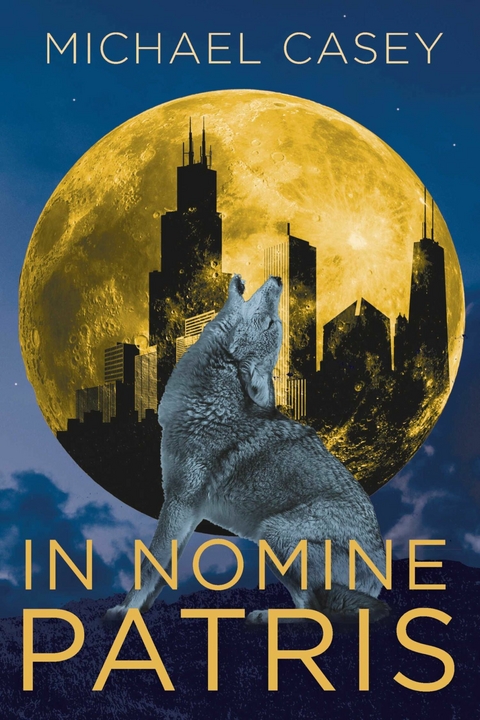
In Nomine Patris (eBook)
476 Seiten
Bookbaby (Verlag)
978-1-0983-5624-8 (ISBN)
Michael Casey is an attorney who has worked for the City of Chicago, the State of Illinois, and in private practice representing government organizations for thirty-seven years. He currently resides with his wife on the East Side of Milwaukee. Mr. Casey's first book, Passage, was written under the pen name of Vince Hurley.
At the peak of his career, Dan Hurley, powerful Chicago politician, master of clout, discovers a conscience, wises up, and comes to regret his life's work running and profiting from a political machine he has come to despise. But he has a plan. Far from the city, on a hill in the country where coyotes howl, he hatches a rebellion to throw a wrench into the machine and salvage his reputation, his son's respect, and what is left of his life. But is it too late? As Dan Hurley discovers, there is danger in rocking the boat and stepping on powerful toes. And help is unlikely from his prodigal son, Billy, who has fled the city for a room above a bar in a lost river town, having written his father and his politics off long ago. But maybe there is hope that Billy might get pulled back into his father's world to unravel a mystery and take up the mantle of the father he loathes. Only Billy's testimony at trial will determine whether Dan Hurley's dreams of reforming himself, his son, and a big city machine will come true.
Chapter Two
The Flow
Constant motion, rotation, spinning, from where space and time do not exist, coming together, swirling apart, closer, distant, waves upon waves, light years, unseen, unknowable, pulsating, beyond reach and close at hand, microcosmic, reflecting, black holes, grains of sand, fingertips touching, beginnings and ends, and the infinite interregnum, of each breath, drop, and joule, each cell, in and out and touching, dividing and growing in the gravitational warmth of stars, mitosis, meiosis, ocean deep and mountain wind, efforts and dreams, and the flow, in constant motion.
While there must be, there is no beginning, as far as we know it, the farther back we go the less we know, if we truly know anything at all, other than what we see and touch, and still in all likelihood do not fully understand, our history confined to a fingernail tip, prehistory, nothing at all unless written down, our vain conceit. Perhaps there is wisdom to be gained, but history would not repeat itself if we learned anything from it, accepting, choosing to remember what flatters us, discarding, conveniently forgetting, lying about, or never writing down the ugly truths, the horrible sins, the stains we all bear, who we are, have been, and perhaps always will be. But the past appears to have the advantage of making us less lonely, less meaningless, prideful, in our selective memory, an enriching we seem to seek out, and apparently need, to justify, rationalize, elevate ourselves over others, and explain the unexplainable.
However the story is told, however reconstructed, and for whatever reason, beyond all wants, needs, and rationales, is the undeniable flow, the constant motion in real time, of water and blood, in rivers and veins, the tumultuous heaving, languid repose, rising, falling, pulse, the random design of mutations, that happen, and cannot be changed, moments, infinitely strung together over billions of years, in the point of time we call now, the time you take to read these words, the warmth of the sun, the creeping advance from water to shore, seed to flower, eruptions, ice, meteors, the fierce storms and gentle waves of Cambrian and Ordovician seas, the Paleozoic, Mesozoic, warming and cooling, the Pleistocene’s glacial advances, back and forth, time and again over millions of years, leaving markers upon the land, in Great Lakes, and small, brooks and streams, in sandstone and dolomite, and rushing water carving its course to the sea.
One such waterway, flowing just to the north of the hill on which Dan Hurley’s body lies, begins humbly, as mighty rivers do, from small springs that bubble from aquifers below impassable swamps in the North Woods, filling a lake left by glaciers, overflowing in a brook, remote, unexceptional, out-of-the-way peaceful, where the waters escape into marsh and reed, and onward, gathering as they travel, mile after mile, swelling slowly with each tributary along the way, transforming, from brook to stream to river wide, over 430 miles, generally south to southwest, through meanders and rapids, oxbows and gorges, rushing, ebbing, past bluff and field, falling 1,067 feet along the way to its mouth, where it flows into the Mississippi.
The lake of the river’s origin, its veritas caput, the Ojibwe (Chippewa) called Gete-gitigaani-zaaga’igan, Lake of the Old Garden, Lac Vieux Desert to the French, which it is known as today. The Woodland Sioux, precursors to the Ojibwe, no doubt called it a different name, as did all the other peoples over thousands of years who preceded the Sioux. The Ojibwe established a summer village on an island in the lake, as others had done before, a meeting place from which trails led through dense woods to the Great Lakes of Superior and Michigan, knowing that the Lake of the Old Garden gave rise to a great river, Ouisconsing, the Wisconsin, the River of a Thousand Isles,3 water trail to the edge of the earth, blessed by the Gods, and formed, eons ago, by a gigantic manitou snake, that twisted and slithered across the land, forming deep grooves along the sandstone surface into which adjoining water rushed, scaring smaller serpents that scrambled away in terror, carving tributaries from their routes of escape.
As many as twenty-five glaciers advanced and receded across the north country over two and a half million years, plowing, compacting, absorbing, and depositing sedimentary glacial drift, over and through which most of the snake river passed on its descent south, through northern highlands, terminal moraines, sedimentary fans and aprons, outwash sand plains, glacial lake bottoms, sandstone gorges, sandstone lowlands, barrens, terraces, and the broad valley carved by the cataclysmic flood, until the river turns west toward the Father of Rivers, and passes through the Driftless, 10,000 square miles of high ridges and deep ravines, untouched by ice sheets for unknown reasons, and shaped by storms and wind and water washing over the hills for millions upon millions of years.
During the glacial era, recurrent lobes of ice invasions, several miles thick, pushed south in millennia of cold, consuming, engulfing all in their path, loss less than gain, until the warmth returned, slowly, over centuries, when loss exceeded gain, retreating, melting, into rivers and streams etching the land, only to freeze again when the cold returned, solid to liquid and back again, when the lobes reformed, marched south and reclaimed the land they had lost, hundreds of thousands of years of back and forth, freezing, warming, water flowing, water trapped, lakes contained by walls of ice that held until the temperature turned, when walls gave way to avalanche, flood, and torrents of destruction that carved wide the river gorges.
Around 18,000 years ago, as the earth warmed, the last of the glaciers, the Younger Dryas, began to retreat slowly back to the north, across the territory that would one day bear the river’s name, and the frozen water and silt began to flow again down ancient riverbeds, marking the beginning of the end of the Pleistocene. In the thousands of years it took this last glacier to release its grip on the land, a stubborn wall of ice and quartzite rose to dam the river flowing in from the north, forming a large proglacial lake, about the size of Delaware and up to 160-feet deep, behind the massive wall. And in one of those moments in time when life goes on as you know it until it suddenly and drastically doesn’t, the massive dam cracked and burst, sending waves of full steam freight trains rampaging downstream, altering the landscape in hours what would have taken thousands of years, and carving wide the river valley, filling it with up to one hundred and fifty feet of sand and gravel, sculpting the gorge with borders of steep dolomite and sandstone bluffs rising 300- to 400-feet above the valley floor, and forming the wide river valley as it appears today.
At around that same time, about 14,000 years ago, the receding glaciers across the continent exposed a land bridge that stretched from Asia to North America along the Bering Strait, and nomadic women and men, seeking food for their children, or driven by enemies, cautiously stepped into a new world of wonder and danger never before seen by human eyes. Over years, and decades, and centuries, bands of ice age hunters traveled ever deeper into the unexplored world the ice had left behind, tundra, deep woods, tall mountains, bogs, clear lakes, rushing rivers, eventually reaching what we now call the Upper Midwest, around 12,000 years ago, where they settled along the Wisconsin River, hunting caribou, muskox, mastodon, wooly mammoth, giant ground sloths, beaver the size of bears, and huge buffalo. They steered clear of dire wolves.
Imagine that. Imagine the life. Nothing but the land, and everything. Hunting with spears much larger and faster beasts. Do you think that was dangerous? Did they suffer tragedy? No horses, no wagons. When they traveled, they did so on foot, on trails the beasts had trodden, or by canoe, along highways of water. Any possession was carried, or thrown in the bottom of a canoe. Do you think maybe they were strong, resourceful, resilient, intelligent? Do you think you are smarter than they were? Better hunter, canoer, athlete? Did they dream, dance, tell stories? Did they sing, cry, laugh, and love? Did they suffer in the cold, and swim in the summer? Think of the insects, the mosquitoes. Did they celebrate life and mourn death, did they worship and fear Gods, and stop from time to time to see beauty, in sunrise and sunset, flowers and trees, constellations, rain storms and snowfall? Did they have poets and war mongers, shtarkers and schmucks? Do you think they had all our emotions? Did they tell jokes? Did they kill each other?
One thing we know for sure is they had what it takes. The large beasts came and went, unable to weather climactic change, the extreme seasons, but the ancient peoples somehow found a way, adapting to constant incremental change, hunting white-tailed deer, elk, and buffalo, catching fish, gathering mussels, moving from season to season, generation after generation, over 7,000 years.
Seven thousand years. Over the past 200 years, we’ve had Abraham Lincoln, Michael Jordan, Alexander Pushkin, Sojourner Truth, Albert Einstein, Henry Aaron, Susan B. Anthony, James Joyce, Frederick Douglass, and Aretha Franklin. Do you think over 7,000 years they did not? Over...
| Erscheint lt. Verlag | 16.6.2021 |
|---|---|
| Sprache | englisch |
| Themenwelt | Literatur ► Krimi / Thriller / Horror |
| ISBN-10 | 1-0983-5624-1 / 1098356241 |
| ISBN-13 | 978-1-0983-5624-8 / 9781098356248 |
| Informationen gemäß Produktsicherheitsverordnung (GPSR) | |
| Haben Sie eine Frage zum Produkt? |
 EPUB (Ohne DRM)
Größe: 1,2 MB
Digital Rights Management: ohne DRM
Dieses eBook enthält kein DRM oder Kopierschutz. Eine Weitergabe an Dritte ist jedoch rechtlich nicht zulässig, weil Sie beim Kauf nur die Rechte an der persönlichen Nutzung erwerben.
Dateiformat: EPUB (Electronic Publication)
EPUB ist ein offener Standard für eBooks und eignet sich besonders zur Darstellung von Belletristik und Sachbüchern. Der Fließtext wird dynamisch an die Display- und Schriftgröße angepasst. Auch für mobile Lesegeräte ist EPUB daher gut geeignet.
Systemvoraussetzungen:
PC/Mac: Mit einem PC oder Mac können Sie dieses eBook lesen. Sie benötigen dafür die kostenlose Software Adobe Digital Editions.
eReader: Dieses eBook kann mit (fast) allen eBook-Readern gelesen werden. Mit dem amazon-Kindle ist es aber nicht kompatibel.
Smartphone/Tablet: Egal ob Apple oder Android, dieses eBook können Sie lesen. Sie benötigen dafür eine kostenlose App.
Geräteliste und zusätzliche Hinweise
Buying eBooks from abroad
For tax law reasons we can sell eBooks just within Germany and Switzerland. Regrettably we cannot fulfill eBook-orders from other countries.
aus dem Bereich